Department of Biology, College of Natural and Computational Sciences, Wolaita Sodo University, Wolaita Sodo, Ethiopia.
Evolutionary Ecology Group, University of Antwerp, Antwerp, Belgium.
PLoS One. 2024 Nov 18;19(11):e0313831. doi: 10.1371/journal.pone.0313831. eCollection 2024.
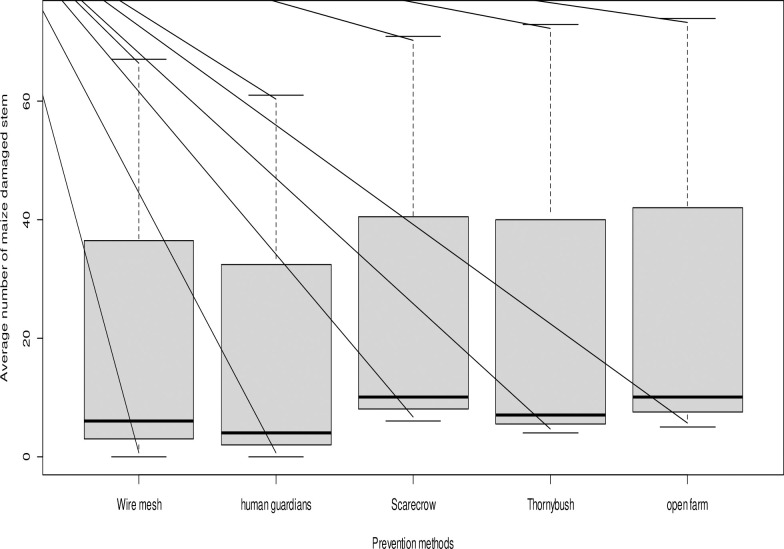
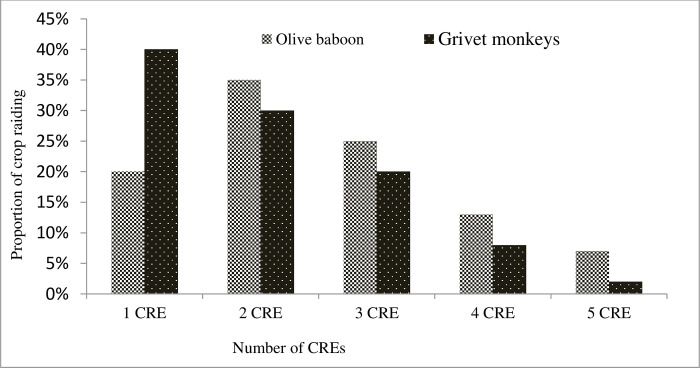
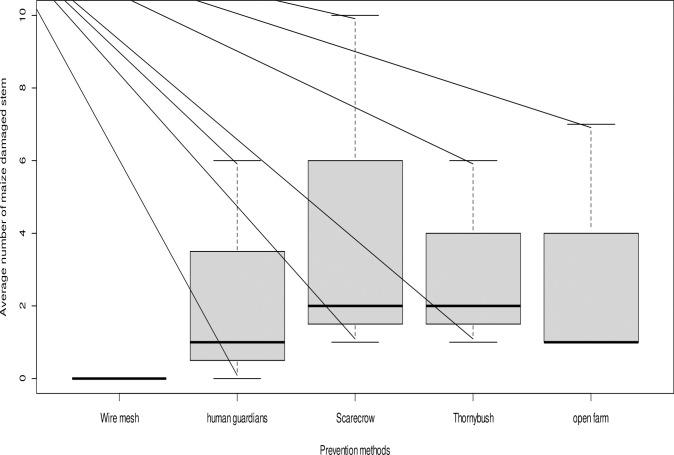
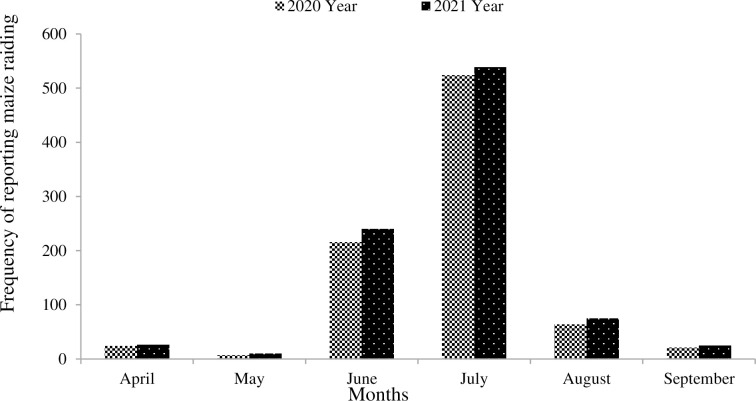
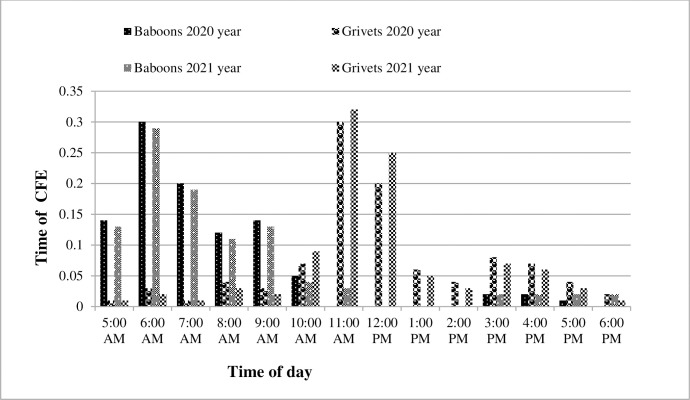
Crop foraging by primates is a prevalent form of human-wildlife conflict, especially near protected areas. This behavior poses significant economic challenges for subsistence farmers, jeopardizing both livelihoods and conservation efforts. This study aimed to assess patterns of primate crop-foraging events and estimate maize damage in protected and unprotected fields in southern Ethiopia. Data were collected over 12 months between 2020 and 2021 in the Sodo Zuriya and Damot Gale districts of Southern Ethiopia. A team of six field experts and 25 farmers participated in the study, during which maize damage inflicted by primates was assessed using 25 deployed camera traps. Linear mixed models were used to explore the relationship between maize damage by primates and spatio-temporal variables. Olive baboons and grivet monkeys were found to target maize more frequently during June, July, and August. Olive baboons forage in the morning, while grivet monkeys do so in the afternoon. The average maize yield losses due to primate damage were 43.1% in protected fields and 31.4% in unprotected fields. Of the total damage, 43.1% occurred in protected fields situated 50 meters from the forest edge. Conversely, unprotected fields experienced lower rates of damage: 14.4%, 13.2%, 3.7%, and 0.1% at distances of 50 m, 100 m, 200 m, and 300 m from the forest edge, respectively. Camera traps captured 47 photos of baboons, 21 photos of grivet monkeys, and documented eight primate crop-foraging events. This study revealed that maize fields within 50 meters of the forest edge faced significant damage. Despite the use of wire mesh fencing, it was largely ineffective in deterring olive baboons and grivet monkeys. Additionally, while human guarding is often considered an effective protective strategy, these findings suggest its ineffectiveness due to inconsistent implementation. Overall, this study provides valuable insights for promoting primate conservation and mitigating human-primate conflicts.
灵长类动物对农作物的觅食是一种普遍存在的人与野生动物冲突形式,尤其是在保护区附近。这种行为给以自给自足为生计的农民带来了巨大的经济挑战,危及生计和保护工作。本研究旨在评估埃塞俄比亚南部保护区和非保护区内灵长类动物作物觅食事件的模式,并估计玉米的受损情况。数据收集于 2020 年至 2021 年期间的 12 个月,在埃塞俄比亚南部的 Sodo Zuriya 和 Damot Gale 地区进行。一个由六名实地专家和 25 名农民组成的团队参与了这项研究,期间使用 25 个部署的相机陷阱评估了灵长类动物对玉米造成的损害。线性混合模型用于探索灵长类动物对玉米的损害与时空变量之间的关系。发现橄榄狒狒和绿长尾猴在 6 月、7 月和 8 月更频繁地捕食玉米。橄榄狒狒在早上觅食,而绿长尾猴在下午觅食。受灵长类动物损害导致的玉米平均产量损失在保护区内为 43.1%,在非保护区内为 31.4%。在总损害中,43.1%发生在距森林边缘 50 米的保护区内。相反,非保护区内的损害率较低:距森林边缘 50 米、100 米、200 米和 300 米处的玉米分别遭受了 14.4%、13.2%、3.7%和 0.1%的损害。相机陷阱捕捉到 47 张狒狒照片、21 张绿长尾猴照片,并记录了 8 起灵长类动物作物觅食事件。这项研究表明,距森林边缘 50 米范围内的玉米地遭受了严重的破坏。尽管使用了铁丝网围栏,但对橄榄狒狒和绿长尾猴的阻止作用并不大。此外,虽然人类看守通常被认为是一种有效的保护策略,但这些发现表明其无效性,因为实施不一致。总的来说,这项研究为促进灵长类动物保护和减轻人与灵长类动物冲突提供了有价值的见解。