Sasaki Yuki, Matsumoto Kazuyuki, Takaki Akinobu, Adachi Takuya, Takahara Masahiro, Ozato Keita, Takeuchi Yasuto, Sue Masahiko, Miyake Nozomi, Wada Nozomu, Onishi Hideki, Shiraha Hidenori, Oda Takashi, Tsutsumi Koichiro, Nouso Kazuhiro, Kariyama Kazuya, Hagihara Hiroaki, Moriya Akio, Otsuka Motoyuki
Department of Gastroenterology and Hepatology, Okayama University Graduate School of Medicine, Dentistry and Pharmaceutical Sciences, Okayama, Japan.
Department of Gastroenterology, Okayama City Hospital, Okayama, Japan.
Gastro Hep Adv. 2024 Aug 2;3(8):1138-1147. doi: 10.1016/j.gastha.2024.07.018. eCollection 2024.
Methods for predicting therapeutic response to immune checkpoint inhibitors in cancer therapy are in high demand. In patients with advanced hepatocellular carcinoma (HCC), atezolizumab (anti-programmed cell death-ligand 1 [PD-L1]) and bevacizumab (anti-vascular endothelial growth factor) combination therapy (Atezo/Bev therapy) is a first-line treatment. However, no reliable biomarkers are currently available to predict its efficacy. Here, we examined serum anti-PD-1 autoantibody levels as candidate biomarkers.
We prospectively enrolled 63 patients with advanced HCC who received Atezo/Bev therapy. Serum anti-PD-1 autoantibody levels were measured before treatment using an indirect enzyme-linked immunosorbent assay. The correlation between the titers and response to therapy was statistically examined.
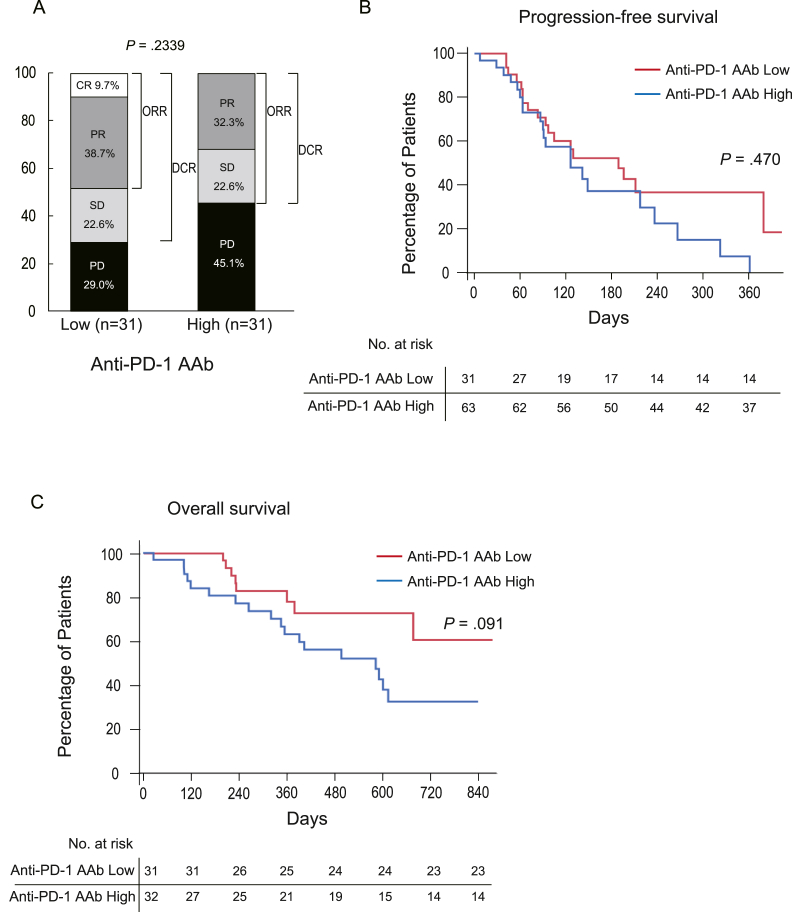
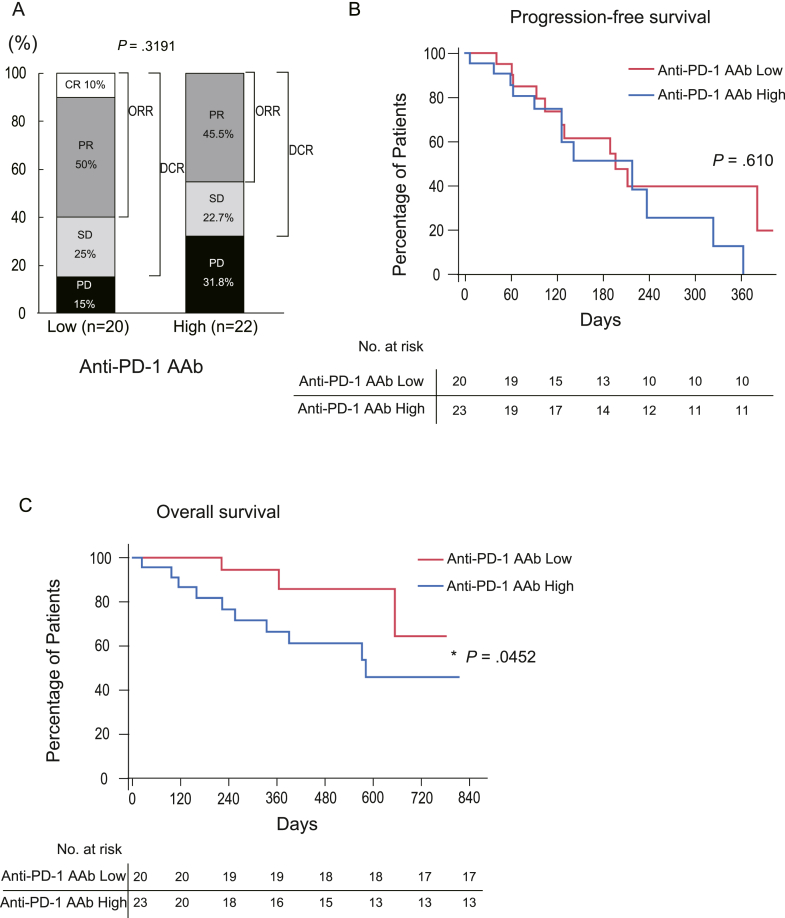
Serum anti-PD-1 autoantibody levels were not significantly associated with the treatment response in any patient. However, when examining only patients who received the Atezo/Bev as their first-line therapy, higher anti-PD-1 autoantibody levels were significantly associated with worse overall survival rates. The titer was an independent risk factor for poor prognosis (odds ratio [OR] = 7.8, = .013), in addition to a higher neutrophil-to-lymphocyte ratio (OR = 7.1, = .009) and lower albumin levels (OR = 14.2, = .003).
Serum anti-PD-1 autoantibody levels correlated with the overall survival rate in patients who received Atezo/Bev as first-line therapy. Serum anti-PD-1 autoantibody levels may serve as new biomarkers for predicting the efficacy of immune checkpoint inhibitors in patients with HCC.
癌症治疗中预测免疫检查点抑制剂治疗反应的方法需求迫切。在晚期肝细胞癌(HCC)患者中,阿替利珠单抗(抗程序性细胞死亡配体1[PD-L1])和贝伐单抗(抗血管内皮生长因子)联合治疗(阿替利珠单抗/贝伐单抗治疗)是一线治疗方案。然而,目前尚无可靠的生物标志物可预测其疗效。在此,我们检测了血清抗PD-1自身抗体水平作为候选生物标志物。
我们前瞻性纳入了63例接受阿替利珠单抗/贝伐单抗治疗的晚期HCC患者。治疗前使用间接酶联免疫吸附测定法检测血清抗PD-1自身抗体水平。对滴度与治疗反应之间的相关性进行统计学检验。
在任何患者中,血清抗PD-1自身抗体水平与治疗反应均无显著相关性。然而,仅检查将阿替利珠单抗/贝伐单抗作为一线治疗的患者时,较高的抗PD-1自身抗体水平与较差的总生存率显著相关。除了较高的中性粒细胞与淋巴细胞比值(比值比[OR]=7.1,P=.009)和较低的白蛋白水平(OR=14.2,P=.003)外,滴度是预后不良的独立危险因素(OR=7.8,P=.013)。
血清抗PD-1自身抗体水平与将阿替利珠单抗/贝伐单抗作为一线治疗的患者的总生存率相关。血清抗PD-1自身抗体水平可能作为预测HCC患者免疫检查点抑制剂疗效的新生物标志物。