Fang Zheyu, Zhao Jiaxin, Zhang Yuan, Hua Xin, Li Jia, Zhang Xu
Neurology, The First Affiliated Hospital of Wenzhou Medical University, Wenzhou, CHN.
Surgery, The Fourth Affiliated Hospital, School of Medicine, Zhejiang University, Yiwu, CHN.
Cureus. 2024 Oct 17;16(10):e71734. doi: 10.7759/cureus.71734. eCollection 2024 Oct.
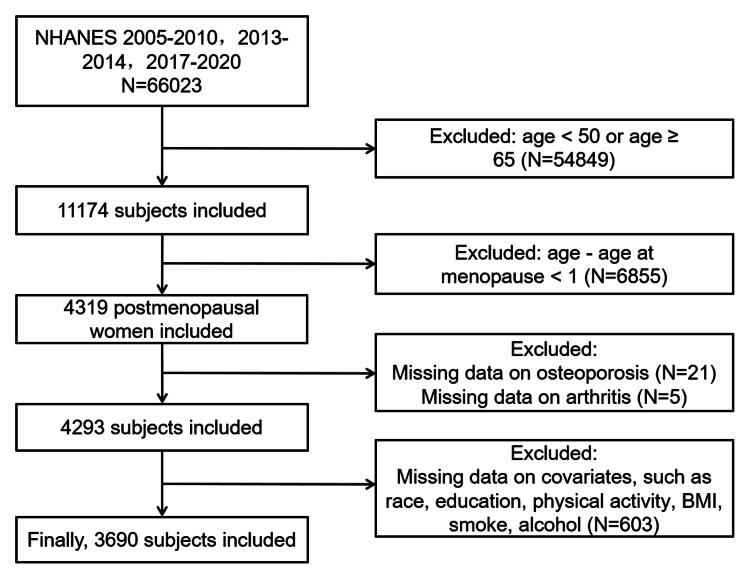
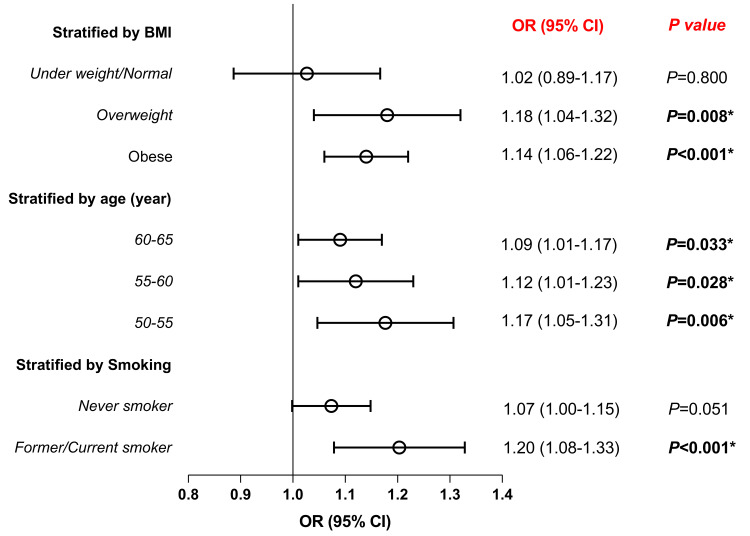
Introduction Due to the increased prevalence of osteoarthritis (OA) and osteoporosis (OP) in women, urgent interventions are needed to reduce the risk of postmenopausal fractures in female OA patients. Moreover, the relationship between OA and OP remains contentious, emphasizing the need for further research to deepen our understanding. This study aimed to investigate the relationship between OA and postmenopausal OP using data from the National Health and Nutrition Examination Survey (NHANES). Methods We conducted a cross-sectional analysis using NHANES summary data from 2005 to 2010, 2013 to 2014, and 2017 to 2020. Multivariable logistic regression was employed to evaluate the association between OA and the risk of postmenopausal OP. Adjustments were made for potential confounding factors. Additionally, we conducted stratified analyses, which provided further insights into the association between OA and postmenopausal OP across various subgroups. Results The analysis revealed a significant correlation between OA and an increased risk of postmenopausal OP, with an odds ratio (OR) of 1.12 (95% confidence interval (CI): 1.07-1.17, P < 0.001) after adjusting for confounders. Stratified analyses revealed a significant association between OA and postmenopausal OP in obese and overweight individuals (OR 1.14, 95% CI 1.06-1.22, P < 0.001; OR 1.18, 95% CI 1.04-1.32, P = 0.008) and among former or current smokers (OR 1.20, 95% CI 1.08-1.33, P < 0.001). Conclusions The study underscores a significant association between OA and postmenopausal OP, particularly in obese, overweight, and smoking populations. Given the higher prevalence of OA and OP among women, understanding these associations could lead to improved strategies for reducing postmenopausal fracture risks. The study offers valuable insights and potential directions for future therapeutic approaches.
引言 由于骨关节炎(OA)和骨质疏松症(OP)在女性中的患病率不断上升,需要采取紧急干预措施以降低女性OA患者绝经后骨折的风险。此外,OA与OP之间的关系仍存在争议,这凸显了进一步开展研究以加深我们理解的必要性。本研究旨在利用美国国家健康与营养检查调查(NHANES)的数据,探讨OA与绝经后OP之间的关系。
方法 我们使用了2005年至2010年、2013年至2014年以及2017年至2020年的NHANES汇总数据进行横断面分析。采用多变量逻辑回归来评估OA与绝经后OP风险之间的关联。对潜在的混杂因素进行了调整。此外,我们进行了分层分析,这为深入了解OA与绝经后OP在各个亚组中的关联提供了进一步的见解。
结果 分析显示,OA与绝经后OP风险增加之间存在显著相关性,在调整混杂因素后,比值比(OR)为1.12(95%置信区间(CI):1.07 - 1.17,P < 0.001)。分层分析显示,在肥胖和超重个体中(OR 1.14,95% CI 1.06 - 1.22,P < 0.001;OR 1.18,95% CI 1.04 - 1.32,P = 0.008)以及曾经或当前吸烟者中(OR 1.20,95% CI 1.08 - 1.33,P < 0.001),OA与绝经后OP之间存在显著关联。
结论 该研究强调了OA与绝经后OP之间存在显著关联,特别是在肥胖、超重和吸烟人群中。鉴于女性中OA和OP的患病率较高,了解这些关联可能会带来改善绝经后骨折风险降低策略。该研究为未来的治疗方法提供了有价值的见解和潜在方向。