Huhe Hasi, Shapley Sarah M, Duong Duc M, Wu Fang, Ha Seung-Kwon, Choi Sang-Ho, Kofler Julia, Mou Yongshan, Guimaraes Thais Rafael, Thathiah Amantha, Watson Caroline M, Schaeffer Lauren K H, Carter Gregory W, Seyfried Nicholas T, Silva Afonso C, Sukoff Rizzo Stacey J
Aging Institute, University of Pittsburgh School of Medicine, Pittsburgh, Pennsylvania, USA.
Department of Biochemistry, Emory University School of Medicine, Atlanta, Georgia, USA.
Alzheimers Dement. 2025 Jan;21(1):e14366. doi: 10.1002/alz.14366. Epub 2024 Nov 19.
Marmosets spontaneously develop pathological hallmarks of Alzheimer's disease (AD) including amyloid beta plaques. However, tau expression in the marmoset brain has been understudied.
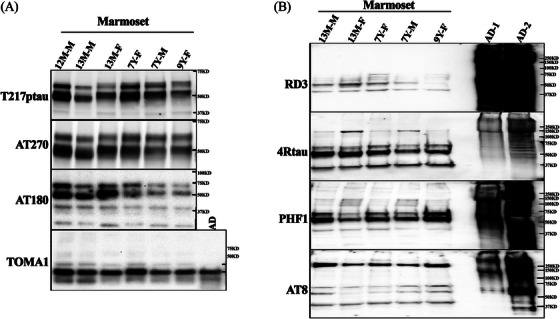
Isoforms of tau were examined by western blot, mass spectrometry, immunofluorescence, and immunohistochemical staining.
3R and 4R tau isoforms are expressed in marmoset brains at both the transcript and protein levels across ages. Mass spectrometry analysis revealed that tau peptides in marmoset corresponded to the 3R and 4R peptides in human brain, with 3R predominating at birth and an ≈40%:60% 3R:4R ratios in adolescents and adults; tau was distributed widely in neurons, with localization in the soma and synaptic regions. Phosphorylation residues were observed on Threonine (Thr) Thr181, Thr217, Thr231, Serine (Ser) Ser202/Thr205, and Ser396/Ser404.
Our results confirm both 3R and 4R tau isoform expression and phosphorylation residues in the marmoset brain, and emphasize the significance of marmosets with natural expression of AD-related hallmarks as important translational models for AD. Highlights We report comprehensive characterization of tau isoform expression in marmoset brains across the lifespan. 3R and 4R tau isoforms are expressed in marmoset brains at both the transcript and protein levels across ages. These data emphasize the significance of marmosets with natural expression of primate-specific traits that are important for the study of Alzheimer's disease.
狨猴会自发出现阿尔茨海默病(AD)的病理特征,包括β淀粉样蛋白斑块。然而,狨猴大脑中tau蛋白的表达尚未得到充分研究。
通过蛋白质免疫印迹法、质谱分析法、免疫荧光法和免疫组织化学染色法检测tau蛋白的异构体。
3R和4R tau蛋白异构体在狨猴大脑中各个年龄段的转录本和蛋白质水平均有表达。质谱分析显示,狨猴体内的tau肽段与人脑的3R和4R肽段相对应,出生时3R肽段占主导,青少年和成年狨猴中3R:4R比例约为40%:60%;tau蛋白广泛分布于神经元中,定位于胞体和突触区域。在苏氨酸(Thr)的Thr181、Thr217、Thr231,丝氨酸(Ser)的Ser202/Thr205以及Ser396/Ser404位点观察到磷酸化残基。
我们的研究结果证实了狨猴大脑中3R和4R tau蛋白异构体的表达以及磷酸化残基,并强调了具有AD相关特征自然表达的狨猴作为AD重要转化模型的意义。要点我们报告了狨猴大脑在整个生命周期中tau蛋白异构体表达的全面特征。3R和4R tau蛋白异构体在狨猴大脑中各个年龄段的转录本和蛋白质水平均有表达。这些数据强调了具有灵长类特异性特征自然表达的狨猴对于阿尔茨海默病研究的重要性。