Pezzicoli Gaetano, Musci Vittoria, Ciciriello Federica, Salonne Francesco, Cafforio Paola, Lionetti Nicoletta, Ragno Anna, Rizzo Mimma
Department of Interdisciplinary Medicine, University of Bari "Aldo Moro," Bari, Italy.
Medical Oncology Unit, Azienda Ospedaliera Universitaria Consorziale, Policlinico di Bari, Bari, Italy.
Ther Adv Med Oncol. 2024 Nov 19;16:17588359241298500. doi: 10.1177/17588359241298500. eCollection 2024.
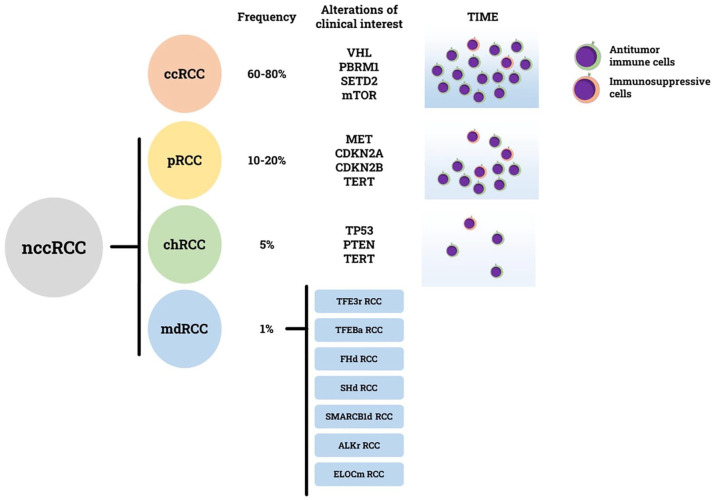
While the clear-cell renal cell carcinoma (ccRCC) treatment has undergone several paradigm shifts in recent years, the non-clear cell renal cell carcinoma (nccRCC) therapeutic approach has yet to be extensively investigated and improved. The WHO 2022 classification of renal neoplasms redefined the most common nccRCC subtypes (papillary and chromophobe RCC) and introduced the molecularly defined RCC class, which is a first step in the direction of better molecular profiling of nccRCC. We reviewed the literature data on known genomic alterations of clinical interest in nccRCC and discussed their potential role in guiding therapeutic choices in each nccRCC entity. Among the alterations discussed, we focused on the ones that could be treated with already available drugs, such as MET-driven papillary RCC, mechanistic target of rapamycin altered chromophobe RCC, anaplastic lymphoma kinase-rearranged RCC, and fumarate-hydratase deficient RCC. Furthermore, we focused on the currently ongoing clinical trials and further evidence for all the other entities, such as SMARCB1-deficient RCC, TFE3 and transcription factorEB (TFEB)-altered RCC, and Elongin C (ELOC)-mutated RCC. The vast heterogeneity of nccRCC does not allow a one-size-fits-all solution; therefore, molecular characterization is the path toward effective therapies and fully personalized medicine for these entities.
近年来,虽然透明细胞肾细胞癌(ccRCC)的治疗发生了几次模式转变,但非透明细胞肾细胞癌(nccRCC)的治疗方法尚未得到广泛研究和改进。世界卫生组织2022年肾肿瘤分类重新定义了最常见的nccRCC亚型(乳头状和嫌色性RCC),并引入了分子定义的RCC类别,这是朝着更好地对nccRCC进行分子分析迈出的第一步。我们回顾了关于nccRCC中具有临床意义的已知基因组改变的文献数据,并讨论了它们在指导每个nccRCC实体的治疗选择中的潜在作用。在讨论的改变中,我们重点关注那些可以用现有药物治疗的改变,如MET驱动的乳头状RCC、雷帕霉素机制性靶点改变的嫌色性RCC、间变性淋巴瘤激酶重排的RCC和延胡索酸水合酶缺乏的RCC。此外,我们关注了目前正在进行的临床试验以及所有其他实体的进一步证据,如SMARCB1缺陷型RCC、TFE3和转录因子EB(TFEB)改变的RCC以及延伸蛋白C(ELOC)突变的RCC。nccRCC的巨大异质性不允许采用一刀切的解决方案;因此,分子特征分析是针对这些实体实现有效治疗和完全个性化医疗的途径。