Wang Fanfan, Liu Jian, Fang Yanyan, Sun Yue, He Mingyu
The First Affiliated Hospital of Anhui University of Chinese Medicine, Hefei, Anhui, People's Republic of China.
Department of Rheumatism Immunity, The First Affiliated Hospital of Anhui University of Chinese Medicine, Hefei, Anhui, People's Republic of China.
Int J Gen Med. 2024 Nov 15;17:5285-5298. doi: 10.2147/IJGM.S491218. eCollection 2024.
The present study aimed to investigate the potential association between the treatment with Xinfeng Capsule (XFC) and the risk of readmission among patients with rheumatoid arthritis (RA).
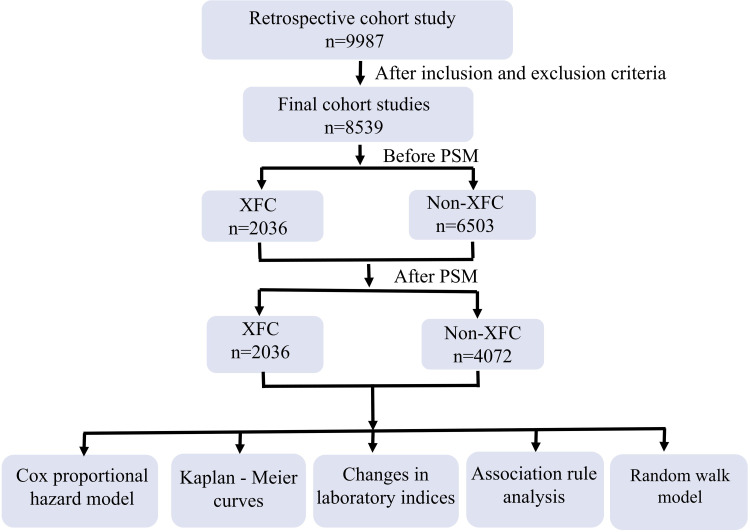
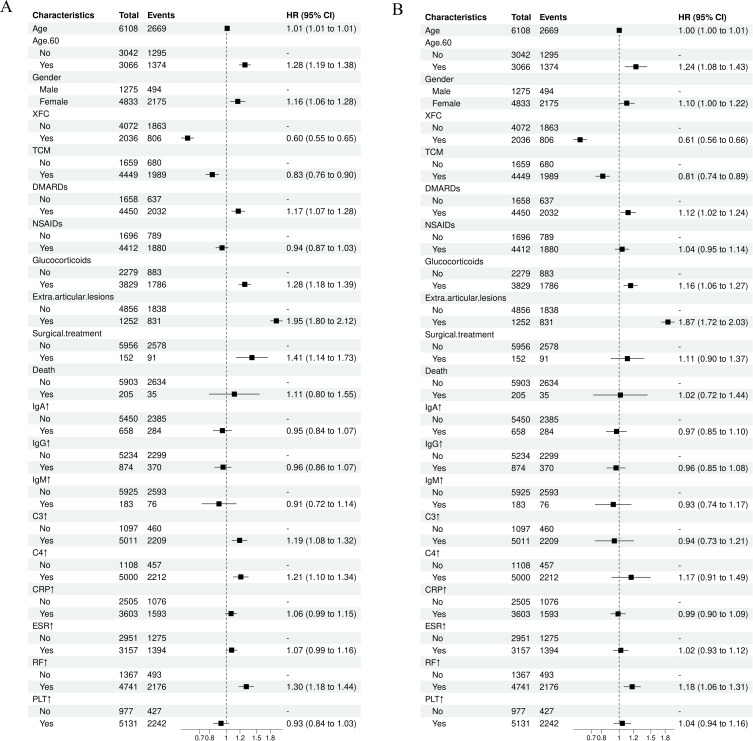
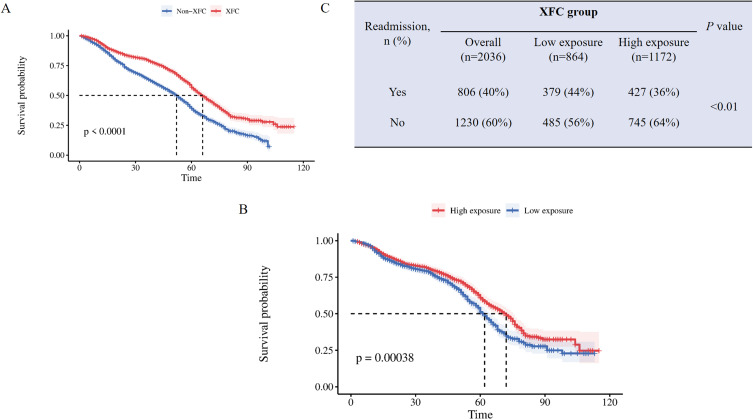
Through a retrospective approach, data were collected from all hospitalized patients diagnosed with RA at the First Affiliated Hospital of Anhui University of Chinese Medicine between 2013 and 2021. To mitigate selection bias and confounding factors, patients were stratified into an XFC group and a Non-XFC (Non-XFC) group based on their treatment status using propensity score matching with a 1:2 ratio. Variables such as age, gender, and baseline medications were adjusted. Subsequently, the Cox proportional hazards model was employed to calculate the hazard ratio (HR) for readmission among RA patients, while Kaplan-Meier curves were utilized to depict the incidence of readmission.
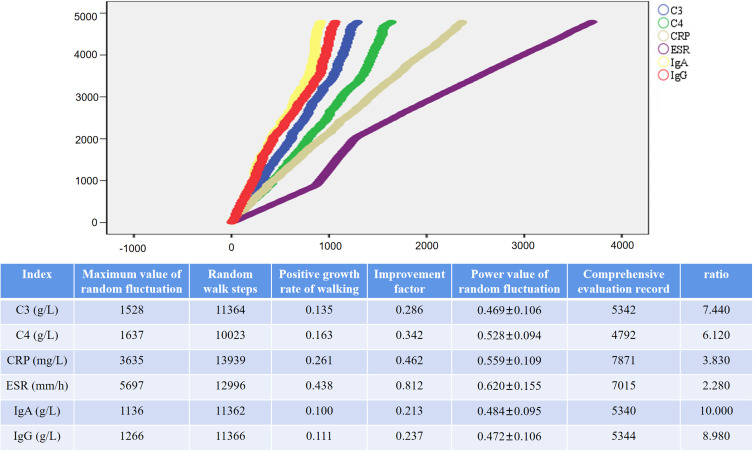
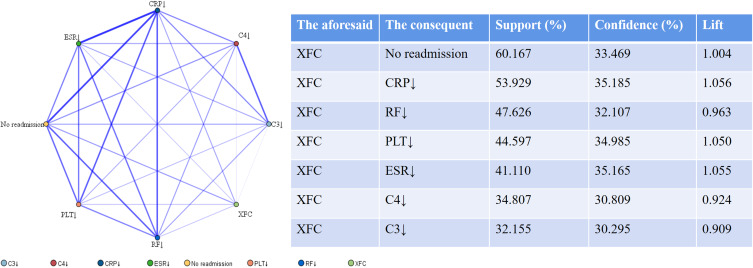
A total of 9987 RA patients were included in this study. Following rigorous inclusion/exclusion criteria and propensity score matching, the XFC group comprised 2036 patients, while the Non-XFC group contained 4072 patients. The Cox proportional hazards model analysis revealed that XFC acted as a protective factor, significantly reducing the risk of readmission among RA patients. Further examination of Kaplan-Meier curves demonstrated that XFC use not only effectively lowered the frequency of readmissions but also exhibited a more pronounced effect in diminishing the risk of readmission with extended usage durations (beyond 12 months). Additionally, association rule analysis underscored the strong link between XFC and freedom from readmission, as well as the robust correlation between XFC usage and significant improvements in multiple laboratory indicators, including C3, C4, CRP, ESR, and others.
This study underscores a robust and long-term association between XFC usage and lower readmission rates among RA patients. As a protective factor against readmission risk in these patients, the clinical value of XFC merits further promotion and investigation.
本研究旨在探讨服用新风胶囊(XFC)与类风湿关节炎(RA)患者再入院风险之间的潜在关联。
采用回顾性研究方法,收集2013年至2021年期间安徽中医药大学第一附属医院所有确诊为RA的住院患者的数据。为减少选择偏倚和混杂因素,根据治疗情况,采用倾向得分匹配法按1:2的比例将患者分为XFC组和非XFC(Non-XFC)组。对年龄、性别和基线用药等变量进行了调整。随后,采用Cox比例风险模型计算RA患者再入院的风险比(HR),并利用Kaplan-Meier曲线描述再入院发生率。
本研究共纳入9987例RA患者。经过严格的纳入/排除标准和倾向得分匹配后,XFC组有2036例患者,而非XFC组有4072例患者。Cox比例风险模型分析显示,XFC是一个保护因素,显著降低了RA患者再入院的风险。对Kaplan-Meier曲线的进一步检查表明,使用XFC不仅有效降低了再入院频率,而且随着使用时间延长(超过12个月),在降低再入院风险方面表现出更显著的效果。此外,关联规则分析强调了XFC与无再入院之间的紧密联系,以及XFC使用与包括C3、C4、CRP、ESR等多项实验室指标的显著改善之间的强相关性。
本研究强调了XFC使用与RA患者较低再入院率之间存在强大且长期的关联。作为这些患者再入院风险的保护因素,XFC的临床价值值得进一步推广和研究。