Institute of Geosciences, Goethe University Frankfurt, Frankfurt, Germany.
Frankfurt Isotope and Element Research Center (FIERCE), Goethe University Frankfurt, Frankfurt, Germany.
Sci Rep. 2024 Nov 20;14(1):28806. doi: 10.1038/s41598-024-79779-0.
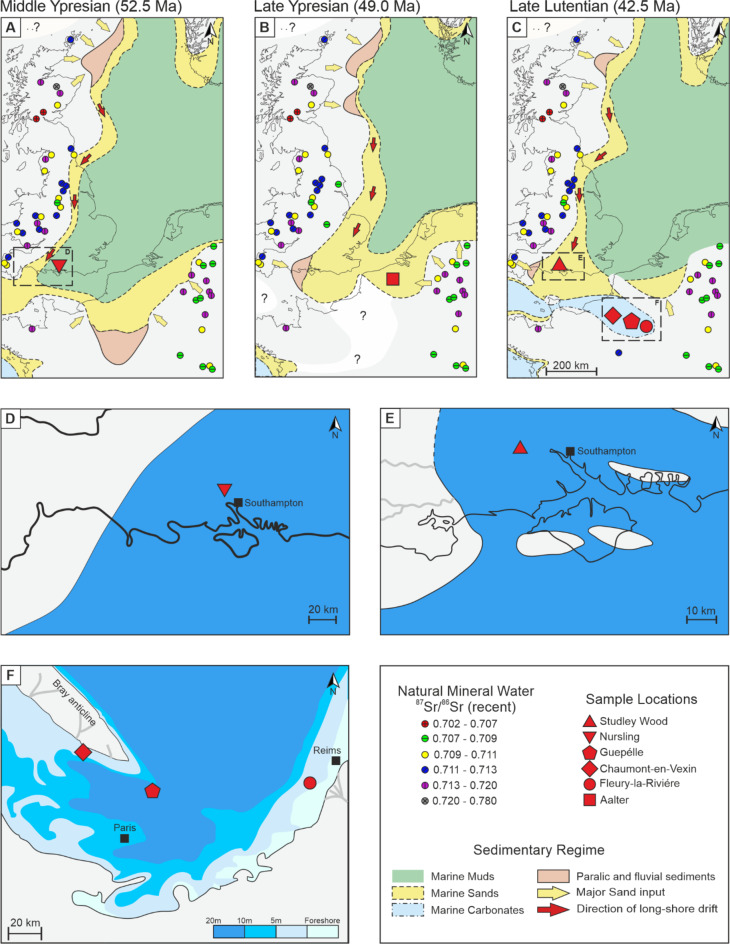
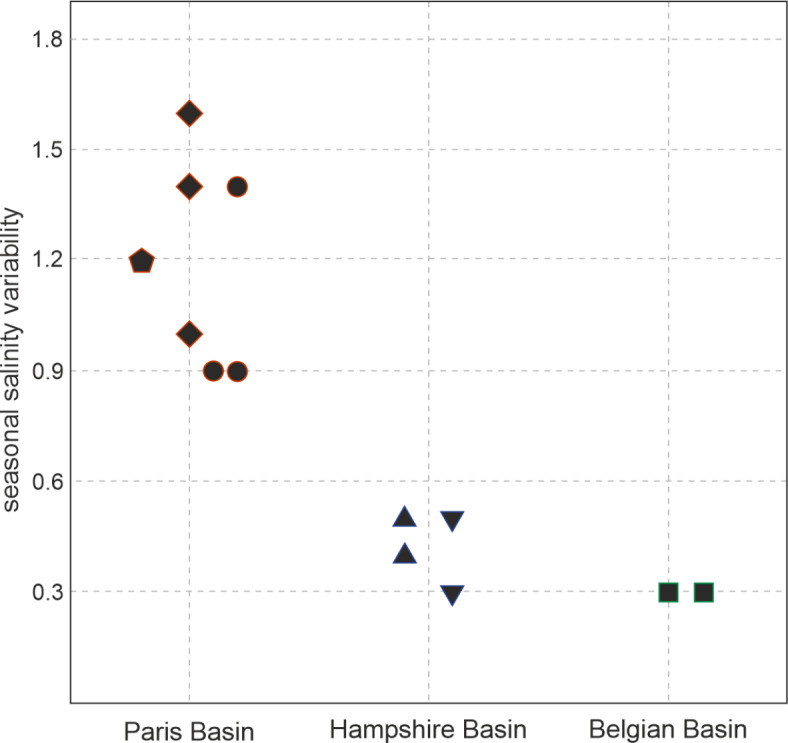
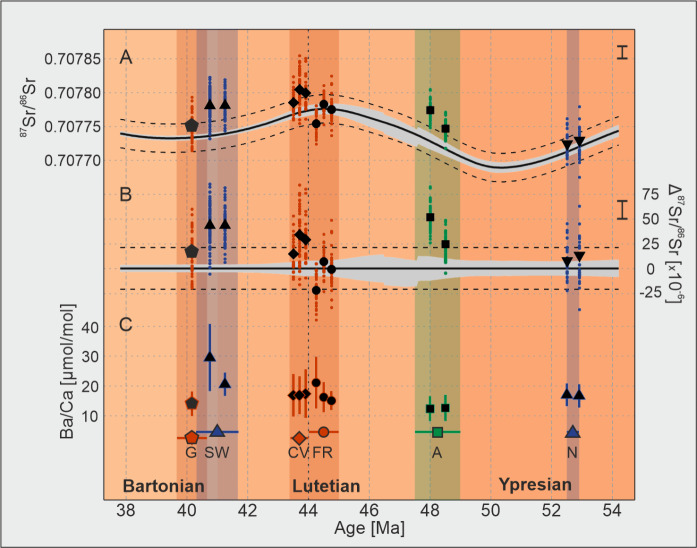
Reconstructing hydrological conditions of past warm periods, such as the Eocene 'hot house' provides empirical data to compare to state of the art climate models. However, reconstructing these changes in deep time is challenging, for example, given the complex interplay between evapotranspiration, precipitation and runoff. As a proxy for past changes in these hydrological systems, the dynamics of fresh water input into marginal seas can be used to identify the spatiotemporal distribution of riverine runoff. Elemental barium (Ba) and radiogenic strontium (Sr) are, depending on the amount of runoff and the background geology of the catchment area, typically enriched in river waters in comparison to seawater and can thus be utilized to determine changes in riverine fresh water discharge. Here, we use barium to calcium ratios (Ba/Ca) and radiogenic strontium isotopes (Sr/Sr) measured in fossil bivalve shells to reconstruct patterns of fresh water input into the paleo North Sea during the early to middle Eocene. Our reconstruction shows the potential of Ba/Ca and Sr/Sr to serve as proxies for riverine runoff and highlights the spatiotemporal complexity of Eocene hydrological conditions in western Europe. In particular, our results enable changes in riverine input along geological to perennial time scales for different coastal regions to be determined, revealing a steady influx of fresh water, but with distinct spatiotemporal differences.
重建过去温暖时期的水文条件,如始新世的“热室”,为与最先进的气候模型进行比较提供了经验数据。然而,在深层时间重建这些变化具有挑战性,例如,考虑到蒸散、降水和径流水之间的复杂相互作用。作为过去这些水文系统变化的替代指标,可以使用边缘海淡水输入的动态来识别河流径流量的时空分布。元素钡(Ba)和放射性锶(Sr)通常取决于径流量和流域地质背景,与海水相比,在河水中更为丰富,因此可用于确定河流淡水排放量的变化。在这里,我们使用测量化石双壳贝类中钡钙比(Ba/Ca)和放射性锶同位素(Sr/Sr)的方法,重建始新世早期到中期古北海淡水输入的模式。我们的重建结果表明,Ba/Ca 和 Sr/Sr 有潜力作为河流径流量的替代指标,并突出了欧洲西部始新世水文条件的时空复杂性。特别是,我们的结果能够确定不同沿海地区沿地质到常年时间尺度的河流输入变化,显示出稳定的淡水流入,但具有明显的时空差异。