Jörgens Maximilian, Ehreiser Sonja, Schroeder Lennart, Watrinet Julius, Böcker Wolfgang, Holzapfel Boris Michael, Radermacher Klaus, Fürmetz Julian
Department of Orthopaedics and Trauma Surgery, Musculoskeletal University Center Munich (MUM), University Hospital, LMU, Munich, Germany.
Endogap, Joint Replacement Institute, Klinikum Garmisch-Partenkirchen, Garmisch-Partenkirchen, Germany.
Knee Surg Relat Res. 2024 Nov 20;36(1):35. doi: 10.1186/s43019-024-00244-3.
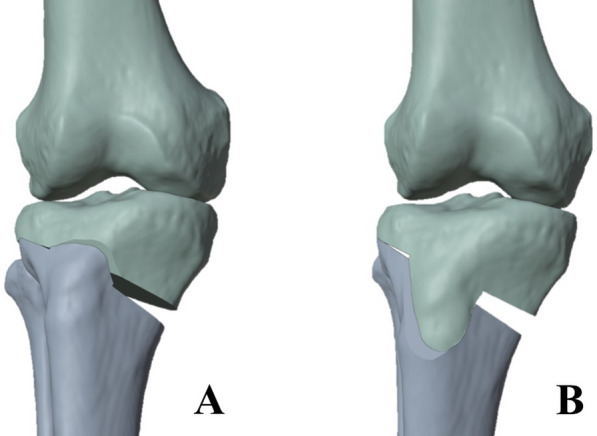
The ascending or descending extended biplanar tibial cut in open wedge high tibial osteotomy (owHTO) not only changes the lower limb anatomy in the coronal plane but also leads to different three-dimensional (3D) changes in the patellofemoral joint. This study aimed to perform a comprehensive analysis of the dynamic biomechanical changes in the knee joint using a multibody simulation model.
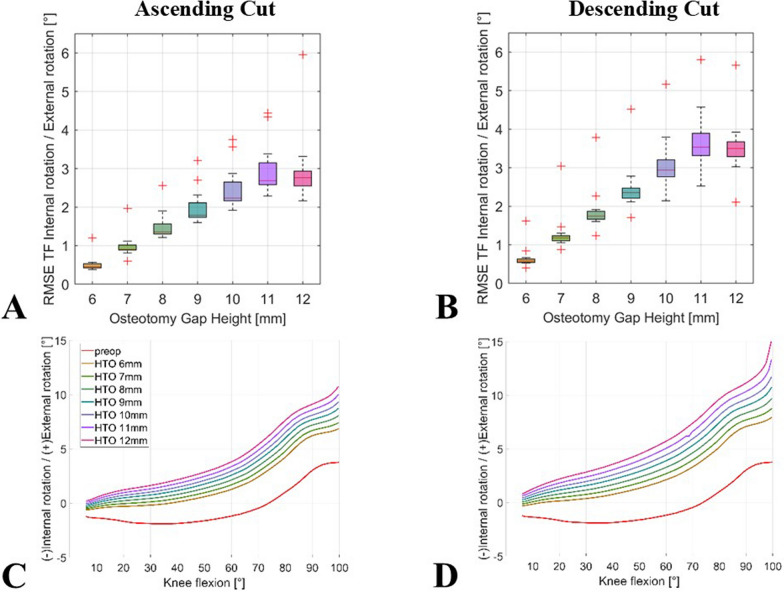
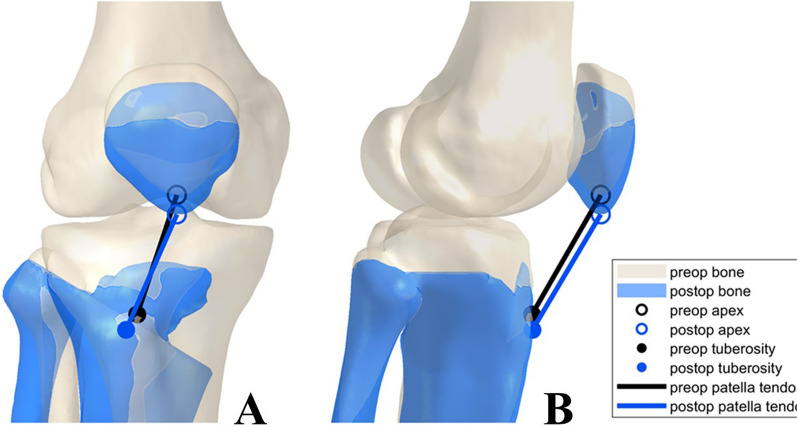
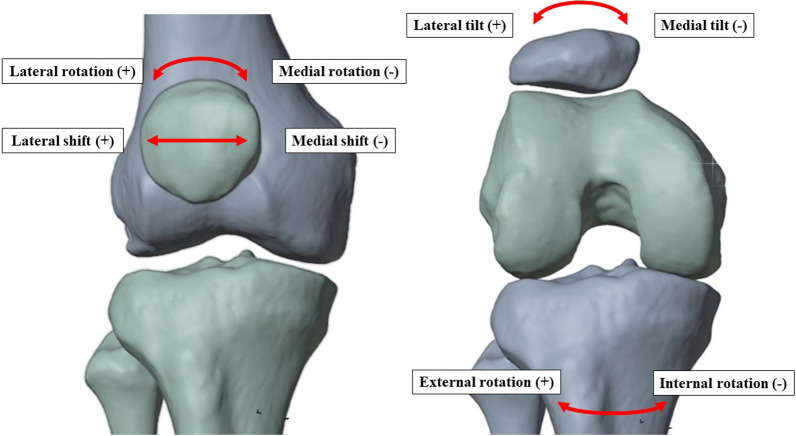
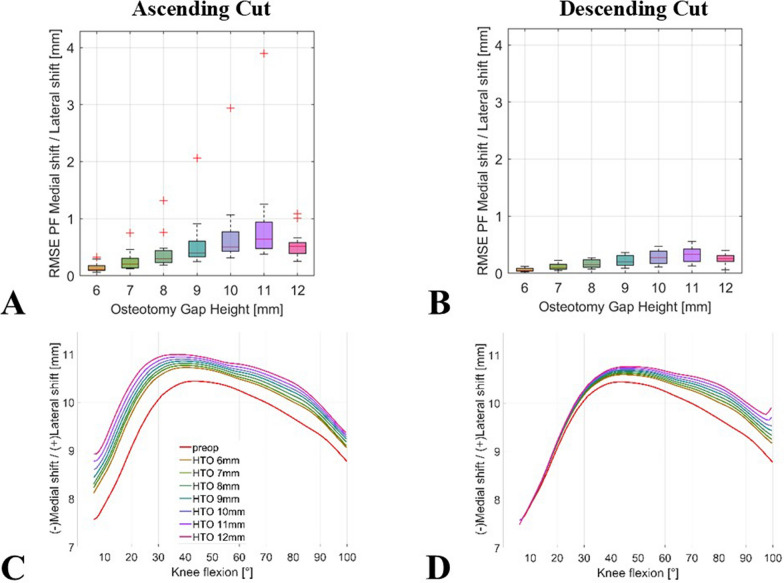
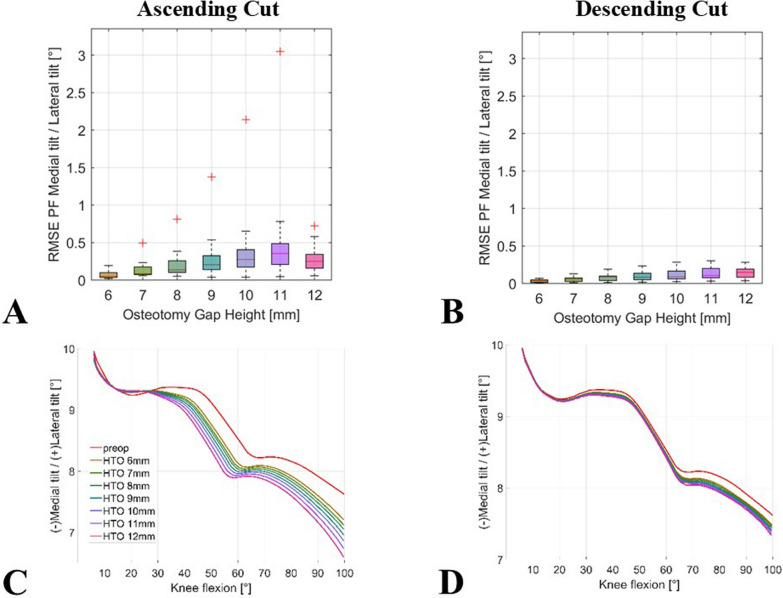
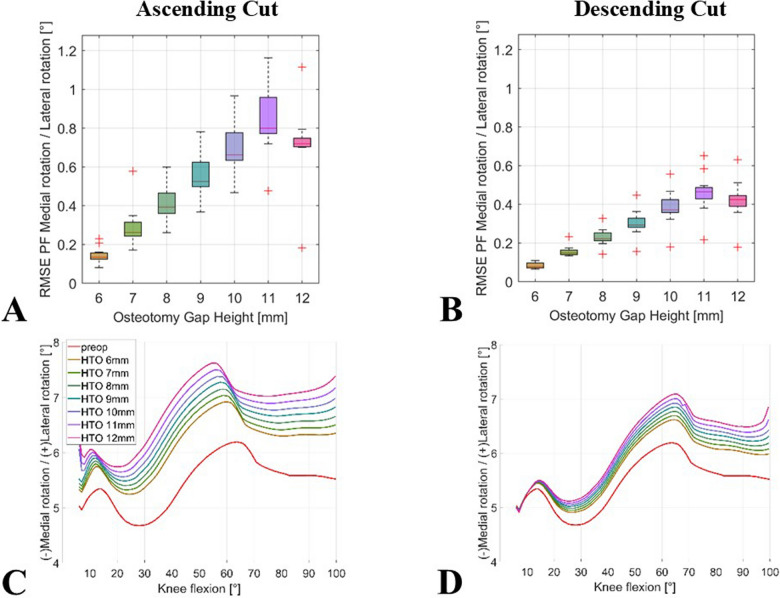
Thirteen 3D computer models derived from lower limb computer tomography scans were used for owHTO. Osteotomies with ascending or descending biplanar cut were simulated for each wedge height from 6 to 12 mm (in 1-mm intervals). Multibody simulation was used to analyze differences in patellar shift, patellar tilt, mediolateral patellar rotation, and tibiofemoral rotation during a squat simulation from 5° to 100° knee flexion.
The main effects of an ascending compared with a descending extended biplanar cut in owHTO were characterized by an increase in lateralization of the patella and rotation, along with reduced tilt. Linear mixed models revealed statistically significant effects of both wedge height and cut variant on knee kinematics at 100° knee flexion, with the influence of the cut variant (ascending/descending) being higher on all analyzed kinematic parameters.
Significant differences in the changes in patellofemoral shift, tilt, rotation, and tibiofemoral rotation were observed when performing owHTO with an ascending versus a descending biplanar cut. Apart from tibiofemoral rotation, the resulting kinematic changes were greater with an ascending cut.
在开放性楔形高位胫骨截骨术(owHTO)中,采用向上或向下的双平面胫骨截骨不仅会改变下肢在冠状面的解剖结构,还会导致髌股关节出现不同的三维变化。本研究旨在使用多体模拟模型对膝关节的动态生物力学变化进行全面分析。
从下肢计算机断层扫描中获取13个三维计算机模型用于owHTO。对每个楔形高度从6到12毫米(间隔1毫米)模拟向上或向下的双平面截骨。在膝关节从5°到100°屈曲的深蹲模拟过程中,使用多体模拟分析髌骨移位、髌骨倾斜、髌骨内外侧旋转和胫股旋转的差异。
与owHTO中向下的双平面截骨相比,向上截骨的主要影响表现为髌骨的外移和旋转增加,同时倾斜度降低。线性混合模型显示,在膝关节屈曲100°时,楔形高度和截骨方式对膝关节运动学均有统计学显著影响,截骨方式(向上/向下)对所有分析的运动学参数的影响更大。
在进行owHTO时,采用向上与向下的双平面截骨,在髌股移位、倾斜、旋转以及胫股旋转的变化方面存在显著差异。除胫股旋转外,向上截骨导致的运动学变化更大。