Han Changxiao, Li Xia, Tian Xiangdong, Zhao Jiping, Zhou Liqun, Tan Yetong, Ma Sheng, Hu Yuanyi, Chen Handong, Huang Ye
Beijing University of Chinese Medicine, Beijing, 100029, China.
Academe of Wudang Medicine of Beijing University of Chinese Medicine, Beijing, 100029, China.
J Orthop Surg Res. 2020 Oct 9;15(1):466. doi: 10.1186/s13018-020-01996-w.
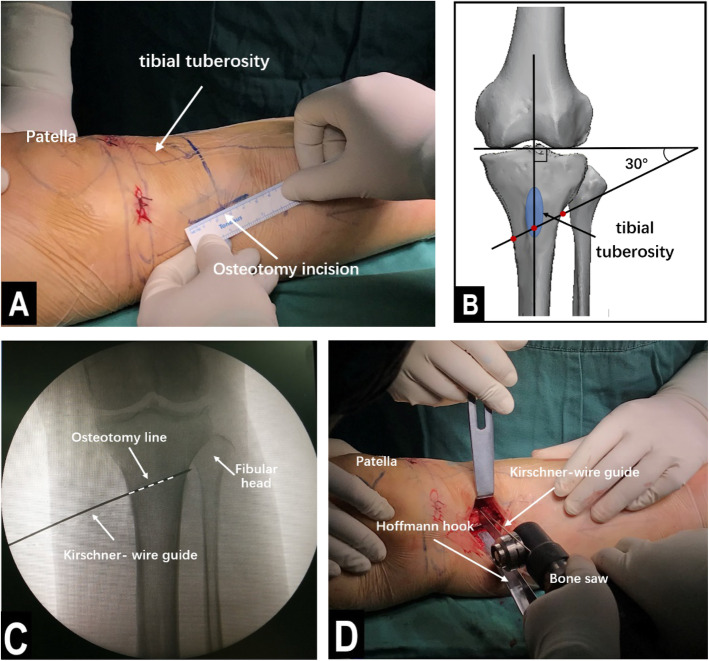
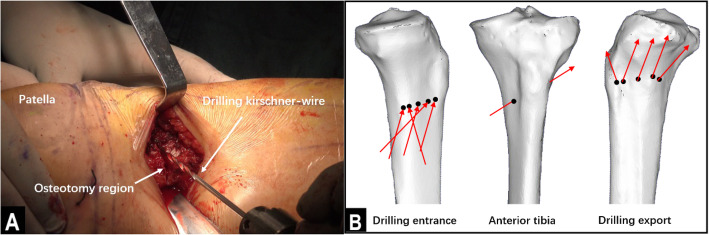
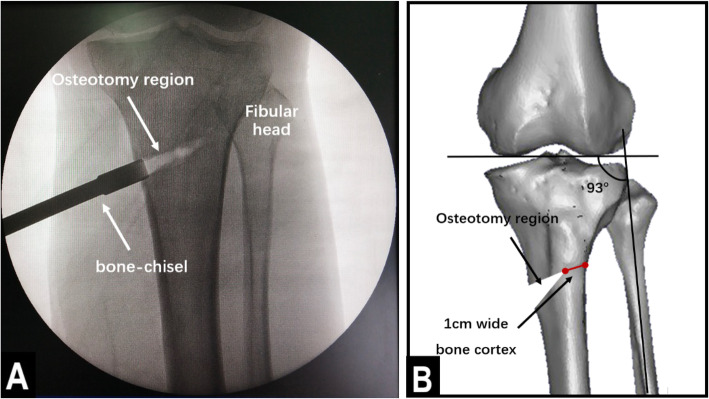
Distal tibial tuberosity high tibial osteotomy (DTT-HTO) can prevent distalization of the tibial tuberosity and thus patellar infera. However, no studies on the clinical and radiological effects of DTT-HTO on the patellofemoral joint have been conducted. The purpose of the study was to evaluate the effect of DTT-HTO on patella height and patellofemoral joint congruity based on the severity of patellofemoral joint OA.
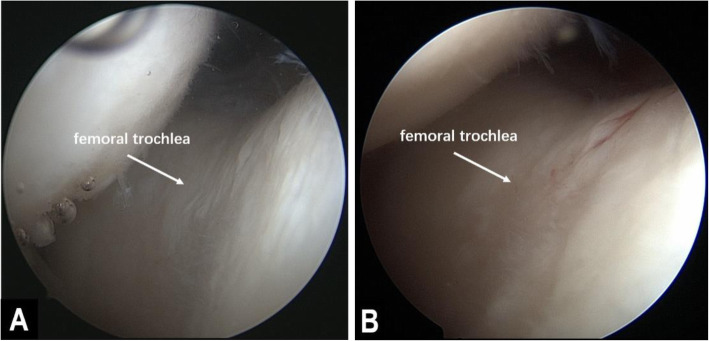
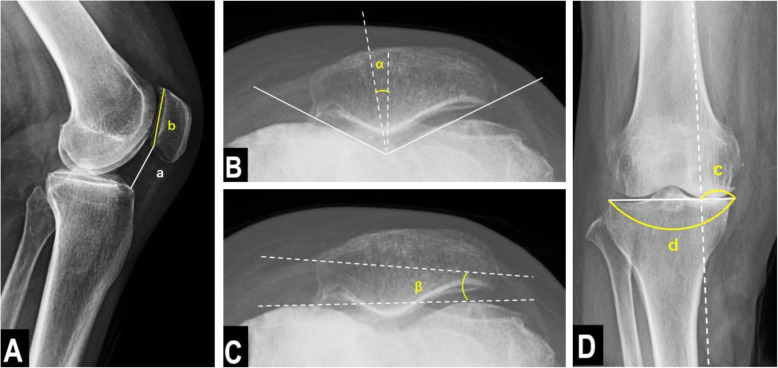
Twenty-nine patients (33 knees) who underwent DTT-HTO and second-look arthroscopy when implant was removed between January 2018 and May 2020 were eligible for the study. Among them, 6 were males, and 23 were females, with ages from 51 to 78 years old. The Caton-Deschamps index (CDI), congruence angle (CA), and lateral patellar tilt (LPT) were measured to evaluate the effect of surgery on patellar height and patellofemoral joint congruity. The weight-bearing line ratio (WBLR) was measured to assess lower limb alignment. The cartilage lesion in the patellofemoral joint was assessed arthroscopically during surgery and implant removal by the International Cartilage Repair Society (ICRS) grading system at 18-24 months after surgery. The Hospital for Special Surgery (HSS) scale was used to evaluate knee joint function.
Twenty-nine patients were followed up for 18-28 months. The preoperative CDI, CA, and LPT changed from 0.92 ± 0.16 to 0.89 ± 0.14, from 5.52 ± 2.19 to 5.44 ± 2.27, and from 6.95 ± 2.88 to 6.54 ± 2.42, respectively, and the differences were not statistically significant (p > 0.05). The preoperative WBLR significantly increased from 16.72 ± 6.77 to 58.77 ± 7.69% (p < 0.001). The cartilage lesions in the patella and femoral trochlea did not progress significantly from the first- to the second-look arthroscopy, according to the ICRS grades (p > 0.05). The HSS score significantly improved from 50.64 ± 19.18 preoperatively to 67.33 ± 14.72, 81.63 ± 11.92, and 82.73 ± 8.05 at the 3-month, 12-month, and last follow-up after surgery (p < 0.001).
DTT-HTO can effectively prevent patellar infera, and its effects on postoperative patellofemoral joint congruity and patellofemoral joint OA progression are inconspicuous. It can be recommended as a treatment of varus knee combined with patellar infera or patellofemoral joint OA.
胫骨远端结节高位胫骨截骨术(DTT-HTO)可防止胫骨结节远移,从而预防髌下。然而,尚未有关于DTT-HTO对髌股关节临床和影像学影响的研究。本研究的目的是根据髌股关节骨关节炎的严重程度,评估DTT-HTO对髌骨高度和髌股关节一致性的影响。
2018年1月至2020年5月期间接受DTT-HTO并在取出植入物时进行二次关节镜检查的29例患者(33个膝关节)符合本研究条件。其中,男性6例,女性23例,年龄51至78岁。测量Caton-Deschamps指数(CDI)、一致性角(CA)和髌骨外侧倾斜(LPT),以评估手术对髌骨高度和髌股关节一致性的影响。测量负重线比率(WBLR)以评估下肢对线情况。在手术和取出植入物时,通过国际软骨修复协会(ICRS)分级系统在术后18至24个月对髌股关节软骨损伤进行关节镜评估。使用特种外科医院(HSS)评分来评估膝关节功能。
29例患者随访18至28个月。术前CDI、CA和LPT分别从0.92±0.16变为0.89±0.14,从5.52±2.19变为5.44±2.27,从6.95±2.88变为6.54±2.42,差异无统计学意义(p>0.05)。术前WBLR从16.72±6.77显著增加至58.77±7.69%(p<0.001)。根据ICRS分级,从首次关节镜检查到二次关节镜检查,髌骨和股骨滑车的软骨损伤无明显进展(p>0.05)。HSS评分从术前的50.64±19.18显著提高到术后3个月、12个月和末次随访时的67.33±14.72、81.63±11.92和82.73±8.05(p<0.001)。
DTT-HTO可有效预防髌下,其对术后髌股关节一致性和髌股关节骨关节炎进展的影响不明显。可推荐作为治疗膝内翻合并髌下或髌股关节骨关节炎的方法。