Bano Saira, Wu Qiaoyu, Yu Siyu, Wang Xinhui, Zhang Xiaojun
State Key Laboratory of Microbial metabolism, Joint International Research Laboratory of Metabolic & Developmental Sciences, School of Life Sciences & Biotechnology, Shanghai Jiao Tong University, 800 Dongchuan Road, Minhang District, Shanghai, 200240, China.
Environ Microbiome. 2024 Nov 21;19(1):94. doi: 10.1186/s40793-024-00643-9.
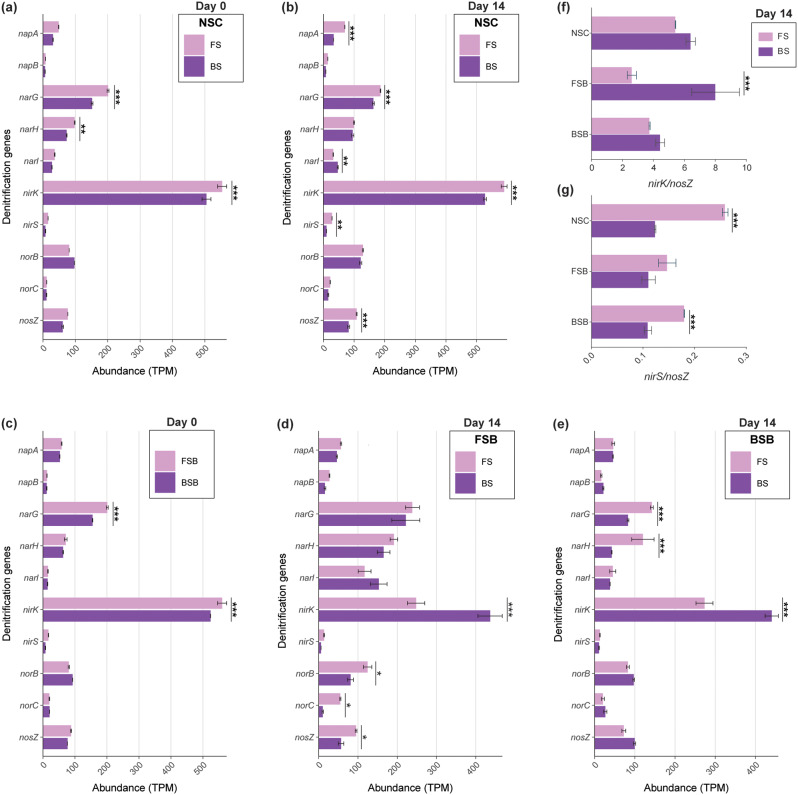
In agroecosystems, nitrous oxide (N₂O) emissions are influenced by both microbiome composition and soil properties, yet the relative importance of these factors in determining differential N₂O emissions remains unclear. This study investigates the impacts of these factors on N₂O emissions using two primary agricultural soils from northern China: fluvo-aquic soil (FS) from the North China Plain and black soil (BS) from Northeast China, which exhibit significant differences in physicochemical properties. In non-sterilized controls (NSC), we observed distinct denitrifying bacterial phenotypes between FS and BS, with BS exhibiting significantly higher N₂O emissions. Cross-inoculation experiments were conducted by introducing extracted microbiomes into sterile recipient soils of both types to disentangle the relative contributions of soil properties and microbiomes on N₂O emission potential. The results showed recipient-soil-dependent gas kinetics, with significantly higher N₂O/(N₂O + N₂) ratios in BS compared to FS, regardless of the inoculum type. Metagenomic analysis further revealed significant shifts in denitrification genes and microbial diversity of the inoculated bacteriomes influenced by the recipient soil. The higher ratios of nirS/nosZ in FS and nirK/nosZ in BS indicated that the recipient soil dictates the formation of different denitrifying guilds. Specifically, the BS environment fosters nirK-based denitrifiers like Rhodanobacter, contributing to higher N₂O accumulation, while FS supports a diverse array of denitrifiers, including Pseudomonas and Stutzerimonas, associated with complete denitrification and lower N₂O emissions. This study underscores the critical role of soil properties in shaping microbial community dynamics and greenhouse gas emissions. These findings highlight the importance of considering soil physicochemical properties in managing agricultural practices to mitigate N₂O emissions.
在农业生态系统中,一氧化二氮(N₂O)排放受微生物群落组成和土壤性质的影响,但这些因素在决定N₂O排放差异方面的相对重要性尚不清楚。本研究利用中国北方的两种主要农业土壤,即华北平原的潮土(FS)和中国东北的黑土(BS),研究了这些因素对N₂O排放的影响,这两种土壤在理化性质上存在显著差异。在未灭菌对照(NSC)中,我们观察到FS和BS之间存在不同的反硝化细菌表型,BS的N₂O排放显著更高。通过将提取的微生物群落引入两种类型的无菌受体土壤中进行交叉接种实验,以厘清土壤性质和微生物群落在N₂O排放潜力方面的相对贡献。结果表明,气体动力学依赖于受体土壤,无论接种物类型如何,BS中的N₂O/(N₂O + N₂)比率均显著高于FS。宏基因组分析进一步揭示,接种的细菌群落的反硝化基因和微生物多样性受受体土壤影响发生了显著变化。FS中nirS/nosZ和BS中nirK/nosZ的较高比率表明,受体土壤决定了不同反硝化菌群的形成。具体而言,BS环境有利于如红杆菌属等基于nirK的反硝化菌生长,导致更高的N₂O积累,而FS则支持包括假单胞菌属和施氏假单胞菌属在内的多种反硝化菌,这些菌与完全反硝化和较低的N₂O排放有关。本研究强调了土壤性质在塑造微生物群落动态和温室气体排放方面的关键作用。这些发现凸显了在管理农业实践以减轻N₂O排放时考虑土壤理化性质的重要性。