From the Department of Neurology and Neurosurgery (J.P.M.M., A.F.J.E.V., N.C.N., W.L.v.d.P.), UMC Utrecht Brain Center; Center for Translational Immunology (K.B., K.D.); Department of Hematology (M.C.M.), University Medical Center Utrecht, Utrecht University, The Netherlands.
Neurol Neuroimmunol Neuroinflamm. 2025 Jan;12(1):e200339. doi: 10.1212/NXI.0000000000200339. Epub 2024 Nov 21.
Polyneuropathy associated with an immunoglobulin M (IgM) monoclonal gammopathy is characterized by slowly progressive, predominantly distal sensorimotor deficits, sensory ataxia, and electrophysiologic features of demyelination. IgM antibodies against myelin-associated glycoprotein (MAG) are present in serum from most patients. Nerve damage most likely results from the concerted action of binding of anti-MAG antibodies to nerves, followed by complement activation. The interaction of anti-MAG antibodies with complement activation and their relation to clinical characteristics have not been studied in detail. We studied the correlation among anti-MAG antibody titers, complement activation, and IgM-associated polyneuropathy disease severity.
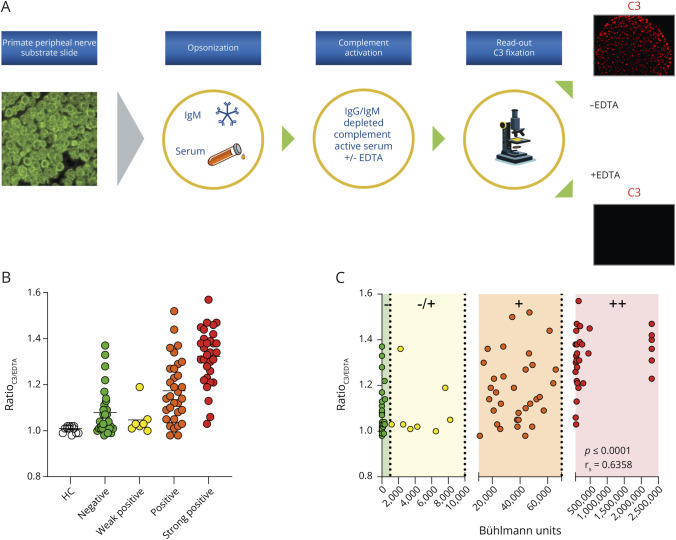
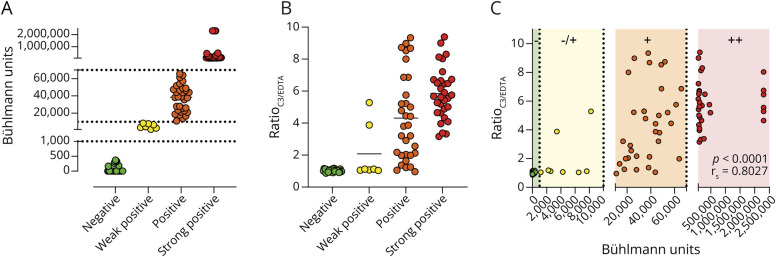
We used serum samples from 101 patients with IgM-associated polyneuropathy to assess IgM anti-MAG titers by ELISA and antibody-mediated complement deposition using both an ELISA-based system and a cell-based system of primate peripheral nerve slides. We studied correlations of complement activation with anti-MAG ELISA titers and clinical characteristics.
IgM anti-MAG titers varied from negative to strongly positive. Complement deposition in the ELISA-based system correlated significantly with anti-MAG antibody titer (Spearman rho 0.80; < 0.0001) despite large variability between serum samples with comparable anti-MAG titers. This variability was even larger in the cell-based assay, which also showed complement deposition in IgM anti-MAG negative patients, indicating the presence of autoantibodies directed against epitopes other than MAG in a subset of patients with IgM-associated polyneuropathy. Clinical characteristics did not correlate with anti-MAG titers or complement activation.
Anti-MAG antibody titers correlate with the level of complement activation in both ELISA and cell-based systems. However, clinical characteristics of IgM-associated polyneuropathy do not or only weakly correlate with titers or the level of complement deposition. The lack of clear correlations between complement activation and clinical characteristics does, at this stage, not support the use of complement inhibitors in the treatment of IgM-associated polyneuropathy.
免疫球蛋白 M(IgM)单克隆丙种球蛋白相关多发性神经病的特征为进行性缓慢,主要为远端感觉运动障碍、感觉性共济失调和脱髓鞘的电生理特征。大多数患者的血清中存在针对髓鞘相关糖蛋白(MAG)的 IgM 抗体。神经损伤最有可能是由于抗 MAG 抗体与神经结合,随后补体激活的协同作用所致。抗 MAG 抗体与补体激活的相互作用及其与临床特征的关系尚未详细研究。我们研究了抗 MAG 抗体滴度、补体激活与 IgM 相关多发性神经病疾病严重程度之间的相关性。
我们使用来自 101 例 IgM 相关多发性神经病患者的血清样本,通过 ELISA 评估 IgM 抗 MAG 滴度,并使用基于 ELISA 的系统和基于灵长类外周神经切片的细胞系统评估抗体介导的补体沉积。我们研究了补体激活与抗 MAG ELISA 滴度和临床特征的相关性。
IgM 抗 MAG 滴度从阴性到强阳性不等。基于 ELISA 的系统中的补体沉积与抗 MAG 抗体滴度显著相关(Spearman rho 0.80;<0.0001),尽管在具有可比抗 MAG 滴度的血清样本之间存在较大差异。在细胞基础测定中,这种变异性更大,该测定还显示 IgM 抗 MAG 阴性患者中存在补体沉积,表明在 IgM 相关多发性神经病的亚组患者中存在针对 MAG 以外表位的自身抗体。临床特征与抗 MAG 滴度或补体激活无相关性。
抗 MAG 抗体滴度与 ELISA 和细胞系统中的补体激活水平相关。然而,IgM 相关多发性神经病的临床特征与滴度或补体沉积水平无相关性或仅轻度相关。在现阶段,补体激活与临床特征之间缺乏明确的相关性并不支持在 IgM 相关多发性神经病的治疗中使用补体抑制剂。