Department of Hematology, Amsterdam UMC, University of Amsterdam, Cancer Center Amsterdam, LYMMCARE, Amsterdam, The Netherlands.
Department of Neurology and Neurophysiology, Amsterdam Neuroscience, Amsterdam UMC, Location AMC, Amsterdam, The Netherlands.
J Neurol. 2022 Jul;269(7):3700-3705. doi: 10.1007/s00415-022-10993-4. Epub 2022 Feb 14.
In anti-myelin-associated glycoprotein IgM paraprotein-related peripheral neuropathy (anti-MAG PN), there is a lack of reliable biomarkers to select patients eligible for therapy and for evaluating treatment effects, both in routine practice and in clinical trials. Neurofilament light chain (NfL) and contactin-1 (CNTN1) can serve as markers of axonal and paranodal damage. Complement activation is involved in the pathogenesis in anti-MAG PN. We, therefore, hypothesized that serum NfL, CNTN1, C3b/c and C4b/c may function as biomarkers of disease activity in anti-MAG PN.
In this prospective cohort study, we included 24 treatment-naïve patients with anti-MAG PN (mean age 69 years, 57% male) that had IgM paraproteinemia, a high IgM MAG-antibody, and clinical diagnosis of anti-MAG PN by a neurologist specialized in peripheral nerve disorders. We measured serum NfL, CNTN1, C3b/c and C4b/c, reference values were based on healthy controls. As controls, 10 treatment-naïve patients with IgM Monoclonal gammopathy of undetermined significance (MGUS) or Waldenström's Macroglobulinemia (mean age 69 years, 60% male) without signs of neuropathy were included (non-PN).
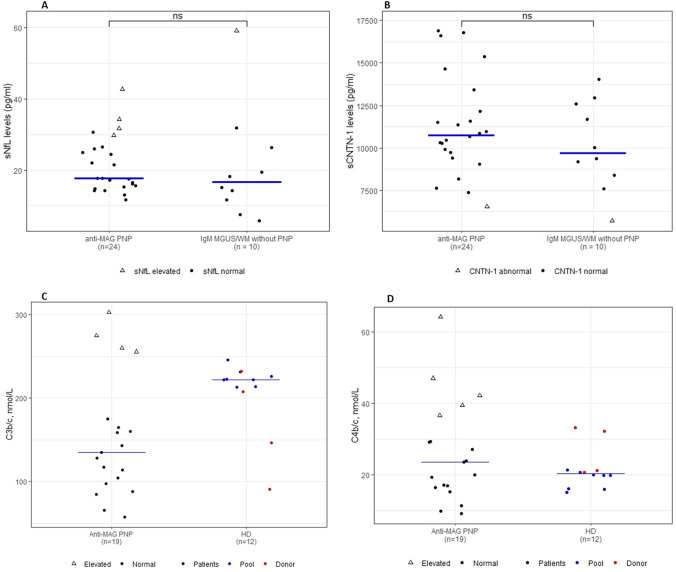
NfL, CNTN1 levels in serum were mostly normal in anti-MAG PN patients and comparable to non-PN patients. C3b/c and C4b/c levels were normal in anti-MAG PN patients.
Our results do not support serum NfL, CNTN1, and C3b/c and C4b/c as potential biomarkers in anti-MAG PN, although we cannot exclude that subgroups or subtle abnormalities could be found in a much larger cohort with longitudinal follow-up.
在抗髓鞘相关糖蛋白 IgM 型副蛋白相关周围神经病(抗-MAG PN)中,缺乏可靠的生物标志物来选择有资格接受治疗的患者,并评估治疗效果,无论是在常规实践中还是临床试验中。神经丝轻链(NfL)和接触蛋白-1(CNTN1)可作为轴突和连接蛋白损伤的标志物。补体激活参与抗-MAG PN 的发病机制。因此,我们假设血清 NfL、CNTN1、C3b/c 和 C4b/c 可能作为抗-MAG PN 疾病活动的生物标志物。
在这项前瞻性队列研究中,我们纳入了 24 例未经治疗的抗-MAG PN 患者(平均年龄 69 岁,57%为男性),这些患者均存在 IgM 副蛋白血症、高 IgM MAG 抗体和神经科医生诊断的抗-MAG PN。我们测量了血清 NfL、CNTN1、C3b/c 和 C4b/c,参考值基于健康对照。作为对照,我们纳入了 10 例未经治疗的 IgM 意义未明的单克隆丙种球蛋白血症(MGUS)或华氏巨球蛋白血症(Waldenström's Macroglobulinemia)患者(平均年龄 69 岁,60%为男性),这些患者没有周围神经病变的迹象(非-PN)。
抗-MAG PN 患者的血清 NfL 和 CNTN1 水平大多正常,与非-PN 患者相当。抗-MAG PN 患者的 C3b/c 和 C4b/c 水平正常。
我们的结果不支持血清 NfL、CNTN1、C3b/c 和 C4b/c 作为抗-MAG PN 的潜在生物标志物,尽管我们不能排除在具有纵向随访的更大队列中可能会发现亚组或细微异常。