
德语版远程医疗可用性问卷及衍生的简短问卷,用于评估远程医疗和数字治疗中的可用性和感知有用性:工具验证研究。
German Version of the Telehealth Usability Questionnaire and Derived Short Questionnaires for Usability and Perceived Usefulness in Health Care Assessment in Telehealth and Digital Therapeutics: Instrument Validation Study.
机构信息
Department of Psychology - Theory and Methodology of Counseling, University of Kassel, Kassel, Germany.
Department of Internal Medicine 3, Rheumatology and Immunology, University Hospital Erlangen, Friedrich-Alexander University (FAU), Erlangen-Nuremberg, Erlangen, Germany.
出版信息
JMIR Hum Factors. 2024 Nov 21;11:e57771. doi: 10.2196/57771.
BACKGROUND
The exponential growth of telehealth is revolutionizing health care delivery, but its evaluation has not matched the pace of its uptake. Various forms of assessment, from single-item to more extensive questionnaires, have been used to assess telehealth and digital therapeutics and their usability. The most frequently used questionnaire is the "Telehealth Usability Questionnaire" (TUQ). The use of the TUQ is limited by its restricted availability in languages other than English and its feasibility.
OBJECTIVE
The aims of this study were to create a translated German TUQ version and to derive a short questionnaire for patients-"Telehealth Usability and Perceived Usefulness Short Questionnaire for patients" (TUUSQ).
METHODS
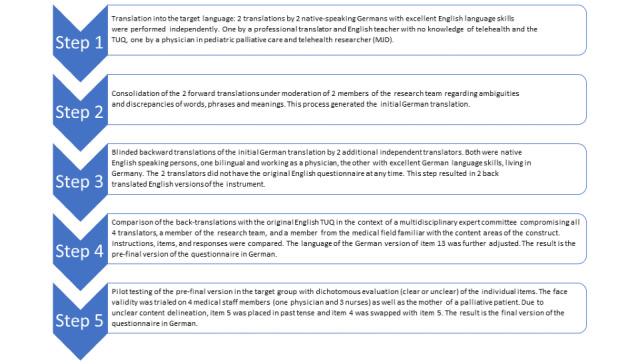
As a first step, the original 21-item TUQ was forward and back-translated twice. In the second step, 13 TUQ items were selected for their suitability for the general evaluation of telehealth on the basis of expert opinion. These 13 items were surveyed between July 2022 and September 2023 in 4 studies with patients and family members of palliative care, as well as patients with chronic autoimmune diseases, evaluating 13 health care apps, including digital therapeutics and a telehealth system (n1=128, n2=220, n3=30, and n4=12). Psychometric exploratory factor analysis was conducted.
RESULTS
The analysis revealed that a parsimonious factor structure with 2 factors ("perceived usefulness in health care" and "usability") is sufficient to describe the patient's perception. Consequently, the questionnaire could be shortened to 6 items without compromising its informativeness.
CONCLUSIONS
We provide a linguistically precise German version of the TUQ for assessing the usability and perceived usefulness of telehealth. Beyond that, we supply a highly feasible shortened version that is versatile for general use in telehealth, mobile health, and digital therapeutics, which distinguishes between the 2 factors "perceived usefulness in health care" and "usability" in patients.
TRIAL REGISTRATION
German Clinical Trials Register DRKS00030546; https://drks.de/search/de/trial/DRKS00030546.
背景
远程医疗呈指数级增长,正在彻底改变医疗服务的提供方式,但对其的评估并没有跟上其采用的步伐。已经使用了各种形式的评估方法,从单项评估到更广泛的问卷,来评估远程医疗和数字疗法及其可用性。使用最频繁的问卷是“远程医疗可用性问卷”(TUQ)。该问卷的使用受到其在英语以外的语言中的可用性有限以及可行性的限制。
目的
本研究的目的是创建一个翻译后的德文 TUQ 版本,并为患者开发一个简短的问卷——“患者远程医疗可用性和感知有用性简短问卷”(TUUSQ)。
方法
作为第一步,对原始的 21 项 TUQ 进行了两次正向和反向翻译。在第二步中,根据专家意见,选择了 13 项 TUQ 项目,这些项目适合于远程医疗的一般评估。这些 13 个项目在 2022 年 7 月至 2023 年 9 月期间在 4 项研究中进行了调查,研究对象为姑息治疗患者和患者家属以及慢性自身免疫性疾病患者,评估了 13 个医疗保健应用程序,包括数字疗法和远程医疗系统(n1=128,n2=220,n3=30,n4=12)。进行了心理测量探索性因子分析。
结果
分析表明,一个简约的因子结构,包括“在医疗保健中的感知有用性”和“可用性”这 2 个因子,足以描述患者的感知。因此,在不影响其信息量的情况下,问卷可以缩短为 6 个项目。
结论
我们提供了一个语言准确的 TUQ 德文版本,用于评估远程医疗的可用性和感知有用性。此外,我们提供了一个高度可行的简化版本,该版本在远程医疗、移动医疗和数字疗法中具有通用性,可区分患者的“在医疗保健中的感知有用性”和“可用性”这 2 个因子。
试验注册
德国临床试验注册处 DRKS00030546;https://drks.de/search/de/trial/DRKS00030546。
 Zotero 插件