Satoh Michihiro, Tatsumi Yukako, Nakayama Shingo, Shinohara Yukiko, Kawazoe Miki, Nozato Yoichi, Kunimura Ayako, Murakami Takahisa, Toyama Maya, Muroya Tomoko, Yagihashi Takahito, Sakima Atsushi, Abe Makiko, Arima Hisatomi, Ohkubo Takayoshi
Division of Public Health, Hygiene and Epidemiology, Faculty of Medicine, Tohoku Medical and Pharmaceutical University, Sendai, Japan.
Department of Preventive Medicine and Epidemiology, Tohoku Medical Megabank Organization, Tohoku University, Sendai, Japan.
Hypertens Res. 2025 Feb;48(2):574-591. doi: 10.1038/s41440-024-01981-4. Epub 2024 Nov 21.
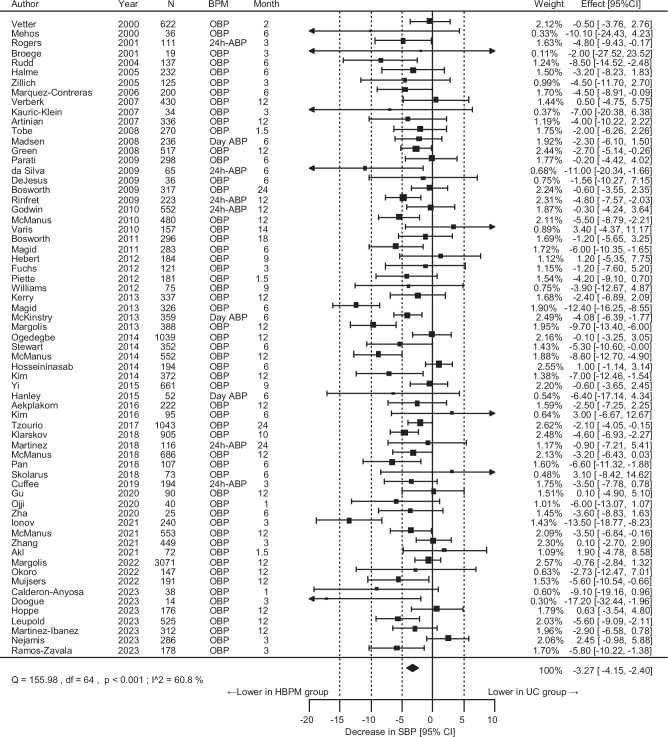
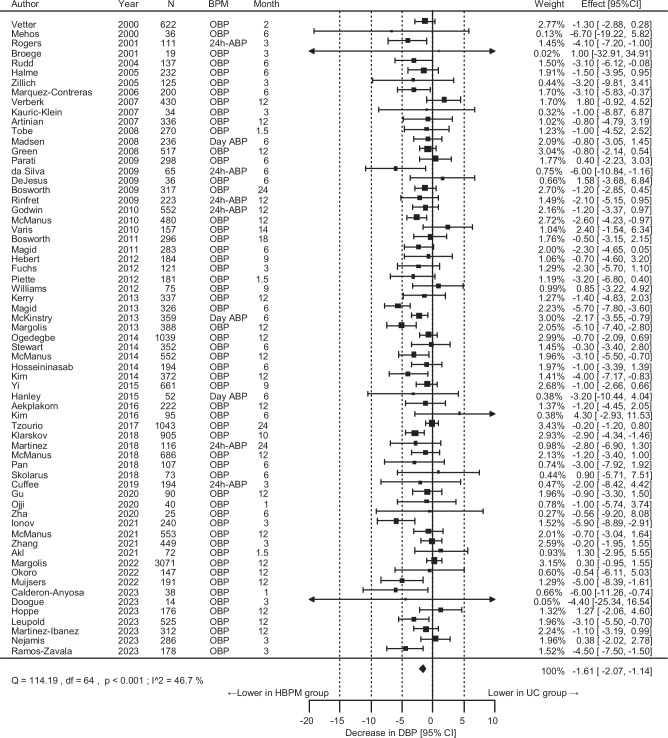
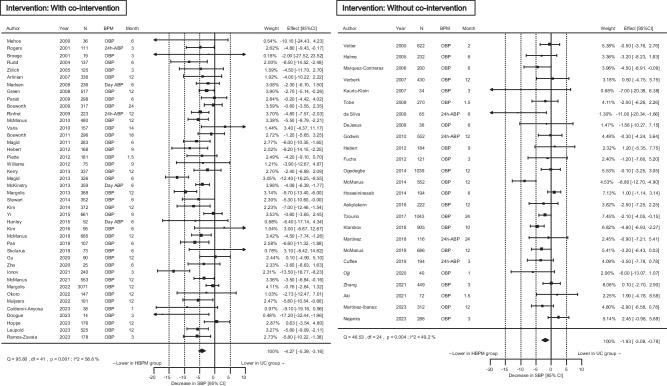
The effect of self-measurement of blood pressure (BP) at home (home BP measurement, HBPM) has been evaluated over the past decade. This meta-analysis included the latest studies to determine whether HBPM reduced BP (PROSPERO ID: CRD42023442225). PubMed, Cochrane Library Database, and IchuShi-Web were searched for randomized controlled trials after the year 2000 which demonstrated the effect of HBPM on BP change compared with usual care (UC). Overall, 65 articles (n = 21,053; 63 based on patients with hypertension) were included. The systolic/diastolic BP reduction was significantly greater in the HBPM than in the UC group by 3.27/1.61 mmHg (95% confidence intervals: 2.40-4.15/1.14-2.07) at the end of the intervention, and I values ≥ 46.7% suggested moderate-to-high heterogeneity. The funnel plots exhibited no notable publication bias (Egger's test p ≥ 0.16). HBPM with co-interventions (such as telemonitoring) showed a stronger BP-lowering effect than without co-interventions while the effect of HBPM on BP change remained significant in the absence of co-interventions. HBPM was not associated with systolic BP changes when we combined the four studies that used a wrist cuff device for HBPM. The number of antihypertensive medications increased by 0.17 medications in the HBPM group compared with that in the UC group. There were no significant differences in body mass index changes or risk of severe adverse outcomes between the groups. Our results demonstrated a beneficial effect of HBPM in reducing BP, particularly when used in conjunction with telemonitoring or additional medical support and when employing upper-arm cuff devices.
在过去十年中,已对在家自行测量血压(家庭血压测量,HBPM)的效果进行了评估。这项荟萃分析纳入了最新研究,以确定HBPM是否能降低血压(国际前瞻性系统评价注册编号:CRD42023442225)。检索了PubMed、Cochrane图书馆数据库和医中志网络,查找2000年后的随机对照试验,这些试验显示了HBPM与常规护理(UC)相比对血压变化的影响。总体而言,纳入了65篇文章(n = 21,053;63篇基于高血压患者)。在干预结束时,HBPM组的收缩压/舒张压降低幅度显著大于UC组,分别为3.27/1.61 mmHg(95%置信区间:2.40 - 4.15/1.14 - 2.07),I值≥46.7%表明存在中度至高度异质性。漏斗图未显示明显的发表偏倚(Egger检验p≥0.16)。与无联合干预措施相比,联合干预措施(如远程监测)的HBPM显示出更强的降压效果,而在无联合干预措施的情况下,HBPM对血压变化的影响仍然显著。当我们合并四项使用腕部袖带装置进行HBPM的研究时,HBPM与收缩压变化无关。与UC组相比,HBPM组的降压药物数量增加了0.17种。两组之间的体重指数变化或严重不良结局风险没有显著差异。我们的结果表明,HBPM在降低血压方面具有有益作用,特别是在与远程监测或额外医疗支持联合使用以及采用上臂袖带装置时。