Institute for Chemistry and Biology of the Marine Environment, University of Oldenburg, Oldenburg, Germany.
Institute of Organic Chemistry, Technische Universität Braunschweig, Braunschweig, Germany.
BMC Microbiol. 2024 Nov 21;24(1):489. doi: 10.1186/s12866-024-03624-7.
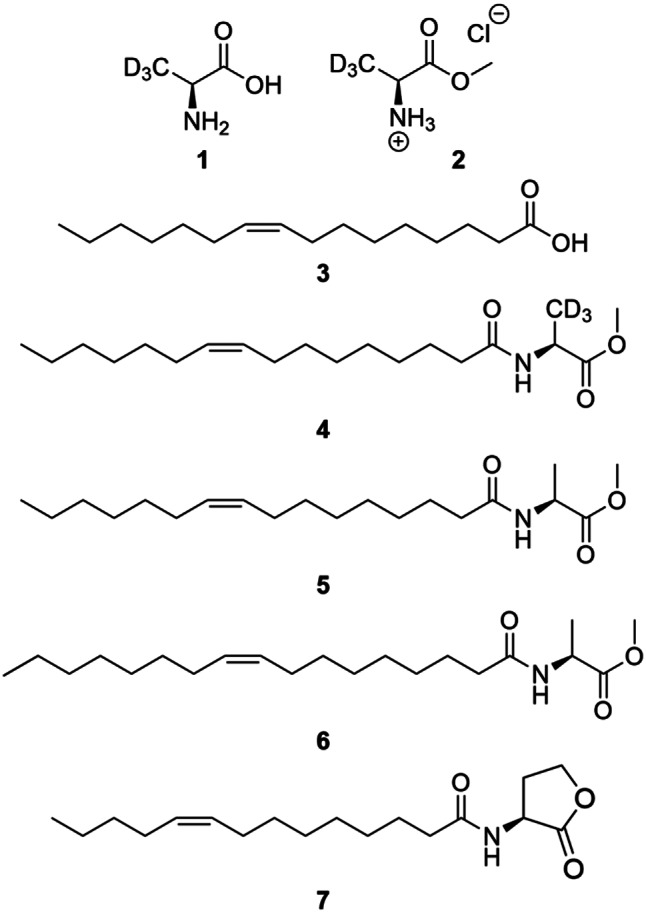
Previous studies have identified structurally diverse N-acyl amino acid methyl esters (NAMEs) in culture extracts of Roseovarius tolerans EL-164 (Roseobacteraceae). NAMEs are structural analogues of the common signaling compounds N-acyl homoserine lactones (AHLs), but do not participate in AHL-mediated signaling. NAMEs show minor antialgal and antimicrobial activity, but whether this activity serves as the primary ecological role remains unclear.
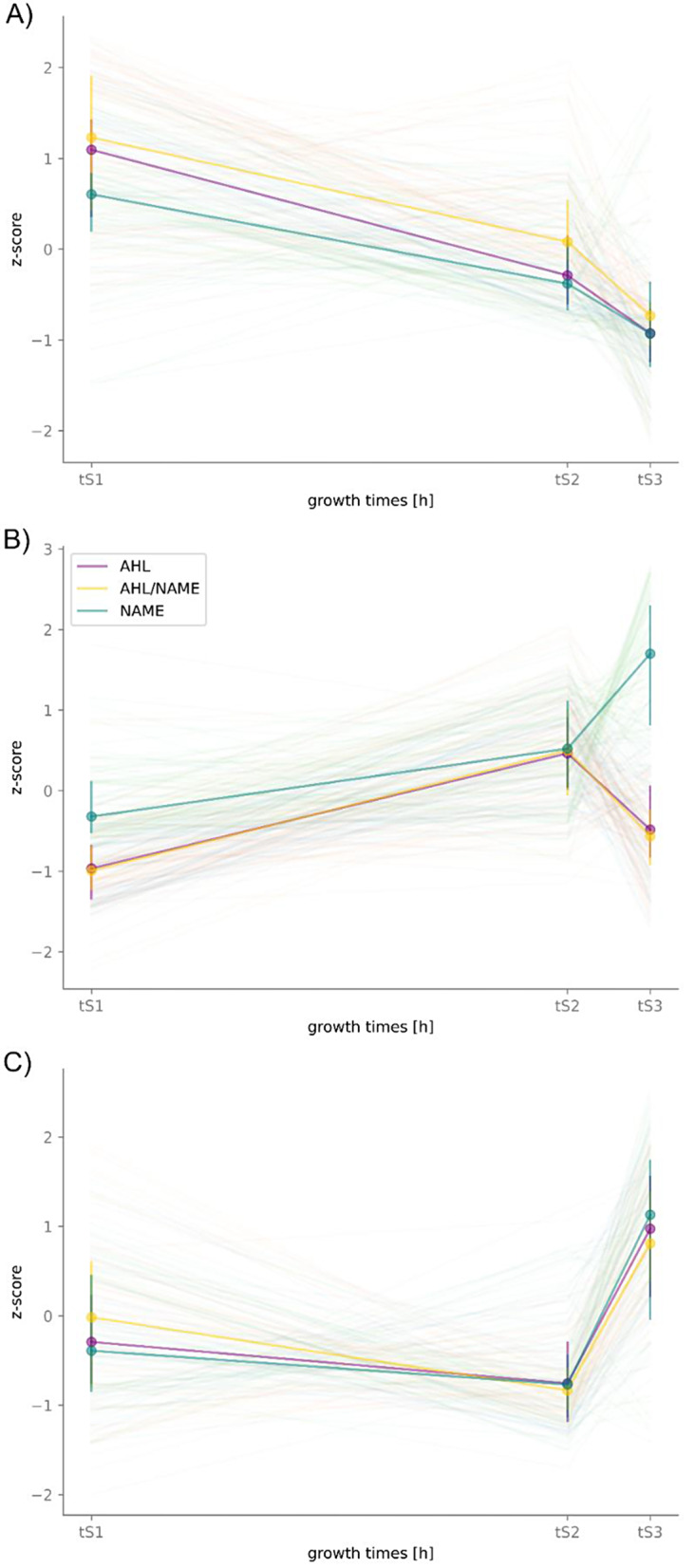
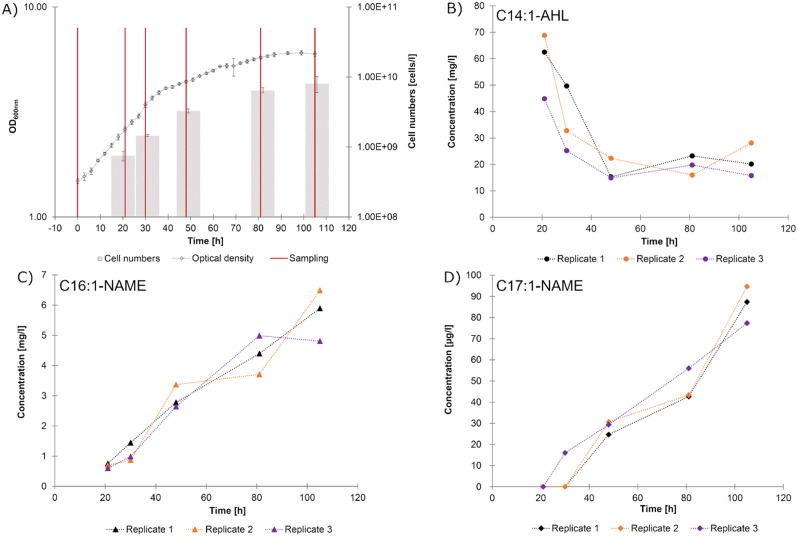
To enable dose-dependent bioactivity-testing, we have established a chromatographic method for quantification of NAMEs in bacterial culture extracts. The concentrations determined for the two major NAMEs produced by EL-164, C16:1-NAME and C17:1-NAME, ranged between 0.685 and 5.731 mg L (2.0-16.9 µM) and 5.3-86.4 µg L (15.0-244.3 nM), respectively. Co-quantification of the C14:1-AHL showed concentrations ranging between 17.5 and 58.7 mg L (56.6-189.7 µM). We observed distinct production patterns for NAMEs and AHLs, with a continuous NAME production during the entire incubation period. We conducted a spike-in experiment, using the determined metabolite concentrations. By comparing the transcriptomes of pre- and post-metabolite-spikes, we identified three clusters of differentially expressed genes with distinct temporal expression patterns. Expression levels of stress response genes differed between NAME- and AHL-spiked EL-164 cultures in the stationary phase.
Our findings support previous studies suggesting an ecological role for C16:1-NAME as antibiotic, by proving that NAME concentrations in batch cultures were higher than the minimal inhibitory concentrations against Maribacter sp. 62 - 1 (Flavobacteriia) and Skeletonema costatum CCMP 1332 (Coscinodiscophyceae) reported in the literature. Our study further exemplified the broad application range of dose-dependent testing and highlighted the different biological activities of NAMEs and AHLs.
先前的研究已经在 Roseovarius tolerans EL-164(红杆菌科)的培养物提取物中鉴定出结构多样的 N-酰基氨基酸甲酯(NAMEs)。NAMEs 是常见信号化合物 N-酰基高丝氨酸内酯(AHLs)的结构类似物,但不参与 AHL 介导的信号转导。NAMEs 表现出轻微的抗藻类和抗菌活性,但这种活性是否作为主要的生态作用尚不清楚。
为了能够进行剂量依赖性生物活性测试,我们建立了一种用于定量测定细菌培养物提取物中 NAMEs 的色谱方法。从 EL-164 产生的两种主要 NAMEs(C16:1-NAME 和 C17:1-NAME)的浓度范围分别为 0.685 至 5.731 mg L(2.0-16.9 µM)和 5.3 至 86.4 µg L(15.0-244.3 nM),而共定量的 C14:1-AHL 浓度范围为 17.5 至 58.7 mg L(56.6-189.7 µM)。我们观察到 NAMEs 和 AHLs 的生产模式明显不同,在整个孵育期间持续产生 NAME。我们进行了一个加标实验,使用确定的代谢物浓度。通过比较加标前后的转录组,我们确定了三个具有不同时间表达模式的差异表达基因簇。在静止期,NAME 和 AHL 加标 EL-164 培养物的应激反应基因表达水平不同。
我们的研究结果支持了先前的研究,即 C16:1-NAME 作为抗生素的生态作用,通过证明分批培养物中的 NAME 浓度高于文献中报道的对 Maribacter sp. 62-1(黄杆菌)和 Skeletonema costatum CCMP 1332(Coscinodiscophyceae)的最小抑菌浓度来证明这一点。我们的研究进一步例证了剂量依赖性测试的广泛应用范围,并强调了 NAMEs 和 AHLs 的不同生物学活性。