Head and Neck Surgery Department, Sichuan Clinical Research Center for Cancer, Sichuan Cancer Hospital and Institute, Sichuan Cancer Center, Affiliated Cancer Hospital of University of Electronic Science and Technology of China, Chengdu, 610041, China.
Department of Oral and Maxillofacial Surgery, School of Stomatology, Guizhou Medical University, Guiyang, 550004, China.
BMC Cancer. 2024 Nov 21;24(1):1434. doi: 10.1186/s12885-024-13116-6.
Circulating tumour DNA (ctDNA) has emerged as a valuable liquid biopsy biomarker in the field of oncology, including head and neck squamous cell carcinomas (HNSCCs), offering potential insights into cancer diagnosis, progression, and prognosis. This review aims to comprehensively evaluate the utility of ctDNA as a prognostic biomarker in HNSCC.
PubMed and Ovid were searched as part of our review. Studies that investigated the relationship between ctDNA and prognosis in HNSCC patients were included. Outcomes extracted included basic characteristics, ctDNA details and survival data. Meta-analysis was performed on eligible studies to determine pooled progression-free/recurrence-free survival (RFS/PFS) and overall survival (OS).
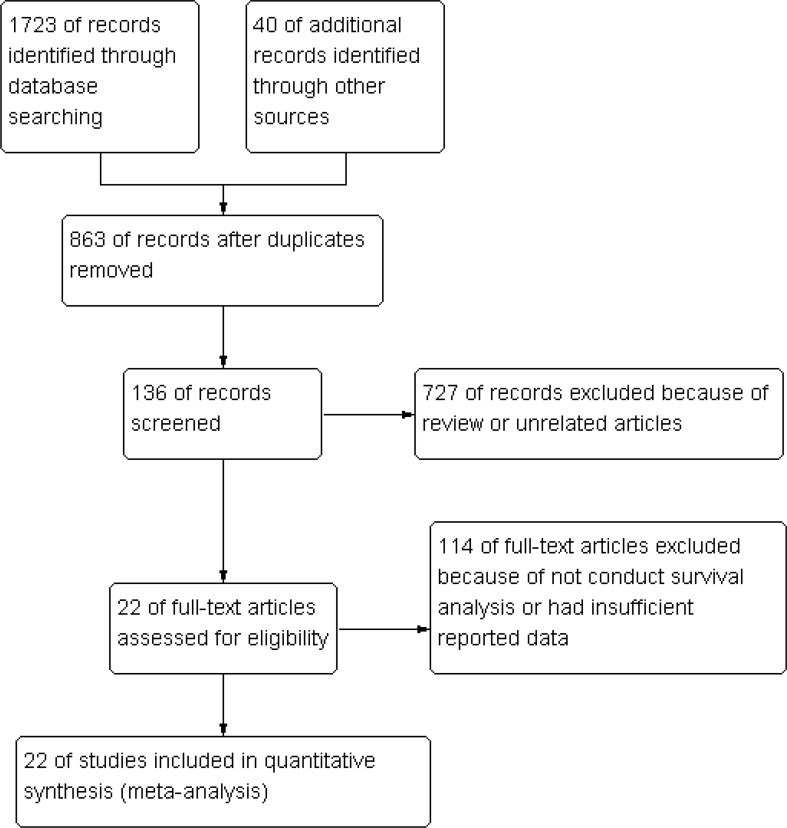
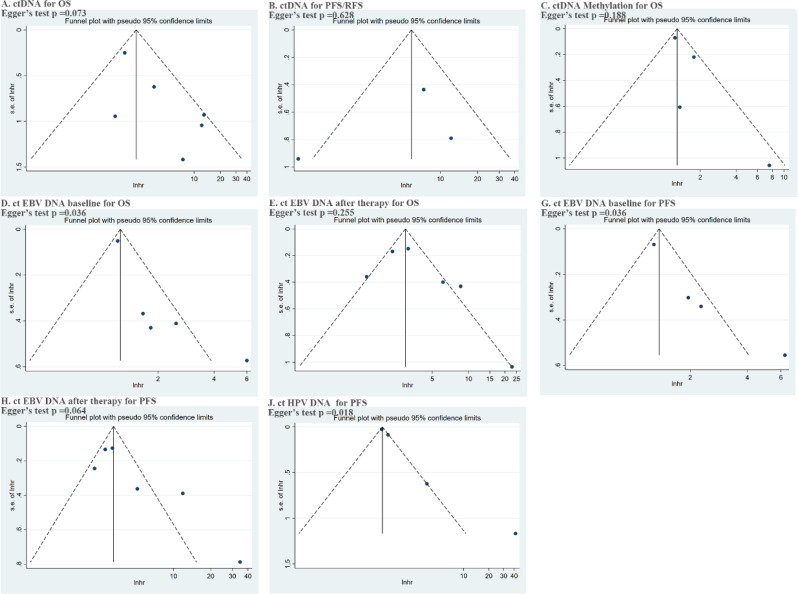
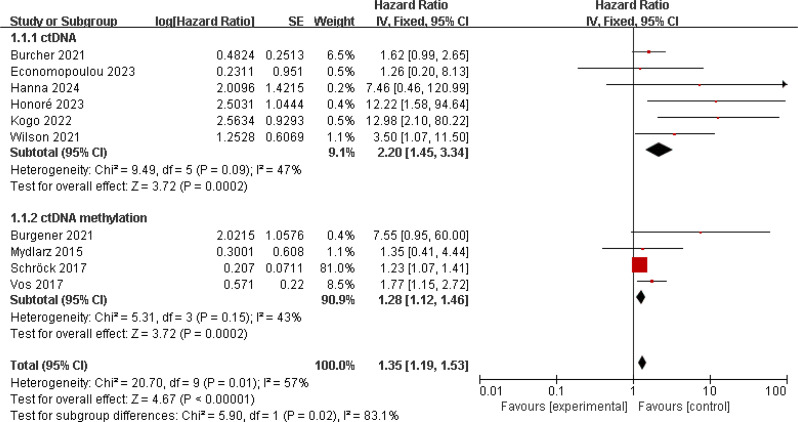
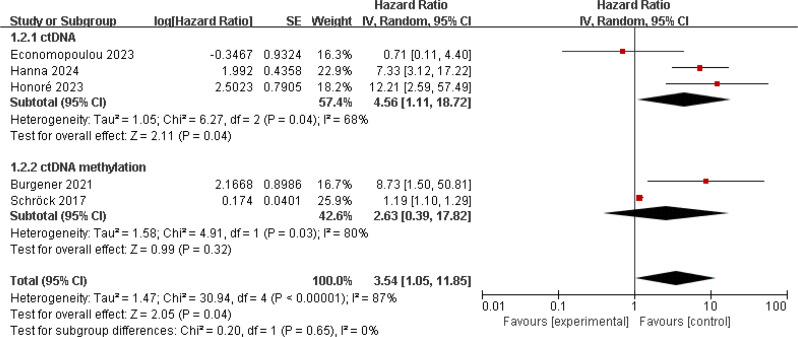
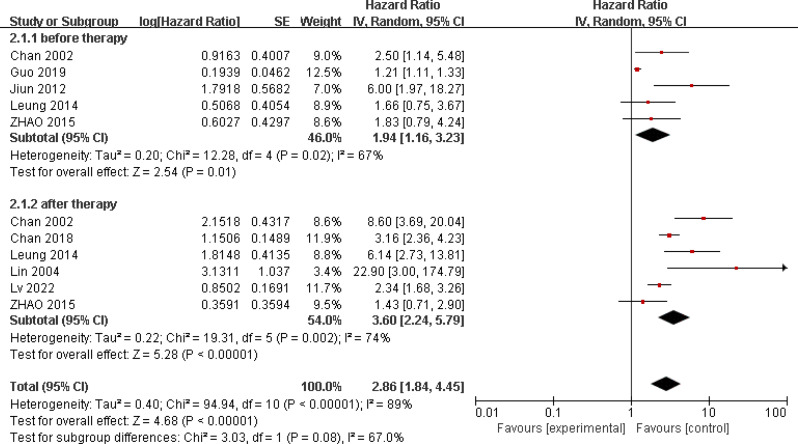
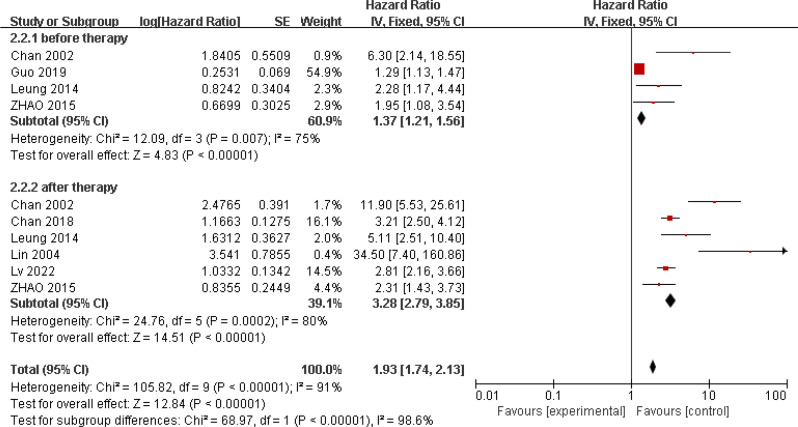
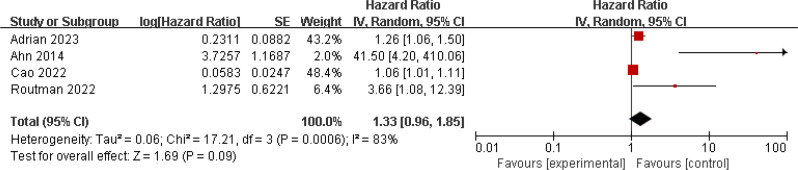
Twenty-two studies were included, involving 5062 HNSCC patients from 11 countries. The meta-analysis demonstrated that the positive ctDNA/methylation detection was associated with worse OS (HR = 2.00, 95% CI 1.35-2.96) and worse PFS/RFS (HR = 3.54, 95% CI 1.05-11.85). Positive ctEBV DNA was associated with poorer OS (HR = 2.86, 95% CI 1.84-4.45) and poorer PFS/RFS (HR = 1.93, 95% CI 1.74-2.13). Positive ctHPV DNA was associated with poorer OS (HR = 1.38, 95% CI 1.07-1.38) but not PFS/PFS (HR = 1.33, 95% CI 0.96-1.85).
Meta-analysis indicates that the status of ctDNA is significantly associated with the prognosis of HNSCC patients, with ctDNA/methylation-negative patients demonstrating better PFS/RFS and OS.
循环肿瘤 DNA(ctDNA)作为一种有价值的液体活检生物标志物,在肿瘤学领域,包括头颈部鳞状细胞癌(HNSCC)中得到了广泛应用,为癌症的诊断、进展和预后提供了潜在的见解。本综述旨在全面评估 ctDNA 作为 HNSCC 预后生物标志物的效用。
我们的综述检索了 PubMed 和 Ovid。纳入了研究 ctDNA 与 HNSCC 患者预后之间关系的研究。提取的结果包括基本特征、ctDNA 细节和生存数据。对符合条件的研究进行荟萃分析,以确定无进展/无复发生存(PFS/RFS)和总生存(OS)的汇总数据。
纳入了 22 项研究,涉及来自 11 个国家的 5062 名 HNSCC 患者。荟萃分析表明,ctDNA/甲基化阳性检测与更差的 OS(HR=2.00,95%CI 1.35-2.96)和更差的 PFS/RFS(HR=3.54,95%CI 1.05-11.85)相关。ctEBV DNA 阳性与较差的 OS(HR=2.86,95%CI 1.84-4.45)和较差的 PFS/RFS(HR=1.93,95%CI 1.74-2.13)相关。ctHPV DNA 阳性与较差的 OS(HR=1.38,95%CI 1.07-1.38)相关,但与 PFS/RFS 无关(HR=1.33,95%CI 0.96-1.85)。
荟萃分析表明,ctDNA 的状态与 HNSCC 患者的预后显著相关,ctDNA/甲基化阴性患者的 PFS/RFS 和 OS 更好。