School of Educational Sciences, Chongqing Normal University, Chongqing, China.
Key Laboratory of Applied Psychology, Chongqing Normal University, Chongqing, China.
BMC Psychol. 2024 Nov 21;12(1):683. doi: 10.1186/s40359-024-02180-z.
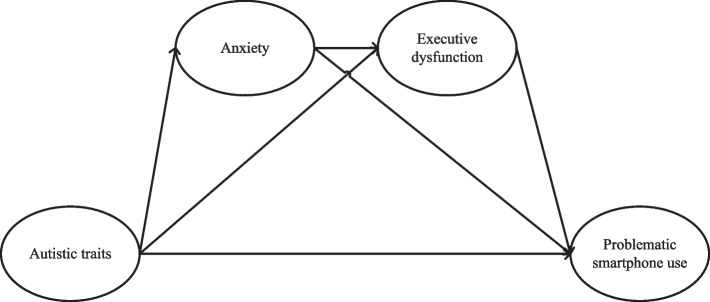
Based on the Interaction of Person-Affect-Cognition-Execution (I-PACE) model, this study aimed to explore the relationship between autistic traits and problematic smartphone use (PSU) among Chinese adolescents and to examine the serial mediation effect of anxiety and executive dysfunction in the association between autistic traits and PSU.
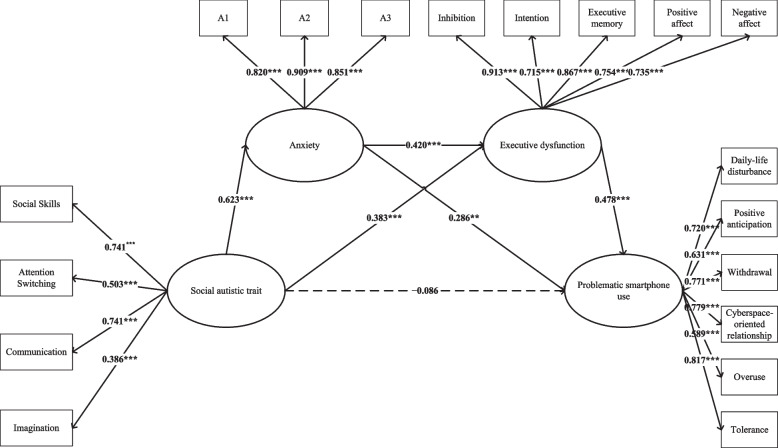
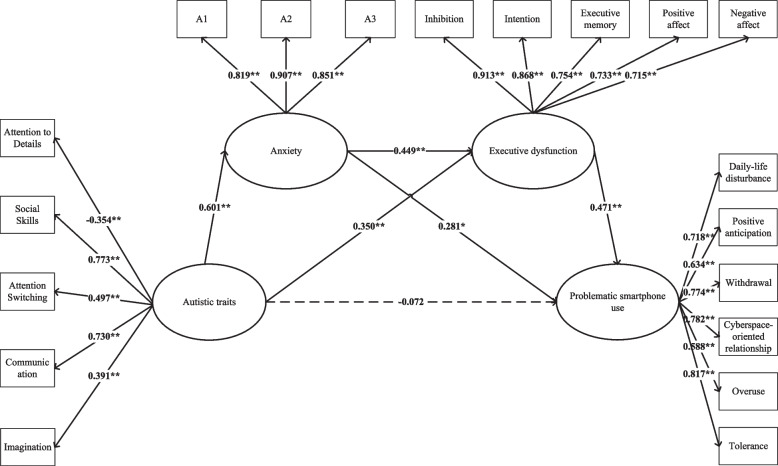
The Autism-Spectrum Quotient, Smartphone Addiction Scale, the trait version of the State-Trait Anxiety Inventory, and Dysexecutive Questionnaire were administered to a sample comprising 412 senior high school students (average age = 17.05 years, SD = 0.65). Structural equation models were utilized to explore the simple and serial mediating role of anxiety and executive dysfunction played in the association between autistic traits and PSU.
This study found that social rather than non-social autistic traits were positively associated with anxiety, executive dysfunction, and PSU. Furthermore, after controlling for gender, anxiety and executive dysfunction acted as sequential mediators in the connection between social autistic trait and PSU. However, non-social autistic trait did not predict anxiety, executive dysfunction, or PSU.
This study supports the I-PACE model and deepens understanding of PSU formation. Furthermore, the findings underscore the importance of addressing social challenges faced by adolescents with high autistic traits, providing a viable potential intervention pathway to promote healthy smartphone use in this population.
基于人际-情绪-认知-执行(I-PACE)模型,本研究旨在探讨中国青少年自闭症特质与智能手机使用问题(PSU)之间的关系,并检验焦虑和执行功能障碍在自闭症特质与 PSU 之间的关联中的序列中介效应。
本研究对 412 名高中生(平均年龄=17.05 岁,SD=0.65)进行了自闭症特质问卷、智能手机成瘾量表、状态-特质焦虑量表特质版和执行功能障碍问卷的测试。采用结构方程模型探讨了焦虑和执行功能障碍在自闭症特质与 PSU 之间的简单和序列中介作用。
本研究发现,社交而非非社交自闭症特质与焦虑、执行功能障碍和 PSU 呈正相关。此外,在控制了性别之后,焦虑和执行功能障碍在社交自闭症特质与 PSU 之间的关系中起到了序列中介作用。然而,非社交自闭症特质并不能预测焦虑、执行功能障碍或 PSU。
本研究支持 I-PACE 模型,并深化了对 PSU 形成的理解。此外,这些发现强调了关注高自闭症特质青少年所面临的社交挑战的重要性,为促进这一人群健康使用智能手机提供了可行的潜在干预途径。