Tarnas Maia C, Hamze Mohamed, Tajaldin Bachir, Sullivan Richard, Parker Daniel M, Abbara Aula
Department of Population Health and Disease Prevention, University of California, Irvine, USA.
Syrian American Medical Society, Washington, DC, USA.
Confl Health. 2024 Nov 21;18(1):70. doi: 10.1186/s13031-024-00630-4.
Attacks on healthcare have been committed throughout the Syrian conflict in violation of International Humanitarian Law (IHL), contributing to the devastation of the country's healthcare system. The conflict has also forcibly displaced over half of Syria's pre-conflict population, 7.2 million of whom are internally displaced. In this retrospective analysis, we aim to assess the relationships between (1) healthcare attacks and general conflict and (2) healthcare attacks and forced displacement between 2016 and 2022.
Data on healthcare attacks, conflict events, and displacement were extracted from the Syrian American Medical Society (SAMS), Uppsala Conflict Data Project, and OCHA Türkiye, respectively. The analysis addresses three research questions: the associations between (1) healthcare attacks and conflict events, (2) healthcare attacks and conflict events in the week after an attack on a healthcare facility, and (3) healthcare attacks and forced displacement. For each, we used generalized additive models with a negative binomial distribution that also accounted for spatial and temporal factors.
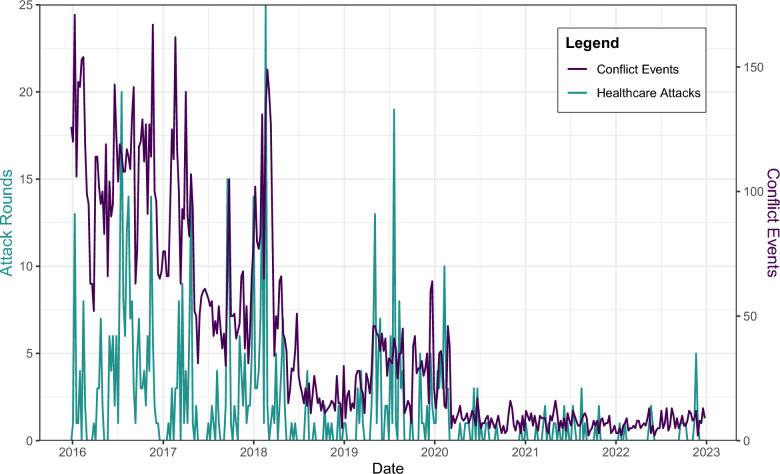
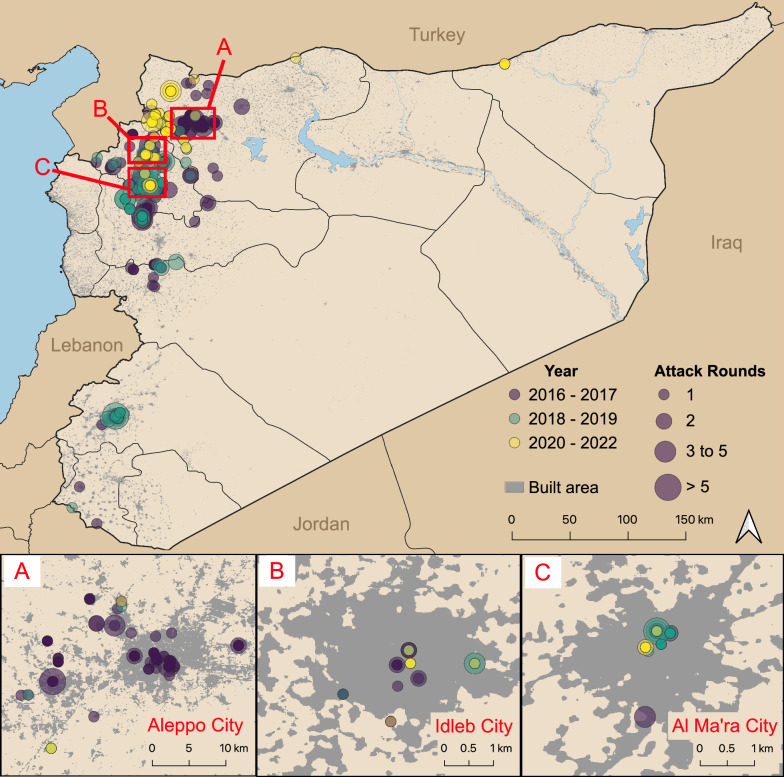
SAMS recorded a total of 541 attack events, comprising 650 attack rounds over 235 facilities between 2016 and 2022. Conflict events were significantly associated with healthcare attacks in the same week (IRR: 1.14, 95% CI 1.12-1.17), and healthcare attacks in one week were associated with a maximum of 1.44 greater risk (95% CI 1.08-1.91) of conflict events in the following week, even when accounting for general conflict levels in the previous weeks. Healthcare attacks were also significantly associated with increased displacement up to three months following the attacks.
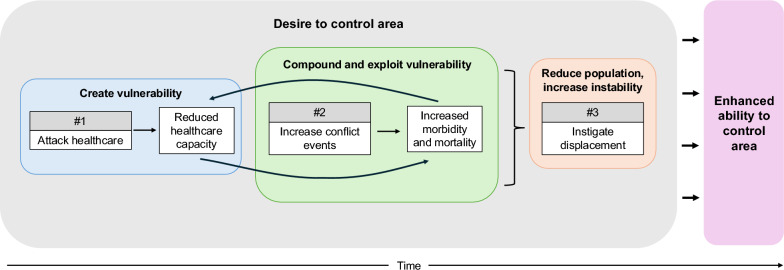
We find that healthcare facilities are not avoided during conflict (as obliged under IHL), and that healthcare attacks significantly precede an escalation of general conflict in the same area. Healthcare attacks are also significantly associated with displacement for months following the attacks, even when accounting for conflict levels. Based on these findings, we present a framework outlining one pathway through which healthcare attacks may contribute to larger conflict tactics. Our findings highlight the critical role of healthcare infrastructure in conflict and reaffirm calls to hold perpetrators of these attacks accountable.
在叙利亚冲突期间,违反国际人道法(IHL)的针对医疗保健的袭击时有发生,这加剧了该国医疗保健系统的破坏。冲突还迫使叙利亚冲突前人口的一半以上流离失所,其中720万人是境内流离失所者。在这项回顾性分析中,我们旨在评估2016年至2022年期间(1)医疗保健袭击与总体冲突之间以及(2)医疗保健袭击与被迫流离失所之间的关系。
医疗保健袭击、冲突事件和流离失所的数据分别从叙利亚美国医学协会(SAMS)、乌普萨拉冲突数据项目和联合国人道主义事务协调厅土耳其办公室提取。该分析涉及三个研究问题:(1)医疗保健袭击与冲突事件之间;(2)医疗设施遭到袭击后一周内医疗保健袭击与冲突事件之间;(3)医疗保健袭击与被迫流离失所之间的关联。对于每个问题,我们使用了具有负二项分布的广义相加模型,该模型还考虑了空间和时间因素。
叙利亚美国医学协会记录了2016年至2022年期间共541起袭击事件,包括对235个设施的650轮袭击。冲突事件与同一周内的医疗保健袭击显著相关(发病率比:1.14,95%置信区间1.12 - 1.17),即使考虑到前几周的总体冲突水平,一周内的医疗保健袭击与下一周冲突事件的最大风险增加1.44相关(95%置信区间1.08 - 1.91)。医疗保健袭击还与袭击后长达三个月内流离失所情况的增加显著相关。
我们发现,在冲突期间(根据国际人道法的规定),医疗设施并未得到避免,而且医疗保健袭击显著先于同一地区总体冲突的升级。即使考虑到冲突水平,医疗保健袭击在袭击后的数月内也与流离失所情况显著相关。基于这些发现,我们提出了一个框架,概述了医疗保健袭击可能促成更大规模冲突策略的一种途径。我们的研究结果凸显了医疗基础设施在冲突中的关键作用,并重申了要求追究这些袭击肇事者责任的呼声。