Lorsung Rebecca, Cramer Nathan, Alipio Jason Bondoc, Ji Yadong, Han Sung, Masri Radi, Keller Asaf
Department of Neurobiology, School of Medicine, University of Maryland, Baltimore, Maryland 21201, USA.
Center to Advance Chronic Pain Research, University of Maryland School of Medicine, Baltimore, MD 21201, USA.
bioRxiv. 2024 Nov 9:2024.11.09.622728. doi: 10.1101/2024.11.09.622728.
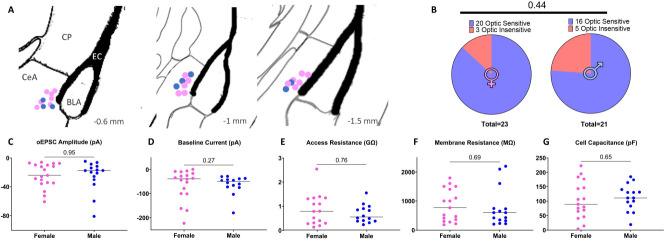
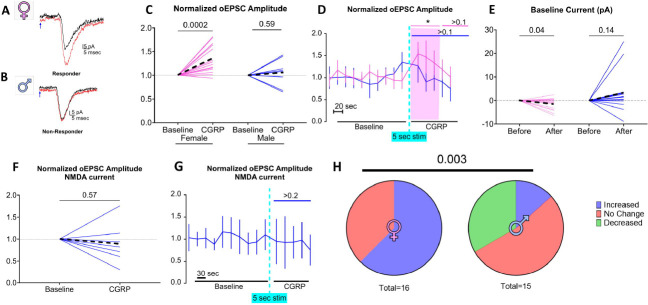
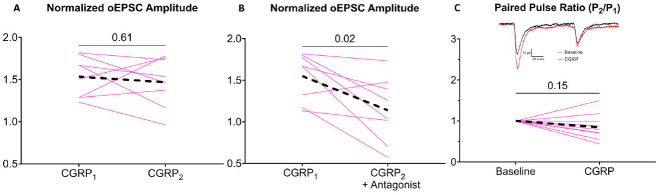
Women are disproportionately affected by chronic pain compared to men. While societal and environmental factors contribute to this disparity, sex-based biological differences in the processing of pain are also believed to play significant roles. The central lateral nucleus of the amygdala (CeLC) is a key region for the emotional-affective dimension of pain, and a prime target for exploring sex differences in pain processing since a recent study demonstrated sex differences in CGRP actions in this region. Inputs to CeLC from the parabrachial nucleus (PB) play a causal role in aversive processing, and release both glutamate and calcitonin gene-related peptide (CGRP). CGRP is thought to play a crucial role in chronic pain by potentiating glutamatergic signaling in CeLC. However, it is not known if this CGRP-mediated synaptic plasticity occurs similarly in males and females. Here, we tested the hypothesis that female CeLC neurons experience greater potentiation of glutamatergic signaling than males following CGRP exposure. Using trains of optical stimuli to evoke transient CGRP release from PB terminals in CeLC, we find that subsequent glutamatergic responses are preferentially potentiated in CeLC neurons from female mice. This potentiation was CGRP-dependent and involved a postsynaptic mechanism. This sex difference in CGRP sensitivity may explain sex differences in affective pain processing.
与男性相比,女性受慢性疼痛的影响更为严重。虽然社会和环境因素导致了这种差异,但疼痛处理过程中基于性别的生物学差异也被认为起着重要作用。杏仁核中央外侧核(CeLC)是疼痛情感维度的关键区域,也是探索疼痛处理过程中性别差异的主要靶点,因为最近的一项研究表明该区域降钙素基因相关肽(CGRP)作用存在性别差异。臂旁核(PB)向CeLC的输入在厌恶处理中起因果作用,并释放谷氨酸和降钙素基因相关肽(CGRP)。CGRP被认为通过增强CeLC中的谷氨酸能信号传导在慢性疼痛中起关键作用。然而,尚不清楚这种CGRP介导的突触可塑性在雄性和雌性中是否以类似方式发生。在这里,我们测试了这样一个假设,即与雄性相比,雌性CeLC神经元在暴露于CGRP后经历更大程度的谷氨酸能信号增强。我们使用一系列光刺激来诱发CeLC中PB终末瞬时释放CGRP,发现随后的谷氨酸能反应在雌性小鼠的CeLC神经元中优先增强。这种增强依赖于CGRP,并涉及一种突触后机制。CGRP敏感性的这种性别差异可能解释情感性疼痛处理中的性别差异。