Li Mengjie, Tian Aiguo, Jiang Jin
Department of Molecular Biology, University of Texas Southwestern Medical Center at Dallas, Dallas, TX 75390.
Department of Pharmacology, University of Texas Southwestern Medical Center at Dallas, Dallas, TX 75390.
bioRxiv. 2025 Feb 15:2024.11.06.622285. doi: 10.1101/2024.11.06.622285.
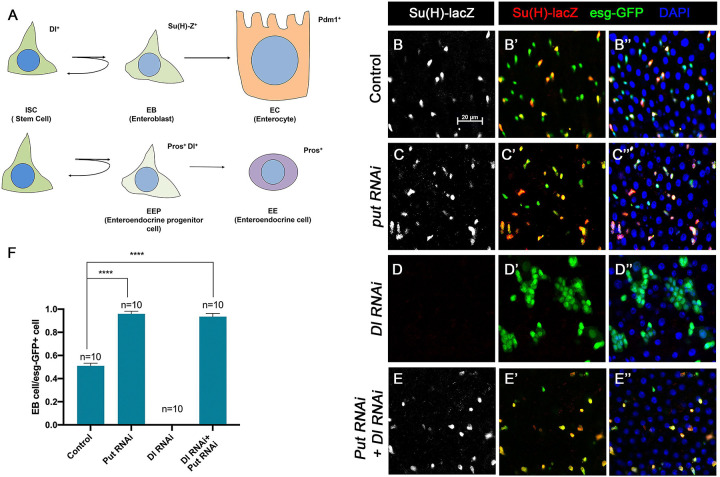
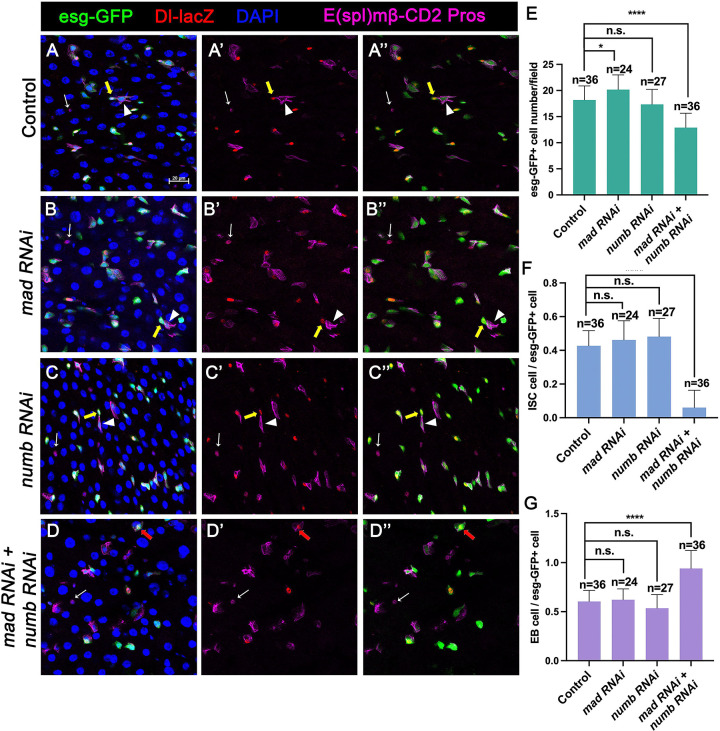
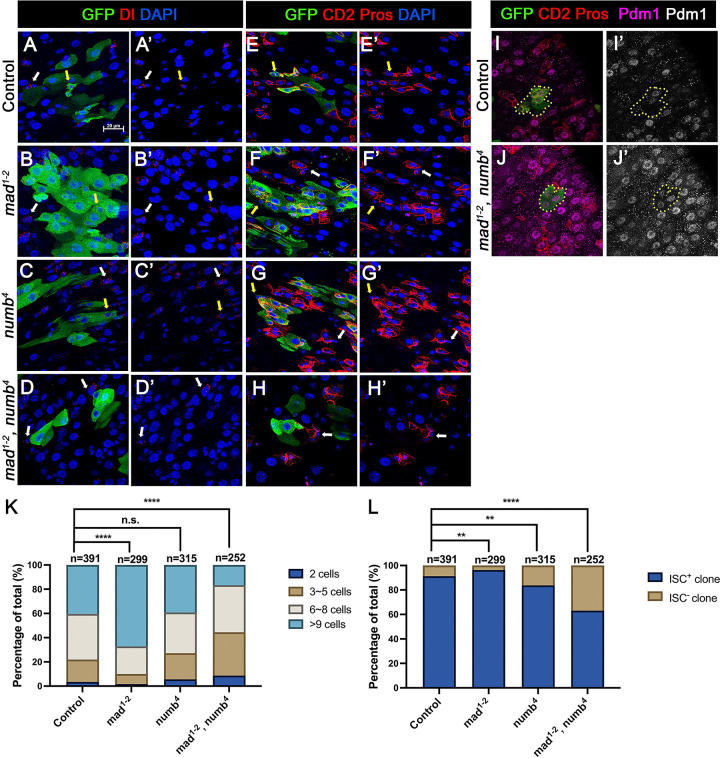
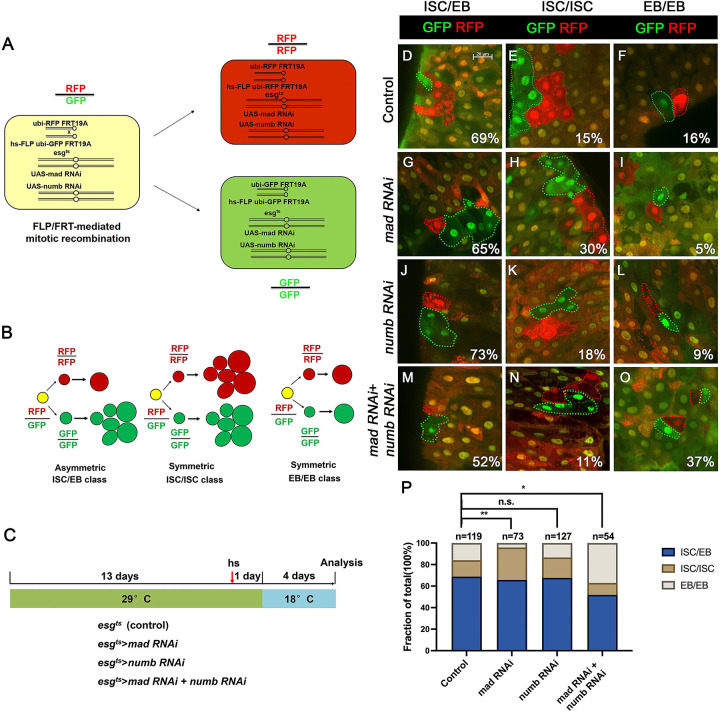
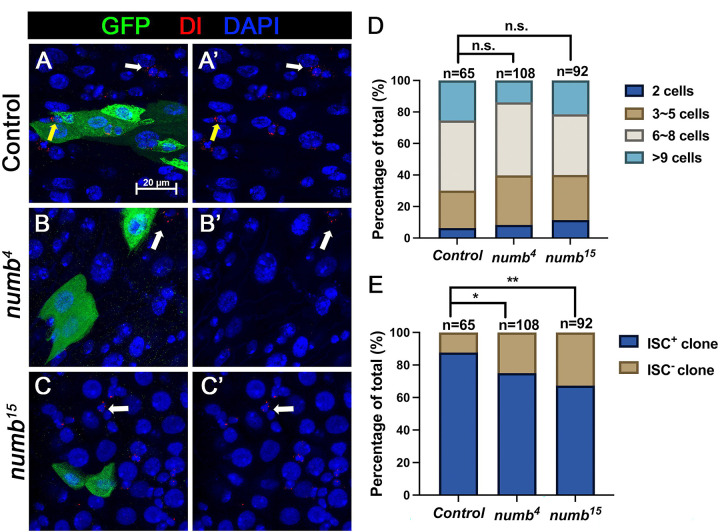
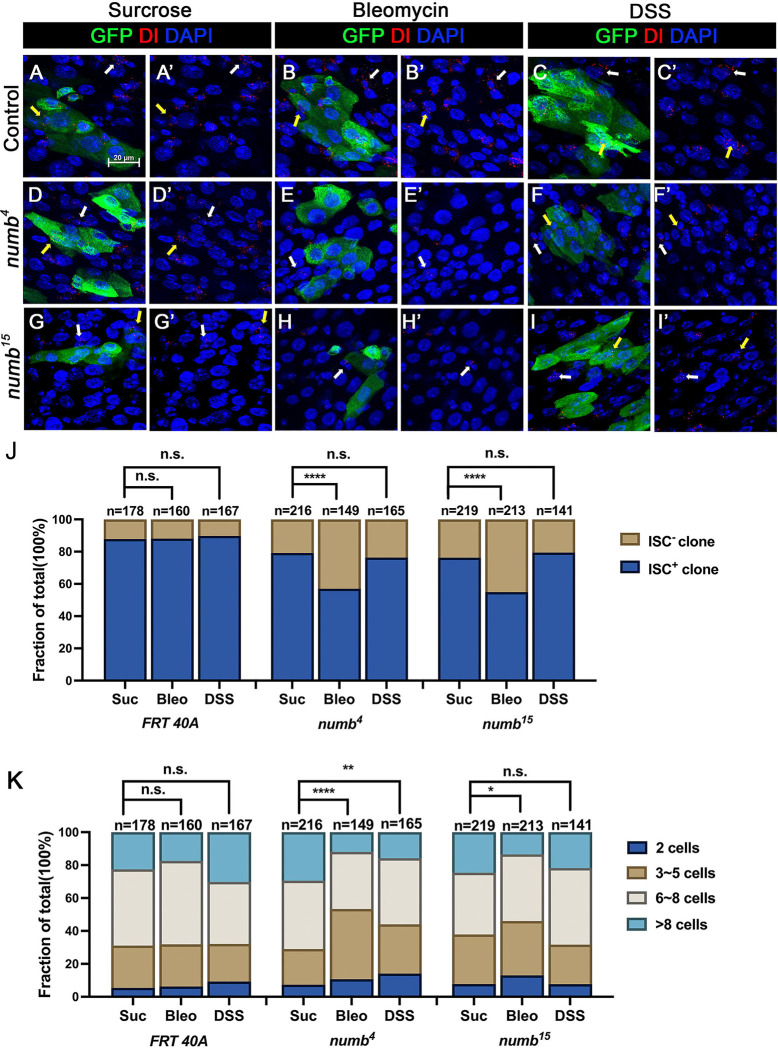
Stem cell self-renewal often relies on asymmetric fate determination governed by niche signals and/or cell-intrinsic factors but how these regulatory mechanisms cooperate to promote asymmetric fate decision remains poorly understood. In adult midgut, asymmetric Notch (N) signaling inhibits intestinal stem cell (ISC) self-renewal by promoting ISC differentiation into enteroblast (EB). We have previously shown that epithelium-derived BMP promotes ISC self-renewal by antagonizing N pathway activity (Tian and Jiang, 2014). Here we show that loss of BMP signaling results in ectopic N pathway activity even when the N ligand Delta (Dl) is depleted, and that the N inhibitor Numb acts in parallel with BMP signaling to ensure a robust ISC self-renewal program. Although Numb is asymmetrically segregated in about 80% of dividing ISCs, its activity is largely dispensable for ISC fate determination under normal homeostasis. However, Numb becomes crucial for ISC self-renewal when BMP signaling is compromised. Whereas neither Mad RNAi nor its hypomorphic mutation led to ISC loss, inactivation of Numb in these backgrounds resulted in stem cell loss due to precocious ISC-to-EB differentiation. Furthermore, we find that mutations resulted in stem cell loss during midgut regeneration in response to epithelial damage that causes fluctuation in BMP pathway activity, suggesting that the asymmetrical segregation of Numb into the future ISC may provide a fail-save mechanism for ISC self-renewal by offsetting BMP pathway fluctuation, which is important for ISC maintenance in regenerative guts.
干细胞自我更新通常依赖于由龛信号和/或细胞内在因素控制的不对称命运决定,但这些调节机制如何协同作用以促进不对称命运决定仍知之甚少。在成体中肠中,不对称的Notch(N)信号通过促进肠干细胞(ISC)分化为成肠细胞(EB)来抑制ISC自我更新。我们之前已经表明,上皮来源的BMP通过拮抗N信号通路活性来促进ISC自我更新(Tian和Jiang,2014)。在这里,我们表明,即使N配体Delta(Dl)被耗尽,BMP信号的缺失也会导致异位N信号通路活性,并且N抑制剂Numb与BMP信号并行发挥作用,以确保强大的ISC自我更新程序。尽管Numb在约80%的正在分裂的ISC中不对称分离,但其活性在正常稳态下对ISC命运决定在很大程度上是可有可无的。然而,当BMP信号受损时,Numb对ISC自我更新变得至关重要。虽然Mad RNA干扰及其亚效突变都不会导致ISC丢失,但在这些背景下Numb的失活会导致干细胞因ISC过早分化为EB而丢失。此外,我们发现,在对导致BMP信号通路活性波动的上皮损伤做出反应的中肠再生过程中,突变导致干细胞丢失,这表明Numb不对称分离到未来的ISC中可能通过抵消BMP信号通路波动为ISC自我更新提供一种故障保护机制,这对于再生肠道中ISC的维持很重要。