Aqeel Gulfisha, Kumar Atosh, Kaur Samarjeet, Rastogi Munish, Rastogi Dolly, Singh Jayvardhan
Physiology, Ganesh Shankar Vidyarthi Memorial Medical College, Kanpur, IND.
Community Medicine, Ganesh Shankar Vidyarthi Memorial Medical College, Kanpur, IND.
Cureus. 2024 Oct 22;16(10):e72125. doi: 10.7759/cureus.72125. eCollection 2024 Oct.
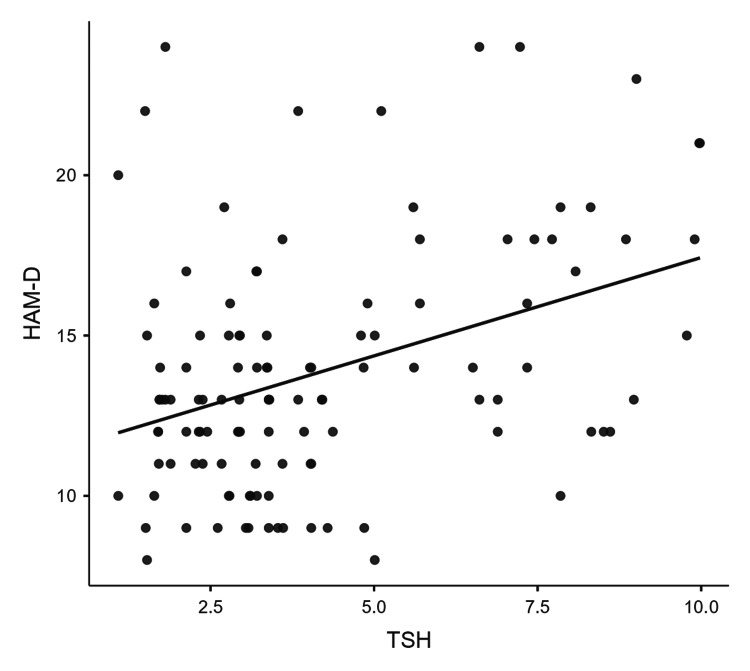
Background The hypothalamic-pituitary-adrenal (HPA) axis and the hypothalamic-pituitary-thyroid (HPT) axis are two neuroendocrine systems that play a crucial role in maintaining homeostasis and regulating mood alterations. These axes have also been implicated in the development and progression of unipolar depression (UD). This study aims to investigate the role of serum cortisol and thyroid function tests on the severity of depression among patients with UD attending the psychiatry department. The severity of depression was assessed using the Hamilton depression rating scale (HAM-D). Methodology In this cross-sectional study, 58 cases of UD were taken, and their serum cortisol levels and thyroid function tests were compared with the same-age and sex-matched controls with no psychiatric disorder. Result The serum cortisol levels were high among patients with UD as compared to controls, but these high values were not statistically significant (p-value >0.05). Serum triiodothyronine (T3) and thyroxine (T4) were lower among patients with UD as compared to controls. Serum thyrotropin (TSH) levels were significantly higher among patients with UD as compared to controls. Regression analysis revealed a linear relationship between levels of serum TSH and HAM-D score. Conclusion In conclusion, our study emphasizes the significance of the thyroid profile, especially TSH levels, in relation to depression and its severity.
背景 下丘脑 - 垂体 - 肾上腺(HPA)轴和下丘脑 - 垂体 - 甲状腺(HPT)轴是两个神经内分泌系统,在维持体内平衡和调节情绪变化方面发挥着关键作用。这些轴也与单相抑郁症(UD)的发生和发展有关。本研究旨在调查血清皮质醇和甲状腺功能测试对精神科就诊的UD患者抑郁严重程度的作用。使用汉密尔顿抑郁评定量表(HAM-D)评估抑郁严重程度。
方法 在这项横断面研究中,选取了58例UD患者,并将他们的血清皮质醇水平和甲状腺功能测试结果与年龄和性别匹配的无精神疾病对照组进行比较。
结果 与对照组相比,UD患者的血清皮质醇水平较高,但这些高值无统计学意义(p值>0.05)。与对照组相比,UD患者的血清三碘甲状腺原氨酸(T3)和甲状腺素(T4)较低。与对照组相比,UD患者的血清促甲状腺激素(TSH)水平显著更高。回归分析显示血清TSH水平与HAM-D评分之间存在线性关系。
结论 总之,我们的研究强调了甲状腺指标,尤其是TSH水平,与抑郁症及其严重程度的相关性。