
使用费曼图分析复杂激发模式。
Analysis of complex excitation patterns using Feynman-like diagrams.
机构信息
Department of Mathematics, KU Leuven Campus Kortrijk (KULAK), Etienne Sabbelaan 53, 8500, Kortrijk, Belgium.
iSi Health, Institute of Physics-based Modeling for In Silico Health, KU Leuven, Oude Markt 13, 3000, Leuven, Belgium.
出版信息
Sci Rep. 2024 Nov 22;14(1):28962. doi: 10.1038/s41598-024-73544-z.
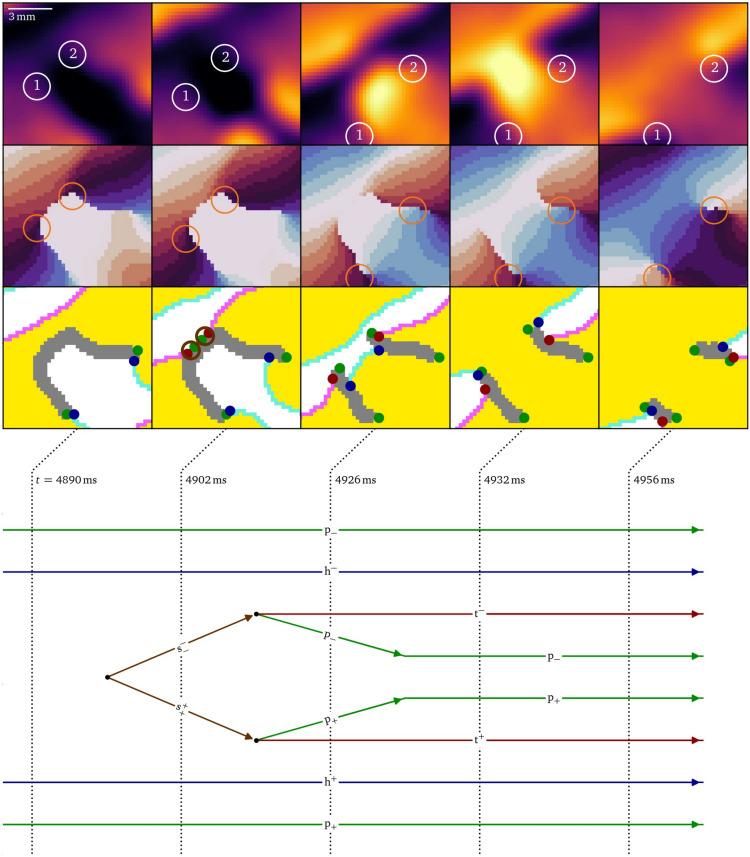
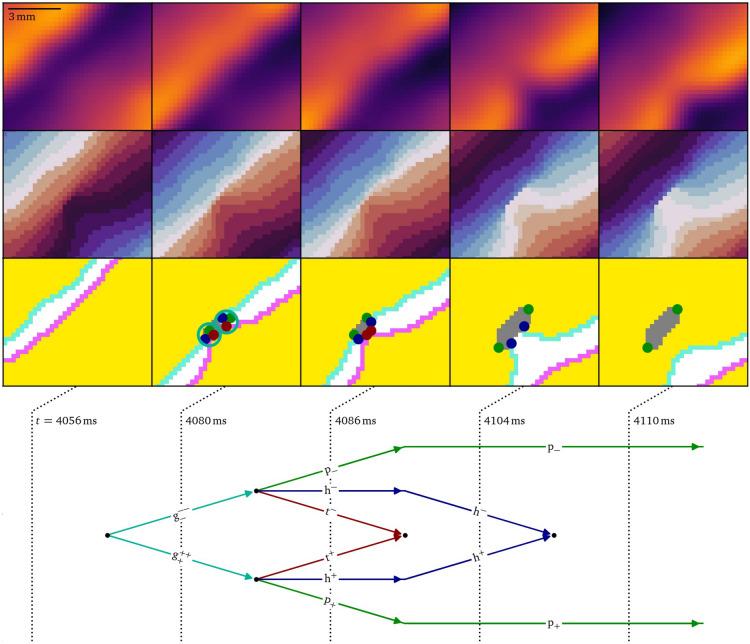
Many extended chemical and biological systems self-organise into complex patterns that drive the medium behaviour in a non-linear fashion. An important class of such systems are excitable media, including neural and cardiac tissues. In extended excitable media, wave breaks can form rotating patterns and turbulence. However, the onset, sustaining and elimination of such complex patterns is currently incompletely understood. The classical theory of phase singularities in excitable media was recently challenged, as extended lines of conduction block were identified as phase discontinuities. Here, we provide a theoretical framework that captures the rich dynamics in excitable systems in terms of three quasiparticles: heads, tails, and pivots. We propose to call these quasiparticles 'cardions'. In simulations and experiments, we show that these basic building blocks combine into at least four different bound states. By representing their interactions similarly to Feynman diagrams in physics, the creation and annihilation of vortex pairs are shown to be sequences of dynamical creation, annihilation, and recombination of the identified quasiparticles. We draw such diagrams for numerical simulations, as well as optical voltage mapping experiments performed on cultured human atrial myocytes (hiAMs). Our results provide a new, unified language for a more detailed theory, analysis, and mechanistic insights of dynamical transitions in excitation patterns.
许多扩展的化学和生物系统会自我组织成复杂的模式,以非线性的方式驱动介质行为。这类系统的一个重要类别是激活动力学系统,包括神经和心脏组织。在扩展的激活动力学系统中,波破裂可以形成旋转模式和湍流。然而,这种复杂模式的起始、维持和消除目前还不完全清楚。最近,激活动力学系统中相位奇点的经典理论受到了挑战,因为已经确定扩展的传导阻滞线是相位不连续的。在这里,我们提供了一个理论框架,可以根据三个准粒子(head、tail 和 pivot)来描述激活动力学系统中的丰富动力学。我们建议将这些准粒子称为“cardions”。在模拟和实验中,我们表明这些基本构建块可以组合成至少四种不同的束缚态。通过类似于物理学中费曼图的方式表示它们的相互作用,表明涡对的产生和湮灭是动态地创建、湮灭和重组所识别的准粒子的序列。我们为数值模拟绘制了这样的图,以及在培养的人心房肌细胞(hiAMs)上进行的光学电压映射实验。我们的结果为更详细的理论、分析和动力学激发模式转变的机制提供了一个新的、统一的语言。




 Zotero 插件