Department of Radiology and Nuclear Medicine, Xuanwu Hospital, Capital Medical University, Beijing, China.
Beijing Key Laboratory of Magnetic Resonance Imaging and Brain Informatics, Capital Medical University, Beijing, China.
Cancer Imaging. 2024 Nov 25;24(1):161. doi: 10.1186/s40644-024-00805-5.
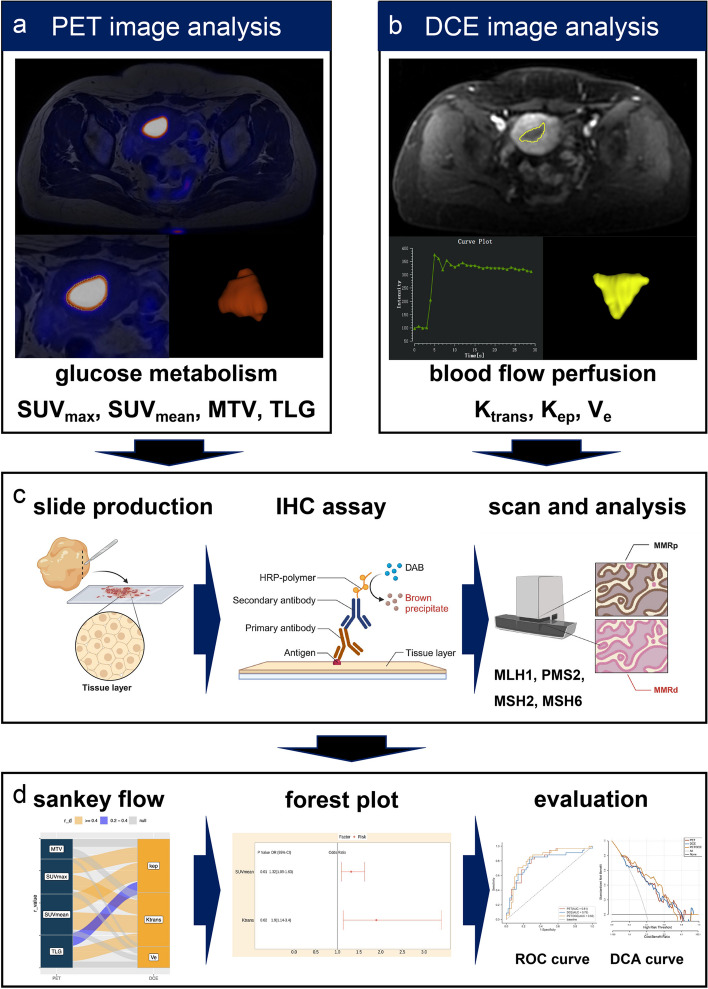
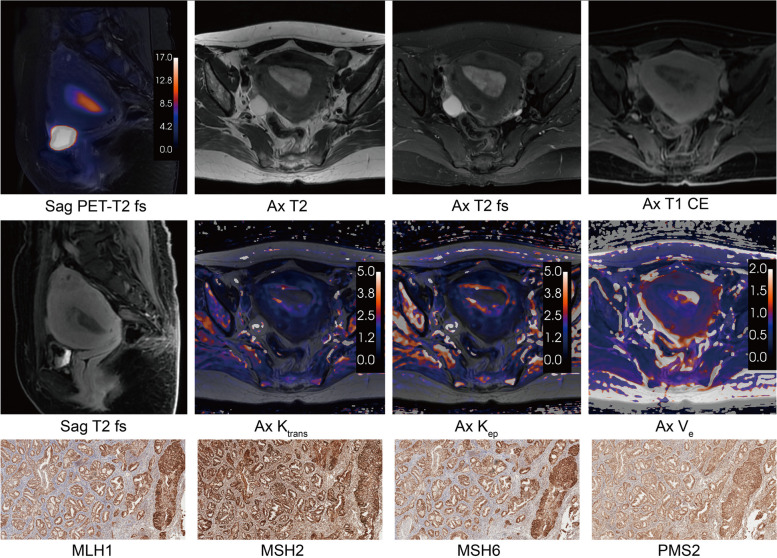
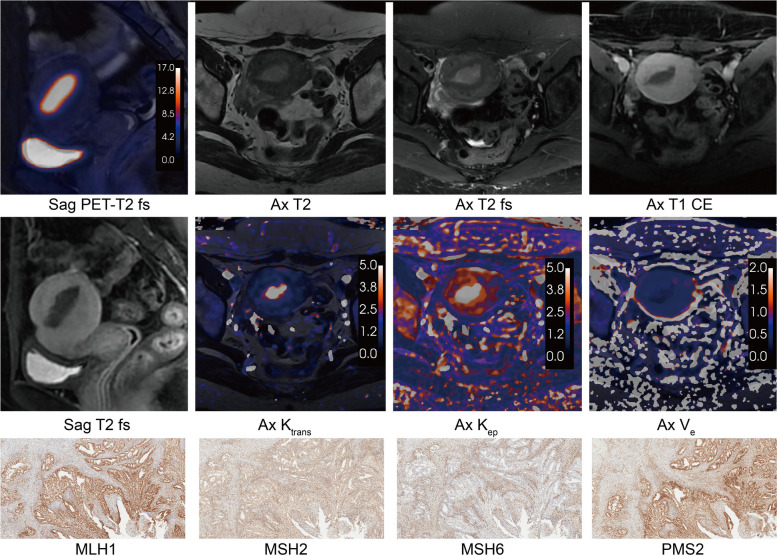
Identifying DNA mismatch repair deficiency (MMRd) is important for prognosis risk stratification in patients with early-stage endometrial cancer (EC), but there is a notable absence of cost-effective and non-invasive preoperative assessment techniques. The study explored the co-reactivity pattern of glucose metabolism and blood perfusion in EC based on hybrid [F]fluorodeoxyglucose ([F]FDG) PET/dynamic contrast enhanced (DCE)-MRI to provide an imaging biomarker for identifying MMRd.
Patients with a history of postmenopausal bleeding and initially diagnosed with EC on ultrasound were recruited to perform a PET/DCE-MRI scan. Glucose metabolism parameters were calculated on PET, and blood perfusion parameters were calculated semi-automatically by the DCE-Tofts pharmacokinetic model. The MMRd of early-stage EC was evaluated by immunohistochemistry. The synchronous variation of PET and DCE-MRI parameters was compared between the MMRd and mismatch repair proficiency (MMRp). The association between PET/DCE-MRI and MMRd was analyzed by logistic regression to establish the digital biomarker for predicting MMRd. Receiver operating characteristic curve, decision curve analysis, and the net reclassification index (NRI) were used to evaluate the value of the digital biomarker in identifying MMRd.
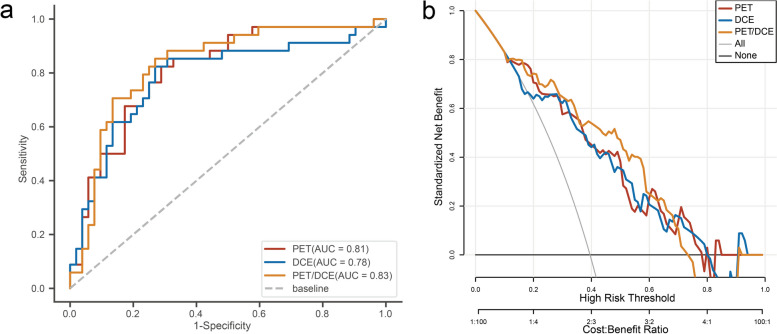
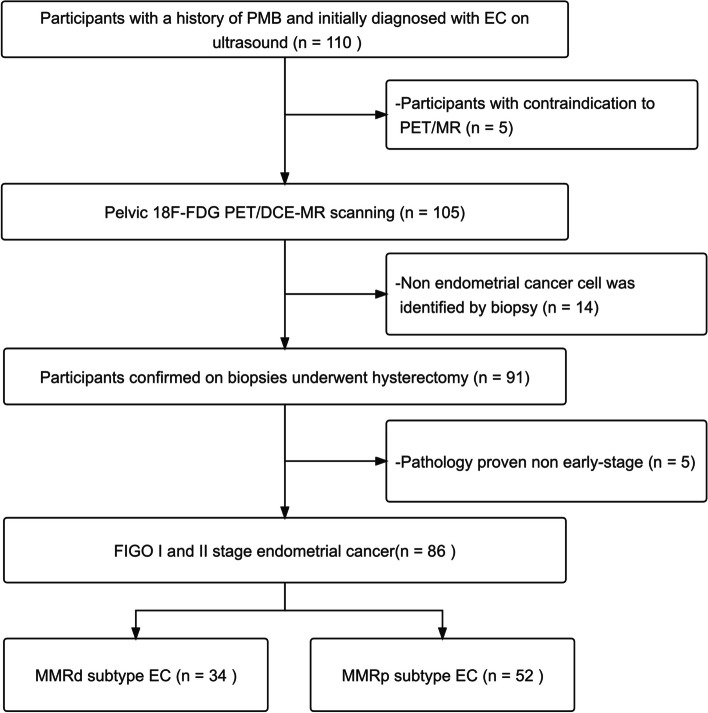
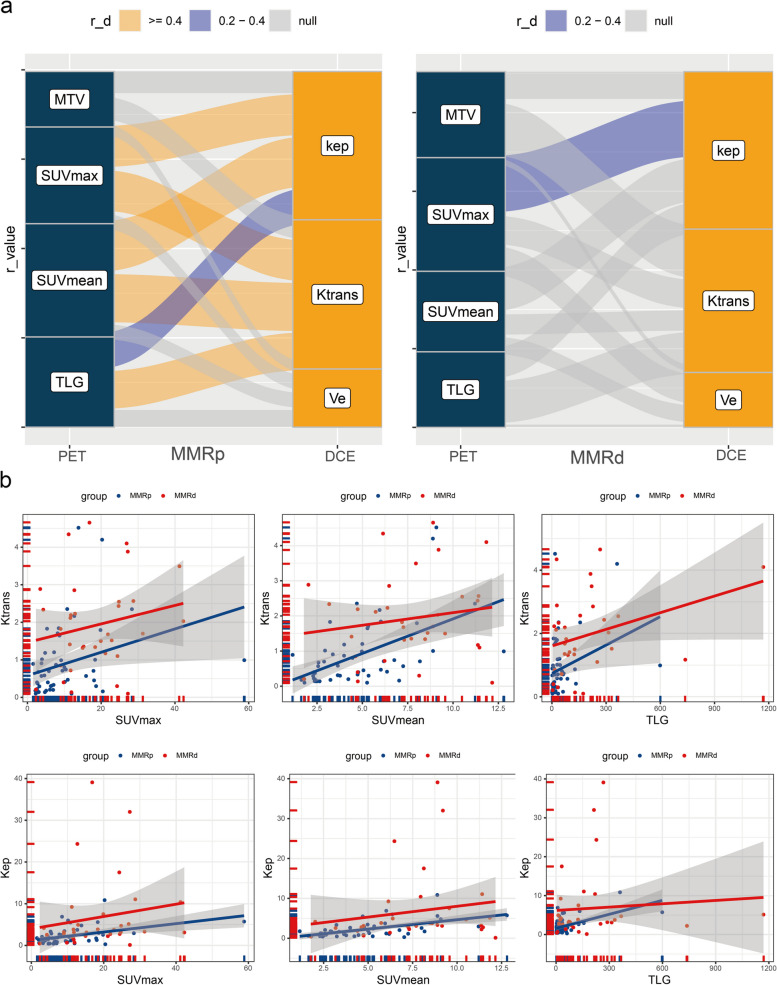
Eighty-six early-stage EC cases (58.92 ± 10.13 years old, 34 MMRd) were enrolled. The max/mean standardized uptake value (SUV/SUV), metabolic tumor volume, total lesion glycolysis, transfer constant (K), and efflux rate (K) were higher in MMRd than those in MMRp (P < 0.001, < 0.001, 0.002, 0.004, < 0.001, and 0.005, respectively). The correlations between glucose metabolism and blood perfusion were different between the MMRd and MMRp subgroups. SUV was correlated with K (r = 0.36) in the MMRd. SUV (odds ratio [OR] = 1.32, P = 0.006) and K (OR = 1.90, P = 0.021) were independent risk factors for MMRd. And the digital biomarker that combined SUV and K outperformed in identifying MMRd in early-stage EC more than DCE-MRI (AUC: 0.83 vs. 0.78, NRI = 13%).
A potential digital biomarker based on [F]FDG PET/DCE-MRI can identify MMRd for prognosis risk stratification in early-stage EC.
识别 DNA 错配修复缺陷(MMRd)对于早期子宫内膜癌(EC)患者的预后风险分层很重要,但缺乏经济有效的非侵入性术前评估技术。本研究基于氟[18F]脱氧葡萄糖([18F]FDG)PET/动态对比增强(DCE)-MRI 探讨了 EC 中葡萄糖代谢和血液灌注的共同反应模式,以提供识别 MMRd 的影像学生物标志物。
招募有绝经后出血病史且超声初诊为 EC 的患者进行 PET/DCE-MRI 扫描。在 PET 上计算葡萄糖代谢参数,在 DCE-Tofts 药代动力学模型中半自动计算血液灌注参数。通过免疫组织化学评估早期 EC 的 MMRd。比较 MMRd 和错配修复能力(MMRp)之间 PET 和 DCE-MRI 参数的同步变化。通过逻辑回归分析 PET/DCE-MRI 与 MMRd 的关系,建立预测 MMRd 的数字生物标志物。受试者工作特征曲线、决策曲线分析和净重新分类指数(NRI)用于评估数字生物标志物识别 MMRd 的价值。
共纳入 86 例早期 EC 病例(58.92±10.13 岁,34 例 MMRd)。MMRd 的最大/平均标准化摄取值(SUV/SUV)、代谢肿瘤体积、总肿瘤糖酵解、转移常数(K)和流出率(K)均高于 MMRp(P<0.001,<0.001,0.002,0.004,<0.001 和 0.005,分别)。葡萄糖代谢与血液灌注之间的相关性在 MMRd 和 MMRp 亚组之间存在差异。SUV 与 K 相关(r=0.36)在 MMRd 中。SUV(优势比[OR] = 1.32,P = 0.006)和 K(OR = 1.90,P = 0.021)是 MMRd 的独立危险因素。并且,联合 SUV 和 K 的数字生物标志物在识别早期 EC 中的 MMRd 方面优于 DCE-MRI(AUC:0.83 与 0.78,NRI=13%)。
基于氟[18F]脱氧葡萄糖 PET/DCE-MRI 的潜在数字生物标志物可用于识别早期 EC 中的 MMRd,以进行预后风险分层。