Wijesingha Ahchige Micha, Fisher Josef, Sokolowska Ewelina, Lyall Rafe, Illing Nicola, Skirycz Aleksandra, Zamir Dani, Alseekh Saleh, Fernie Alisdair R
Root Biology and Symbiosis, Max Planck Institute of Molecular Plant Physiology, Am Mühlenberg 1, 14476 Potsdam-Golm, Germany.
Plant Sciences and Genetics in Agriculture, The Robert H. Smith Institute of Plant Sciences and Genetics in Agriculture, The Hebrew University of Jerusalem, Herzl 229, 7610001 Rehovot, Israel.
Comput Struct Biotechnol J. 2024 Oct 24;23:3967-3988. doi: 10.1016/j.csbj.2024.10.028. eCollection 2024 Dec.
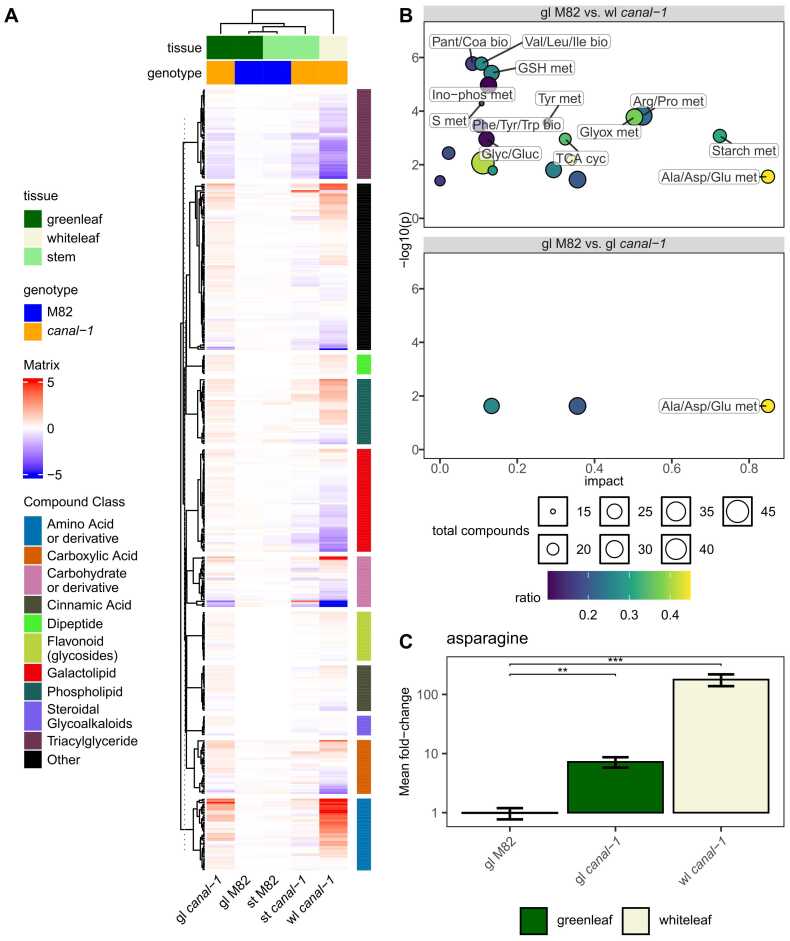
The recently described tomato mutant, which has a variegated leaf phenotype, has been shown to affect canalization of yield. The corresponding protein is orthologous to AtSCO2 -SNOWY COTYLEDON 2, which has suggested roles in thylakoid biogenesis. Here we characterize the mutant through a multi-omics approach, by comparing mutant to wild-type tissues. While white leaves are devoid of chlorophyll, green leaves of the mutant appear wild-type-like, despite an impaired protein function. Transcriptomic data suggest that green mutant leaves compensate for this impaired protein function by upregulation of transcription of photosystem assembly and photosystem component genes, thereby allowing adequate photosystem establishment, which is reflected in their wild-type-like proteome. White leaves, however, likely fail to reach a certain threshold enabling this overcompensation, and plastids get trapped in an undeveloped state, while additionally suffering from high light stress, indicated by the overexpression of ELIP homolog genes. The metabolic profile of white and to a lesser degree also green tissues revealed upregulation of amino acid levels, that was at least partially mediated by transcriptional and proteomic upregulation. These combined changes are indicative of a stress response and suggest that white tissues behave as carbon sinks. In summary, our work demonstrates the relevance of the SCO2 protein in both photosystem assembly and as a consequence in the canalization of yield.
最近描述的番茄突变体具有叶片斑驳的表型,已被证明会影响产量的渠化。相应的蛋白质与AtSCO2(雪白子叶2)直系同源,AtSCO2在类囊体生物发生中具有推测的作用。在这里,我们通过多组学方法,将突变体与野生型组织进行比较,对该突变体进行了表征。虽然白色叶片不含叶绿素,但突变体的绿色叶片尽管蛋白质功能受损,却看起来与野生型相似。转录组数据表明,绿色突变体叶片通过上调光系统组装和光系统组件基因的转录来补偿这种受损的蛋白质功能,从而实现足够的光系统建立,这在其类似野生型的蛋白质组中得到体现。然而,白色叶片可能无法达到实现这种过度补偿的某个阈值,质体被困在未发育状态,同时还受到高光胁迫,ELIP同源基因的过表达表明了这一点。白色组织以及程度较轻的绿色组织的代谢谱显示氨基酸水平上调,这至少部分是由转录和蛋白质组学上调介导的。这些综合变化表明存在应激反应,并表明白色组织起着碳汇的作用。总之,我们的工作证明了SCO2蛋白在光系统组装以及产量渠化方面的相关性。