Pigula Michael L, Ban Yahui, You Hengyao, Schultz Peter G
Department of Chemistry, Scripps Research, 10550 North Torrey Pines Road, La Jolla, California 92037, United States.
Biochemistry. 2024 Dec 17;63(24):3184-3188. doi: 10.1021/acs.biochem.4c00530. Epub 2024 Nov 25.
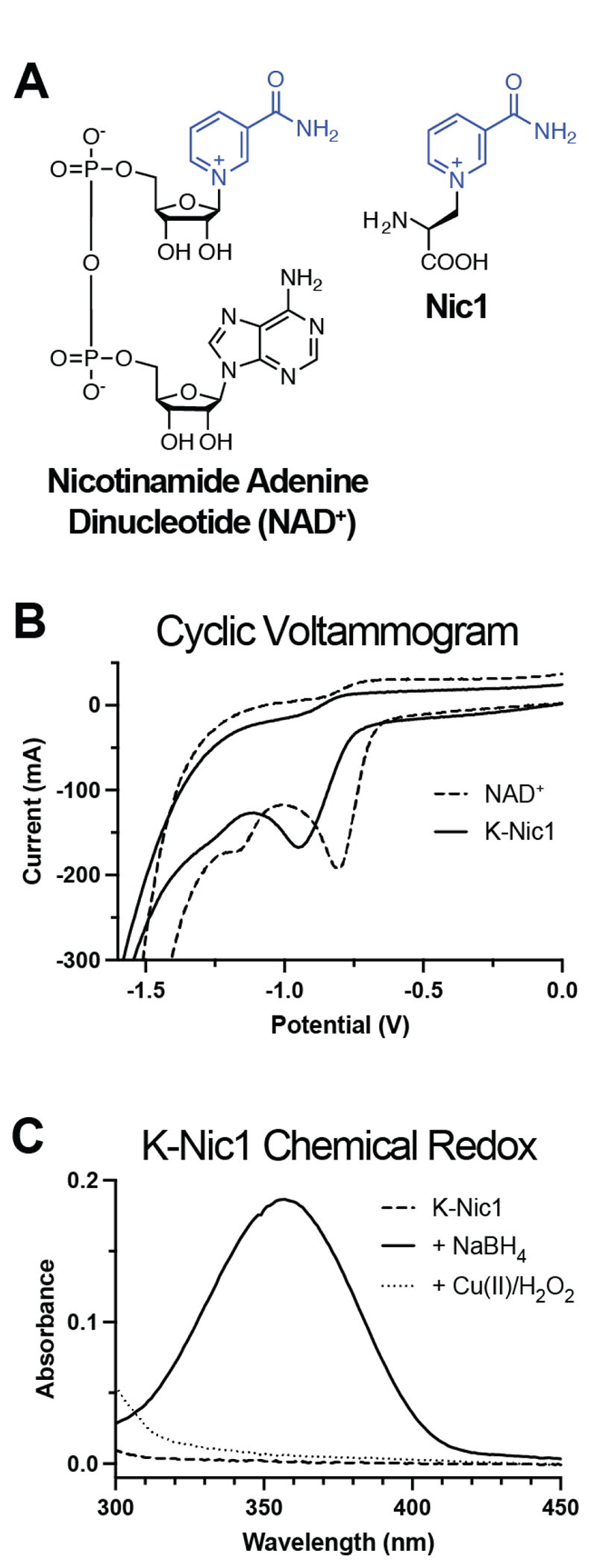
Nicotinamide-containing cofactors play an essential role in many enzymes that catalyze two-electron redox reactions. However, it is difficult to engineer nicotinamide binding sites into proteins due to the extended nature of the cofactor-protein interface and the precise orientation of the nicotinamide moiety required for efficient electron transfer to or from the substrate. To address these challenges, we genetically encoded a noncanonical amino acid (ncAA) bearing a nicotinamide side chain in bacteria. This redox-active amino acid, termed Nic1, exhibits similar electrochemical properties to the natural cofactor nicotinamide adenine dinucleotide (NAD). Nic1 can be reversibly reduced and oxidized using chemical reagents both free in solution and when incorporated into a model protein. This genetically encodable cofactor can be introduced into proteins in a site-specific fashion and may serve as a tool to study electron-transfer mechanisms in enzymes and to engineer redox-active proteins.
含烟酰胺的辅因子在许多催化双电子氧化还原反应的酶中起着至关重要的作用。然而,由于辅因子与蛋白质界面的延伸性质以及烟酰胺部分的精确取向对于底物的有效电子转移是必需的,因此很难将烟酰胺结合位点设计到蛋白质中。为了应对这些挑战,我们在细菌中对带有烟酰胺侧链的非天然氨基酸(ncAA)进行了基因编码。这种具有氧化还原活性的氨基酸称为Nic1,具有与天然辅因子烟酰胺腺嘌呤二核苷酸(NAD)相似的电化学性质。Nic1在溶液中游离以及掺入模型蛋白质时,都可以使用化学试剂进行可逆的还原和氧化。这种可基因编码的辅因子可以以位点特异性的方式引入蛋白质中,并可作为研究酶中电子转移机制以及设计具有氧化还原活性蛋白质的工具。