Department of Natural Resources and the Environment, Cornell University, Ithaca, New York, USA.
Department of Biology, Macalester College, Saint Paul, Minnesota, USA.
Conserv Biol. 2024 Dec;38(6):e14402. doi: 10.1111/cobi.14402.
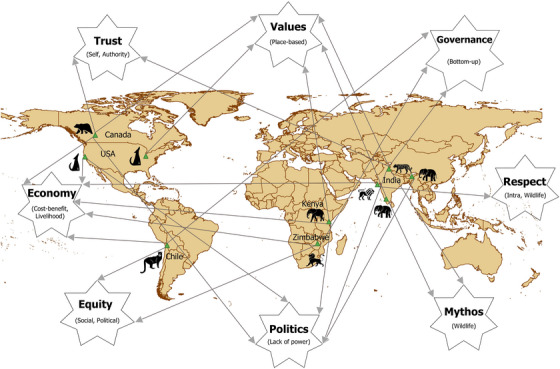
Human-wildlife conflict (HWC) is a critical challenge to human development and well-being and threatens biodiversity conservation. Ideally, HWC mitigation should benefit both wildlife and communities and limit the costs associated with living alongside wildlife. However, place- and context-dependent realizations of conflict are often overlooked in HWC mitigation. Social and systemic dimensions of human-wildlife relationships often receive limited consideration in HWC as a concept and in mitigation strategies implemented globally. In recognizing our collective symmetries as a diverse group of researchers, we pose the idea of constellations of coexistence, based on Atallah et al.'s "constellation of co-resistance." Building on literature and our interdisciplinary and cross-sectoral experiences of working with diverse species inhabiting different sociocultural, sociopolitical, and socioeconomic landscapes, we considered evidence of cultural nuances (e.g., sociocultural dimensions of human-elephant and human-lion interactions in East Africa and India) in HWC mitigation and argue that failing to incorporate them in mainstream practices poses a myriad of ethical and practical consequences. Locally situated but globally relevant, participation of local and Indigenous communities in HWC mitigation activities produces better conservation outcomes. Centering communities in the ideation, implementation, and evaluation of HWC mitigation promotes more equitable and sustainable management strategies for long-term human-wildlife coexistence.
人与野生动物冲突(HWC)是人类发展和福祉的一个重大挑战,威胁着生物多样性的保护。理想情况下,HWC 的缓解应该使野生动物和社区都受益,并限制与野生动物共存相关的成本。然而,在 HWC 的缓解中,往往忽略了冲突的地点和背景依赖性的实现。人类与野生动物关系的社会和系统层面在 HWC 作为一个概念和在全球实施的缓解策略中往往受到有限的考虑。在认识到我们作为一个多样化研究群体的集体对称性时,我们提出了共存的星座的想法,这是基于 Atallah 等人的“共同抵抗的星座”。基于文献以及我们在不同社会文化、社会政治和社会经济景观中与不同物种合作的跨学科和跨部门经验,我们考虑了 HWC 缓解中文化细微差别(例如,东非和印度的人与大象和人与狮子互动的社会文化层面)的证据,并认为在主流实践中不将其纳入其中会带来诸多伦理和实际后果。具有地方特色但具有全球相关性的是,当地和土著社区参与 HWC 缓解活动会产生更好的保护结果。将社区置于 HWC 缓解的构思、实施和评估的中心,促进了更公平和可持续的长期人类与野生动物共存的管理策略。