Gupta Himanshu, Verma Om Prakash, Sharma Tarun Kumar, Varshney Hirdesh, Agarwal Saurabh, Pak Wooguil
Department of Instrumentation and Control Engineering, Manipal Institute of Technology, Manipal Academy of Higher Education, Manipal, 576104, Karnataka, India.
Department of Instrumentation and Control Engineering, Dr B R Ambedkar National Institute of Technology Jalandhar, Jalandhar, 144027, Punjab, India.
Sci Rep. 2024 Nov 26;14(1):29397. doi: 10.1038/s41598-024-80239-y.
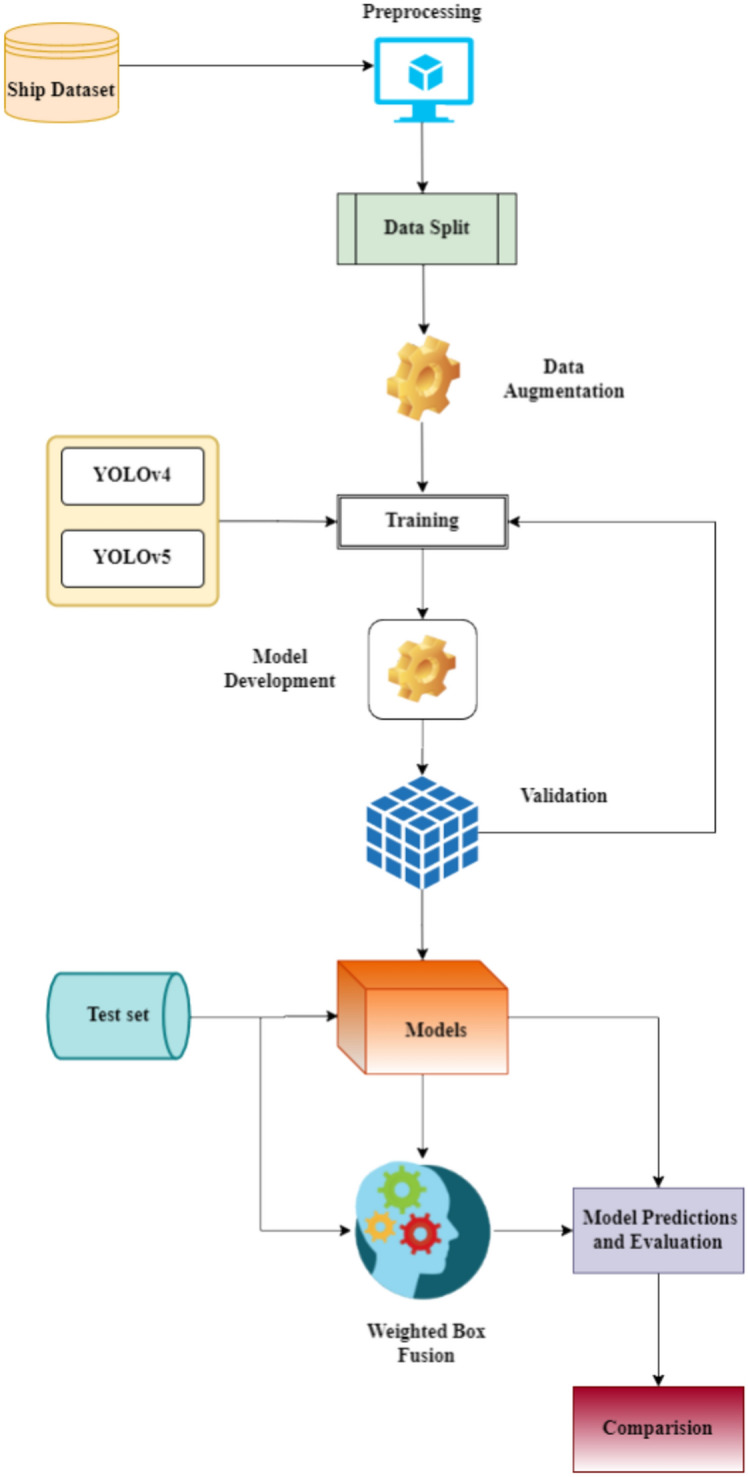
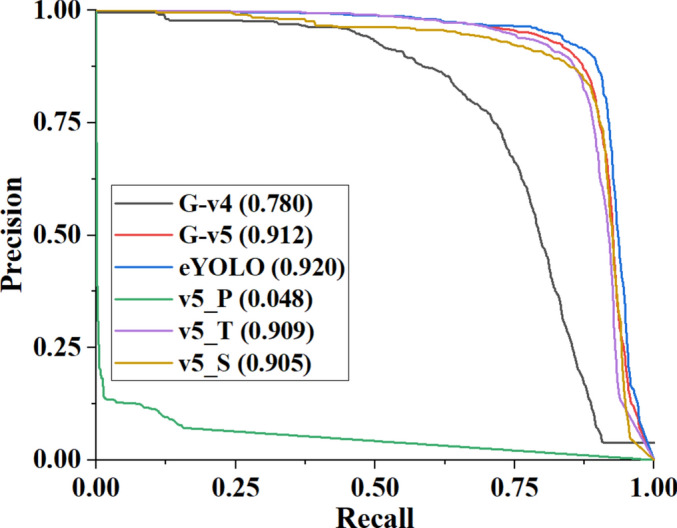
Synthetic Aperture Radar (SAR) integrated with deep learning has been widely used in several military and civilian applications, such as border patrolling, to monitor and regulate the movement of people and goods across land, air, and maritime borders. Amongst these, maritime borders confront different threats and challenges. Therefore, SAR-based ship detection becomes essential for naval surveillance in marine traffic management, oil spill detection, illegal fishing, and maritime piracy. However, the model becomes insensitive to small ships due to the wide-scale variance and uneven distribution of ship sizes in SAR images. This increases the difficulties associated with ship recognition, which triggers several false alarms. To effectively address these difficulties, the present work proposes an ensemble model (eYOLO) based on YOLOv4 and YOLOv5. The model utilizes a weighted box fusion technique to fuse the outputs of YOLOv4 and YOLOv5. Also, a generalized intersection over union loss has been adopted in eYOLO which ensures the increased generalization capability of the model with reduced scale sensitivity. The model has been developed end-to-end, and its performance has been validated against other reported results using an open-source SAR-ship dataset. The obtained results authorize the effectiveness of eYOLO in multi-scale ship detection with an F score and mAP of 91.49% and 92.00%, respectively. This highlights the efficacy of eYOLO in multi-scale ship detection using SAR imagery.
合成孔径雷达(SAR)与深度学习相结合,已广泛应用于多种军事和民用领域,如边境巡逻,以监测和管控人员及货物在陆地、空中和海上边境的流动。其中,海上边境面临着不同的威胁和挑战。因此,基于SAR的船舶检测对于海上交通管理、石油泄漏检测、非法捕鱼和海盗行为的海军监视至关重要。然而,由于SAR图像中船舶尺寸的广泛差异和分布不均,该模型对小船不敏感。这增加了船舶识别的难度,引发了一些误报。为有效解决这些难题,本研究提出了一种基于YOLOv4和YOLOv5的集成模型(eYOLO)。该模型利用加权框融合技术融合YOLOv4和YOLOv5的输出。此外,eYOLO采用了广义交并比损失,确保模型在降低尺度敏感性的同时提高泛化能力。该模型是端到端开发的,并使用开源SAR船舶数据集,将其性能与其他报告结果进行了验证。所得结果证实了eYOLO在多尺度船舶检测中的有效性,F分数和平均精度均值分别为91.49%和92.00%。这突出了eYOLO在使用SAR图像进行多尺度船舶检测中的功效。