Department of Community Nutrition, School of Nutritional Sciences and Dietetics, Tehran University of Medical Sciences, Tehran, Iran.
Cancer Research Center, Cancer Institute, Tehran University of Medical Science, Tehran, Iran.
BMC Cancer. 2024 Nov 26;24(1):1452. doi: 10.1186/s12885-024-13189-3.
Dietary factors might contribute to the risk of lung cancer by increasing the concentration of inflammatory markers. The literature-derived Dietary Inflammatory Index (DII) has been established to evaluate the inflammatory potential of diet correlated with inflammatory markers. The association between DII scores and the risk of lung cancer has been conflicting. So, in the current study, we aimed to assess the effect of pro-inflammatory dietary patterns measured with DII and the risk of lung cancer.
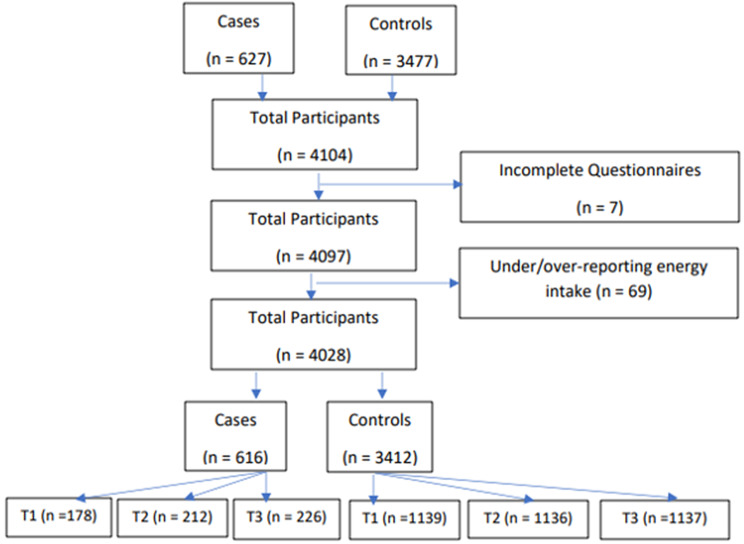
A multi-center case-control study was carried out on 616 patients with lung cancer and 3412 healthy controls. Dietary intakes were collected using a 131-item food frequency questionnaire during a face-to-face interview. The DII scores including thirty-six nutrients were calculated after energy adjustments. Finally, the association between DII level and the risk of lung cancer was evaluated by performing a multi-variable regression method after adjusting for potential confounders.
The risk of overall lung cancer, small cell, and squamous cell carcinoma was elevated in the third tertile compared to the first tertile of the DII score, (odds ratio [OR] of overall lung cancer = 1.38 (95% confidence interval [CI] 1.08-1.77), P trend = 0.01, OR of squamous cell lung cancer = 1.82 (95% CI 1.02-3.24), P trend = 0.04, OR of small cell lung cancer = 1.66 (95% CI 1.08-2.54), P trend = 0.019). However, no increase was observed in the risk of adenocarcinoma by adherence to a pro-inflammatory dietary pattern.
A positive link was found between DII and the risk of overall lung cancer, small-cell, and squamous-cell lung cancer. However, there was no association between DII and the risk of lung adenocarcinoma.
饮食因素可能通过增加炎症标志物的浓度而增加肺癌的风险。已经建立了基于文献的饮食炎症指数(DII),以评估与炎症标志物相关的饮食的炎症潜力。 DII 评分与肺癌风险之间的关联存在争议。因此,在本研究中,我们旨在评估 DII 测量的促炎饮食模式与肺癌风险之间的关系。
在 616 名肺癌患者和 3412 名健康对照者中进行了一项多中心病例对照研究。在面对面访谈中,使用 131 项食物频率问卷收集饮食摄入量。在调整能量后,计算出包括 36 种营养素的 DII 评分。最后,在调整了潜在混杂因素后,通过多变量回归方法评估 DII 水平与肺癌风险之间的关系。
与 DII 评分的第一三分位相比,第三三分位的总体肺癌、小细胞癌和鳞状细胞癌的风险增加(总体肺癌的比值比 [OR] =1.38(95%置信区间 [CI] 1.08-1.77),P 趋势=0.01,鳞状细胞肺癌的 OR=1.82(95% CI 1.02-3.24),P 趋势=0.04,小细胞肺癌的 OR=1.66(95% CI 1.08-2.54),P 趋势=0.019)。然而,按照促炎饮食模式,腺癌的风险并没有增加。
DII 与总体肺癌、小细胞癌和鳞状细胞癌的风险之间存在正相关。然而,DII 与肺腺癌风险之间没有关联。