Gonzalez Jose M, Ortiz Ryan, Holland Lawrence, Ruiz Austin, Ross Evan, Snider Eric J
Organ Support and Automation Technologies Group, U.S. Army Institute of Surgical Research, Joint Base San Antonio, Fort Sam Houston, San Antonio, TX 78234, USA.
Bioengineering (Basel). 2024 Oct 27;11(11):1075. doi: 10.3390/bioengineering11111075.
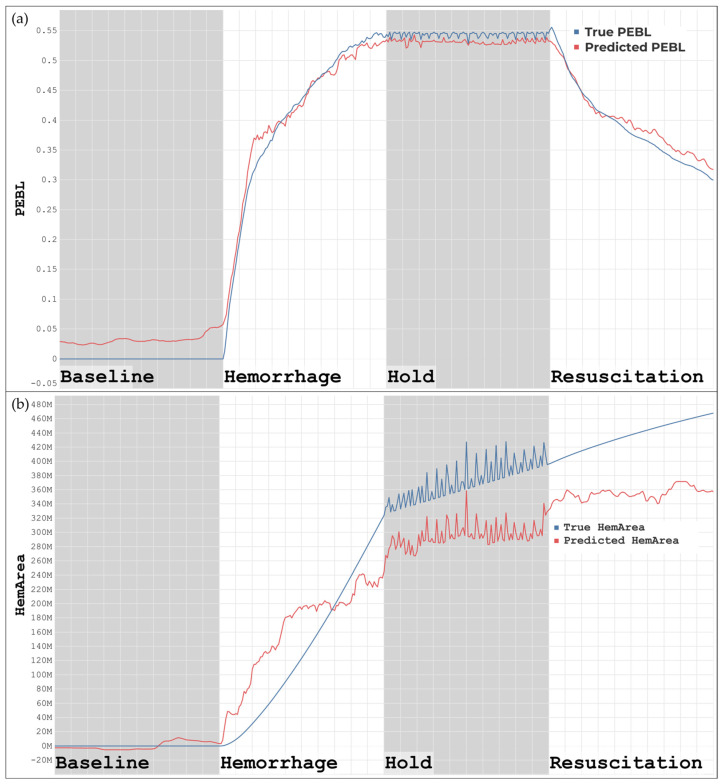
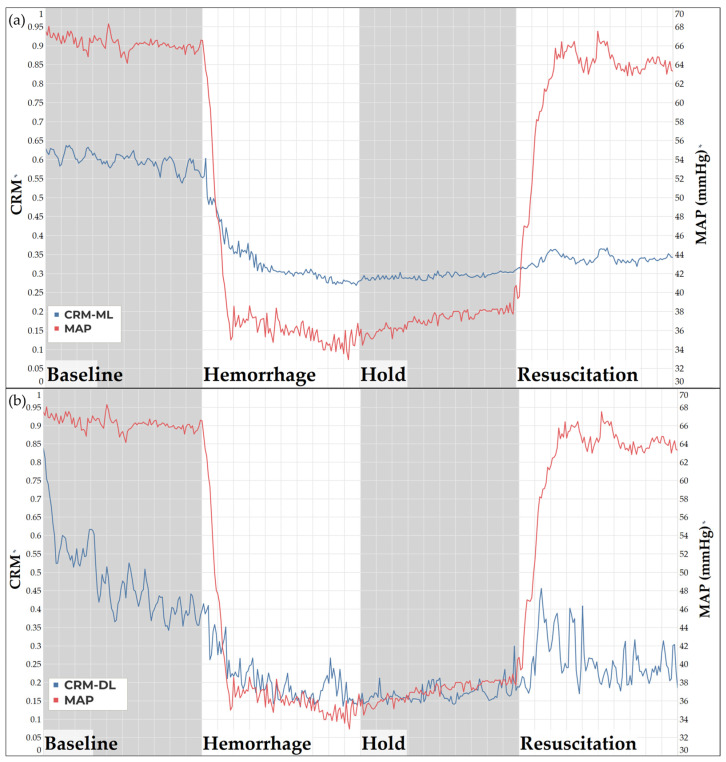
Hemorrhage leading to life-threatening shock is a common and critical problem in both civilian and military medicine. Due to complex physiological compensatory mechanisms, traditional vital signs may fail to detect patients' impending hemorrhagic shock in a timely manner when life-saving interventions are still viable. To address this shortcoming of traditional vital signs in detecting hemorrhagic shock, we have attempted to identify metrics that can predict blood loss. We have previously combined feature extraction and machine learning methodologies applied to arterial waveform analysis to develop advanced metrics that have enabled the early and accurate detection of impending shock in a canine model of hemorrhage, including metrics that estimate blood loss such as the Blood Loss Volume Metric, the Percent Estimated Blood Loss metric, and the Hemorrhage Area metric. Importantly, these metrics were able to identify impending shock well before traditional vital signs, such as blood pressure, were altered enough to identify shock. Here, we apply these advanced metrics developed using data from a canine model to data collected from a swine model of controlled hemorrhage as an interim step towards showing their relevance to human medicine. Based on the performance of these advanced metrics, we conclude that the framework for developing these metrics in the previous canine model remains applicable when applied to a swine model and results in accurate performance in these advanced metrics. The success of these advanced metrics in swine, which share physiological similarities to humans, shows promise in developing advanced blood loss metrics for humans, which would result in increased positive casualty outcomes due to hemorrhage in civilian and military medicine.
导致危及生命的休克的出血是民用和军事医学中常见且关键的问题。由于复杂的生理代偿机制,当仍有可行的挽救生命的干预措施时,传统生命体征可能无法及时检测到患者即将发生的失血性休克。为了解决传统生命体征在检测失血性休克方面的这一缺点,我们试图确定能够预测失血量的指标。我们之前将特征提取和机器学习方法应用于动脉波形分析,以开发先进的指标,这些指标能够在犬类出血模型中早期准确地检测到即将发生的休克,包括估计失血量的指标,如失血体积指标、估计失血量百分比指标和出血面积指标。重要的是,这些指标能够在传统生命体征(如血压)发生足够变化以识别休克之前就很好地识别即将发生的休克。在此,我们将使用犬类模型数据开发的这些先进指标应用于从猪的控制性出血模型收集的数据,作为向证明它们与人类医学相关性迈出的中间步骤。基于这些先进指标的表现,我们得出结论,之前在犬类模型中开发这些指标的框架在应用于猪模型时仍然适用,并在这些先进指标中产生准确的表现。这些先进指标在与人类具有生理相似性的猪身上取得成功,显示出开发用于人类的先进失血量指标的前景,这将在民用和军事医学中因出血而增加积极的伤亡结果。