Cardiovascular Degeneration, Haendeler Group, Clinical Chemistry and Laboratory Diagnostics, Medical Faculty, University Hospital and Heinrich Heine University Düsseldorf, 40225 Düsseldorf, Germany.
Cardiovascular Degeneration, Altschmied Group, Clinical Chemistry and Laboratory Diagnostics, Medical Faculty, University Hospital and Heinrich Heine University Düsseldorf, 40225 Düsseldorf, Germany.
Cells. 2024 Nov 5;13(22):1826. doi: 10.3390/cells13221826.
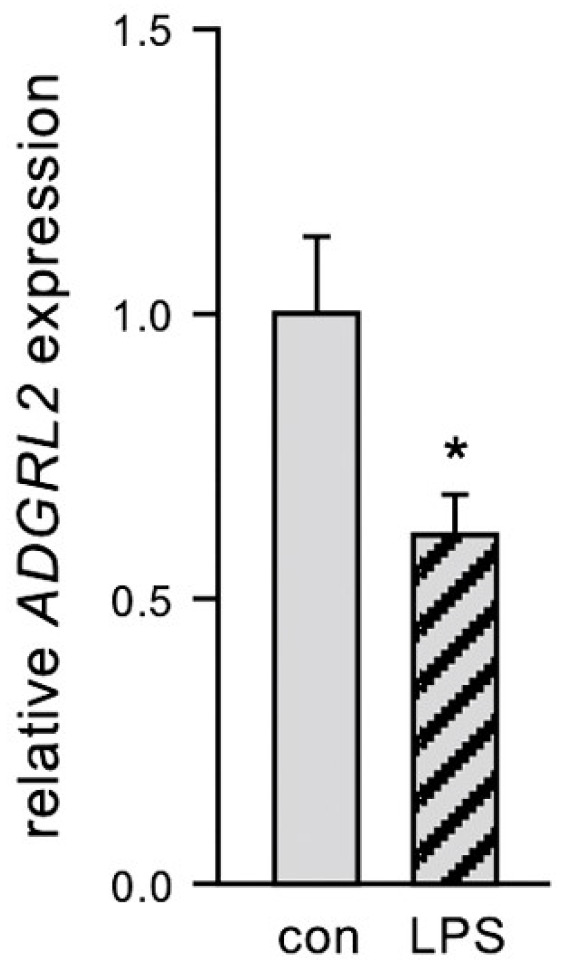
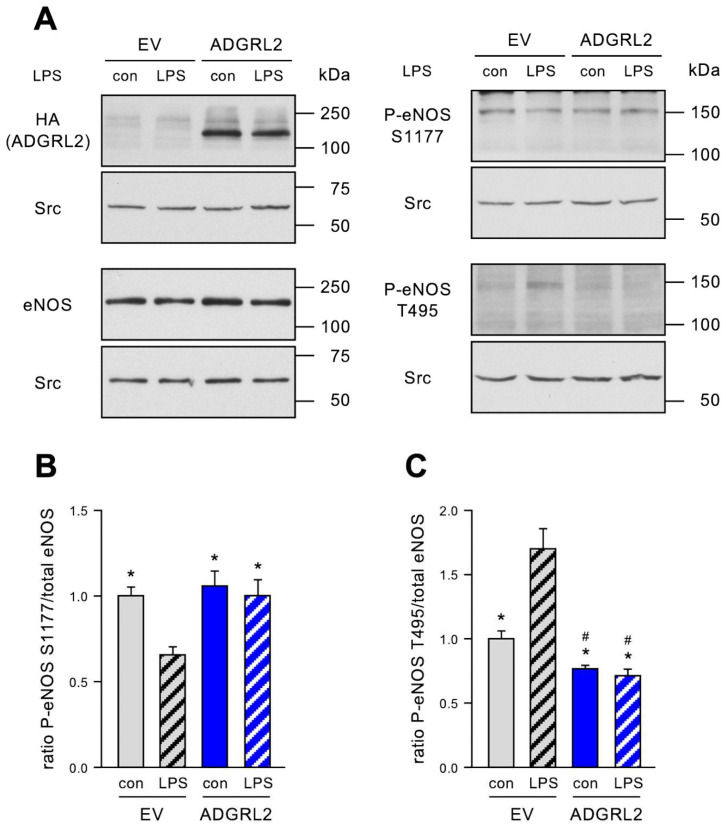
The most common trigger of sepsis and septic shock is bacterial lipopolysaccharide (LPS). Endothelial cells are among the first to encounter LPS directly. Generally, their function is closely linked to active endothelial NO Synthase (eNOS), which is significantly reduced under septic conditions. LPS treatment of endothelial cells leads to their activation and apoptosis, resulting in loss of integrity and vascular leakage, a hallmark of septic shock. Hence, therapies that prevent endothelial leakage or restore the endothelial barrier would be invaluable for patients. Adhesion GPCRs (aGPCRs) have been largely overlooked in this context, although particularly one of them, ADGRL2/LPHN2, has been implicated in endothelial barrier function. Our study shows that overexpression of ADGRL2 protects endothelial cells from LPS-induced activation, apoptosis, and impaired migration. Mechanistically, ADGRL2 preserves eNOS activity by shifting its binding from Caveolin-1 to Heat Shock Protein 90. Furthermore, ADGRL2 enhances antioxidative responses by increasing NRF2 activity. Notably, we found that this function may be evolutionarily conserved. In the absence of , a homolog of ADGRL2 in , worms show higher ROS levels and altered stress response gene expression. Additionally, mutants have a significantly reduced lifespan, altogether indicating a protective role of ADGRL2 against oxidative stress across species.
内毒素脂多糖(LPS)是引发脓毒症和脓毒性休克最常见的原因。内皮细胞是最先直接接触 LPS 的细胞之一。一般来说,它们的功能与活性内皮型一氧化氮合酶(eNOS)密切相关,而在脓毒症条件下,eNOS 的活性显著降低。LPS 处理内皮细胞会导致其激活和凋亡,从而导致完整性丧失和血管渗漏,这是脓毒性休克的一个标志。因此,预防内皮渗漏或恢复内皮屏障的疗法对患者来说将是非常宝贵的。在这种情况下,粘附 GPCR(aGPCR)在很大程度上被忽视了,尽管其中有一种特别的 GPCR,ADGRL2/LPHN2,已被牵连到内皮屏障功能中。我们的研究表明,ADGRL2 的过表达可保护内皮细胞免受 LPS 诱导的激活、凋亡和迁移受损。从机制上讲,ADGRL2 通过将其与 Caveolin-1 的结合转移到热休克蛋白 90 上来维持 eNOS 的活性。此外,ADGRL2 通过增加 NRF2 活性来增强抗氧化反应。值得注意的是,我们发现这种功能可能是进化保守的。在不存在 ADGRL2 的情况下,秀丽隐杆线虫中的一种 ADGRL2 同源物会显示出更高的 ROS 水平和改变的应激反应基因表达。此外, 突变体的寿命明显缩短,这表明 ADGRL2 在跨物种的氧化应激中具有保护作用。