Department of Neuroscience, Psychiatric Section, Azienda Ospedaliera Universitaria Pisana (A.U.O.P.), 56126 Pisa, Italy.
Department of Human Pathology of Adulthood and Childhood G. Barresi, University of Messina, 98125 Messina, Italy.
Biomolecules. 2024 Oct 31;14(11):1389. doi: 10.3390/biom14111389.
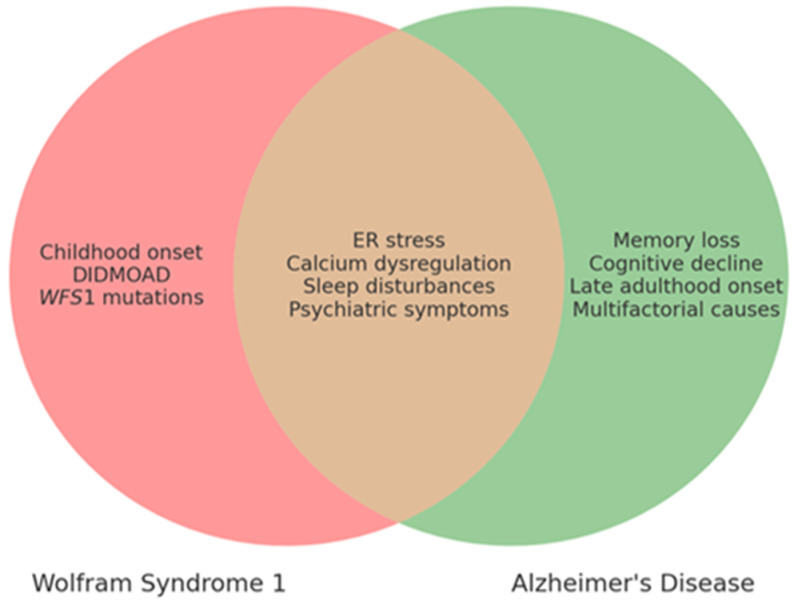
The gene was first identified in Wolfram Syndrome 1 (WS1), a rare autosomal recessive genetic disorder characterized by severe and progressive neurodegenerative changes. 's role in various cellular mechanisms, particularly in calcium homeostasis and the modulation of endoplasmic reticulum (ER) stress, suggests its potential involvement in the pathogenesis of Alzheimer's disease (AD) and sleep disorders. Because it is involved in maintaining ER balance, calcium signaling, and stress responses, plays a multifaceted role in neuronal health. Numerous studies have shown that the absence or improper expression of disrupts these cellular processes, leading to neurodegeneration and making neurons more vulnerable. In AD, dysfunction is thought to contribute to the accumulation of amyloid-β (Aβ) plaques and tau tangles, thereby accelerating disease progression. Additionally, plays an essential role in sleep regulation by influencing neuronal excitability and neurotransmitter release, which may explain the sleep disturbances frequently observed in neurodegenerative diseases. Due to its involvement in the pathological mechanisms of AD and sleep disorders, is regarded as a potential early diagnostic marker for these diseases. Further research is required to fully elucidate 's role in the cellular pathway, perhaps facilitating the development of new therapeutic strategies for Alzheimer's disease and sleep disorders.
该基因最初在 Wolfram 综合征 1(WS1)中被鉴定出来,WS1 是一种罕见的常染色体隐性遗传疾病,其特征是严重和进行性的神经退行性变化。在各种细胞机制中的作用,特别是在钙稳态和内质网(ER)应激的调节中,表明其可能参与阿尔茨海默病(AD)和睡眠障碍的发病机制。由于它参与维持 ER 平衡、钙信号和应激反应,因此在神经元健康中发挥着多方面的作用。许多研究表明,的缺失或表达不当会破坏这些细胞过程,导致神经退行性变,并使神经元更加脆弱。在 AD 中,功能障碍被认为有助于淀粉样β(Aβ)斑块和tau 缠结的积累,从而加速疾病的进展。此外,通过影响神经元兴奋性和神经递质释放,在睡眠调节中发挥着重要作用,这可能解释了在神经退行性疾病中经常观察到的睡眠障碍。由于其参与 AD 和睡眠障碍的病理机制,被认为是这些疾病的潜在早期诊断标志物。需要进一步研究来充分阐明在细胞途径中的作用,这可能有助于开发针对阿尔茨海默病和睡眠障碍的新治疗策略。