Yu Seong Hyeon, Jung Seung Il, Lee Seung-Ju, Oh Mi-Mi, Choi Jin Bong, Choi Chang Il, Kim Yeon Joo, Park Dong Jin, Bae Sangrak, Min Seung Ki
Department of Urology, Chonnam National University Hospital, Chonnam National University Medical School, Gwangju 61469, Republic of Korea.
Department of Urology, The Catholic University of Korea, St. Vincent's Hospital, Suwon 16247, Republic of Korea.
Antibiotics (Basel). 2024 Nov 12;13(11):1075. doi: 10.3390/antibiotics13111075.
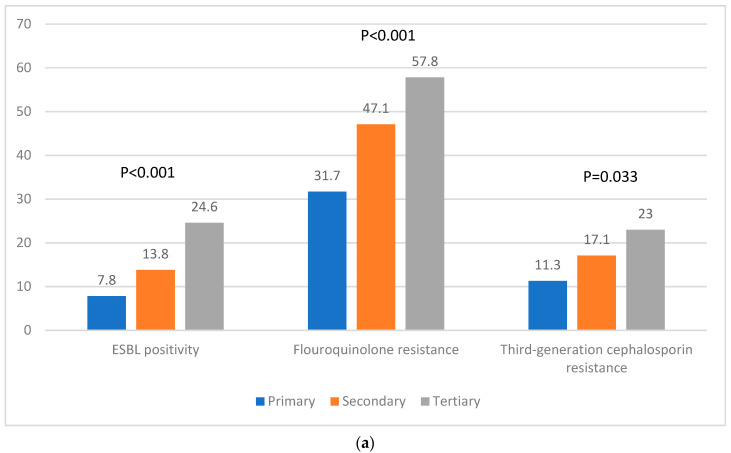
Uncomplicated cystitis is a leading form of bacterial UTI; the most common causative bacterium worldwide is . This internet-based, prospective, multicenter, and national observational study aimed to report the antimicrobial resistance of in patients with uncomplicated cystitis through the use of the Korean Antimicrobial Resistance Monitoring System (KARMS) in 2023. Data for a total of 654 patients were retrieved from the KARMS database. The mean (standard deviation) patient age was 55.9 (18.3) years. The numbers of postmenopausal women and patients with recurrent cystitis were 381 (59.4%) and 78 (11.9%), respectively. Regarding antimicrobial susceptibility, 96.8% were susceptible to fosfomycin, 98.9% to nitrofurantoin, 50.9% to ciprofloxacin, and 82.4% to cefotaxime. Extended-spectrum beta-lactamase positivity was 14.4% (89/616), and was significantly higher in tertiary hospitals (24.6%, < 0.001) and recurrent cystitis (27.6%, < 0.001). Fluoroquinolone resistance was significantly higher in tertiary hospitals (57.8%, < 0.001), postmenopausal women (54.2%, < 0.001), and recurrent cystitis (70.3%, < 0.001). In addition, postmenopausal status (95% confidence interval [CI]: 1.44-3.17, odds ratio [OR] 2.13, < 0.001), recurrent cystitis (95% CI: 1.40-4.66, OR 2.56, = 0.002) and tertiary hospitals (95% CI: 1.00-2.93, OR 1.71, = 0.049) were associated with significantly increased fluoroquinolone resistance. Any female patient diagnosed with clinical uncomplicated cystitis and microbiologically proven infection in 2023 was eligible for this study. Patient data were obtained from the web-based KARMS database. The antimicrobial susceptibility of was analyzed according to clinical factors, including hospital region, hospital type, menopause status, and recurrence status. The antimicrobial resistance of in patients with uncomplicated cystitis in the Republic of Korea has reached a serious level, especially in fluoroquinolone resistance. Therefore, major efforts should be made to reduce antimicrobial resistance.
单纯性膀胱炎是细菌性尿路感染的主要形式;全球最常见的致病菌是 。这项基于网络的前瞻性多中心全国性观察性研究旨在通过使用2023年韩国抗菌药物耐药性监测系统(KARMS)报告单纯性膀胱炎患者中 的抗菌药物耐药性。从KARMS数据库中检索了总共654例患者的数据。患者的平均(标准差)年龄为55.9(18.3)岁。绝经后女性和复发性膀胱炎患者的人数分别为381例(59.4%)和78例(11.9%)。关于抗菌药物敏感性,96.8%的菌株对磷霉素敏感,98.9%对呋喃妥因敏感,50.9%对环丙沙星敏感,82.4%对头孢噻肟敏感。超广谱β-内酰胺酶阳性率为14.4%(89/616),在三级医院(24.6%,<0.001)和复发性膀胱炎患者中(27.6%,<0.001)显著更高。三级医院(57.8%,<0.001)、绝经后女性(54.2%,<0.001)和复发性膀胱炎患者(70.3%,<0.001)的氟喹诺酮耐药率显著更高。此外,绝经状态(95%置信区间[CI]:1.44 - 3.17,比值比[OR] 2.13,<0.001)、复发性膀胱炎(95% CI:1.40 - 4.66,OR 2.56,=0.002)和三级医院(95% CI:1.00 - 2.93,OR 1.71,=0.049)与氟喹诺酮耐药性显著增加相关。任何在2023年被诊断为临床单纯性膀胱炎且微生物学证实为 感染的女性患者均符合本研究条件。患者数据从基于网络的KARMS数据库中获取。根据临床因素,包括医院地区、医院类型、绝经状态和复发状态,分析了 的抗菌药物敏感性。韩国单纯性膀胱炎患者中 的抗菌药物耐药性已达到严重程度,尤其是氟喹诺酮耐药性。因此,应大力努力降低抗菌药物耐药性。