Department of Pathophysiology, Faculty of Medicine, University of Sarajevo, 71000 Sarajevo, Bosnia and Herzegovina.
University Clinical Center Sarajevo, 71000 Sarajevo, Bosnia and Herzegovina.
Medicina (Kaunas). 2024 Nov 1;60(11):1795. doi: 10.3390/medicina60111795.
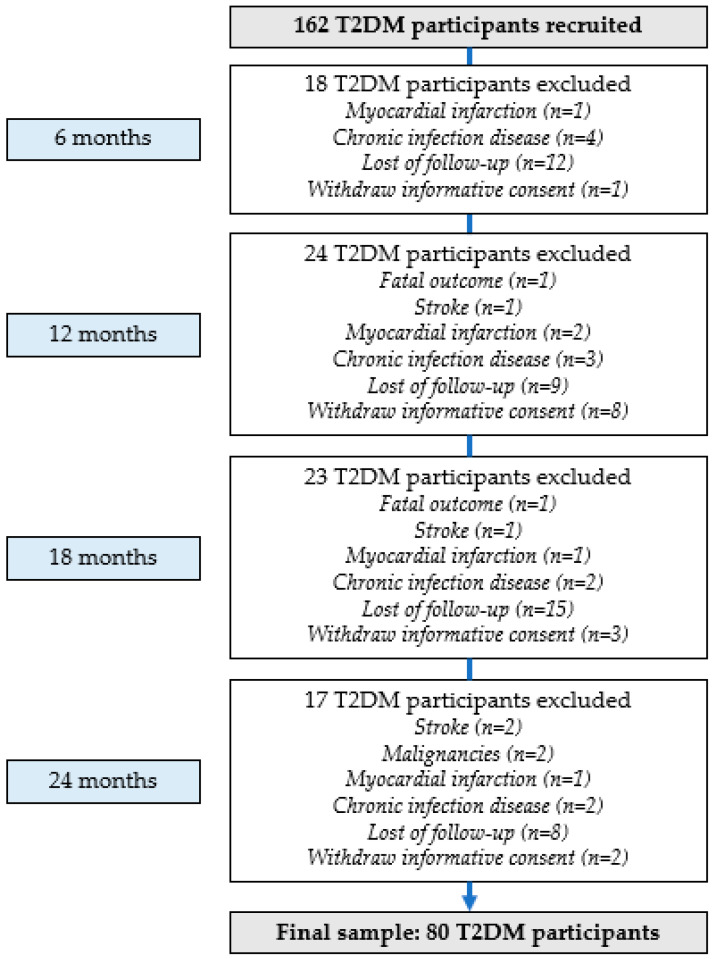
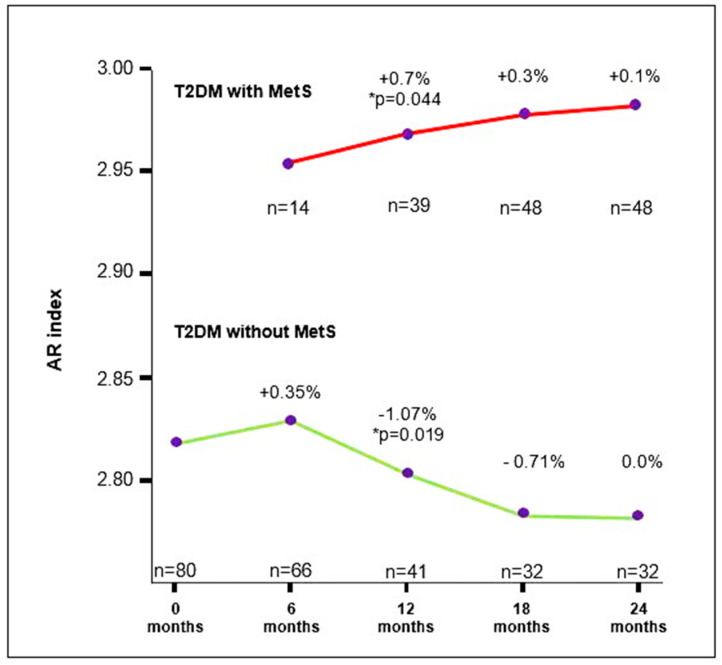
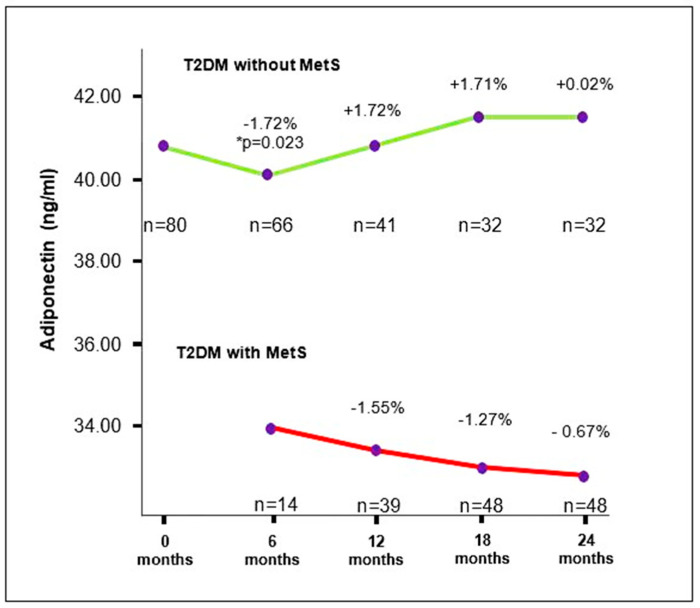
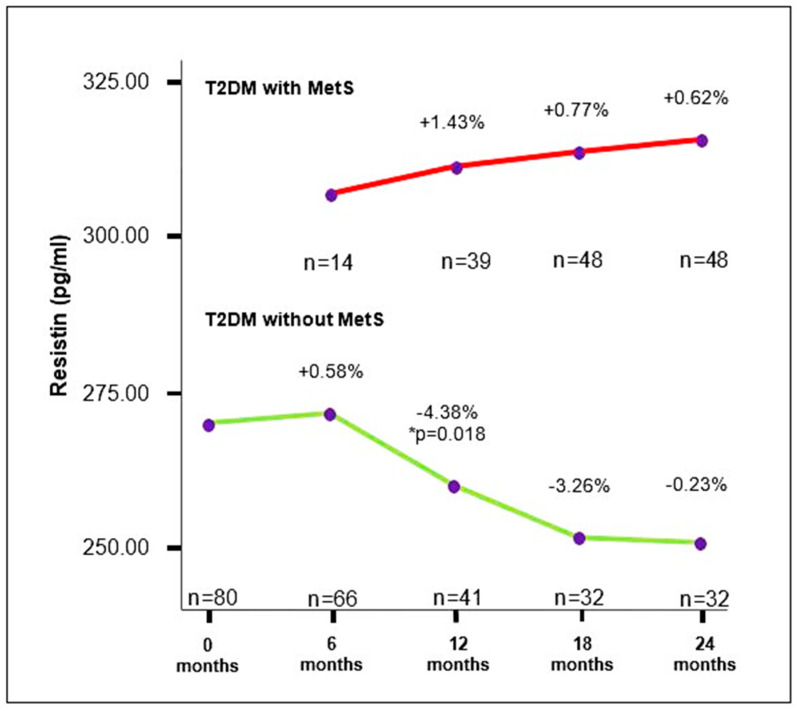
: This study aimed to investigate the novel adiponectin-resistin (AR) index as a predictor of the development of metabolic syndrome (MetS) in individuals with type 2 diabetes mellitus (T2DM). MetS is common in T2DM and increases cardiovascular risk. Adiponectin and resistin, adipokines with opposing effects on insulin sensitivity and inflammation, make the AR index a potential marker for metabolic risk. : This prospective observational study included 80 T2DM participants (ages 30-60) from Sarajevo, Bosnia and Herzegovina, over 24 months. The participants were divided into two groups: T2DM with MetS ( = 48) and T2DM without MetS ( = 32). Anthropometric data, biochemical analyses, and serum levels of adiponectin and resistin were measured at baseline and every six months. The AR index was calculated using the formula AR = 1 + log10(R) - 1 + log10(A), where R and A represent resistin and adiponectin concentrations. Logistic regression identified predictors of MetS. : T2DM patients who developed MetS showed a significant decline in adiponectin levels (40.19 to 32.49 ng/mL, = 0.02) and a rise in resistin levels (284.50 to 315.21 pg/mL, = 0.001). The AR index increased from 2.85 to 2.98 ( = 0.001). The AR index and resistin were independent predictors of MetS after 18 months, with the AR index showing a stronger predictive value ( = 0.007; EXP(B) = 1.265). : The AR index is a practical marker for predicting MetS development in T2DM participants, improving metabolic risk stratification. Incorporating it into clinical assessments may enhance early detection and treatment strategies.
: 本研究旨在探讨新型脂联素-抵抗素(AR)指数作为 2 型糖尿病(T2DM)患者代谢综合征(MetS)发展的预测指标。MetS 在 T2DM 中很常见,会增加心血管风险。脂联素和抵抗素是对胰岛素敏感性和炎症具有相反作用的脂肪因子,使得 AR 指数成为代谢风险的潜在标志物。: 这项前瞻性观察研究纳入了来自波斯尼亚和黑塞哥维那萨拉热窝的 80 名 T2DM 参与者(年龄 30-60 岁),随访时间为 24 个月。参与者被分为两组:T2DM 合并 MetS(n=48)和 T2DM 不合并 MetS(n=32)。在基线和每 6 个月时测量参与者的人体测量数据、生化分析以及血清脂联素和抵抗素水平。AR 指数通过以下公式计算:AR=1+log10(R)-1+log10(A),其中 R 和 A 分别代表抵抗素和脂联素的浓度。逻辑回归确定了 MetS 的预测因素。: T2DM 患者发生 MetS 时,脂联素水平显著下降(40.19 至 32.49ng/mL, = 0.02),抵抗素水平升高(284.50 至 315.21pg/mL, = 0.001)。AR 指数从 2.85 增加到 2.98( = 0.001)。18 个月后,AR 指数和抵抗素是 MetS 的独立预测因素,AR 指数具有更强的预测价值( = 0.007;EXP(B)= 1.265)。: AR 指数是预测 T2DM 患者 MetS 发展的实用标志物,可改善代谢风险分层。将其纳入临床评估可能会增强早期检测和治疗策略。