Lee You-Jeong, Lee Saebom, Kim Beoul, Kwak Dongmi, Kim Taehwan, Seo Min-Goo
College of Veterinary Medicine & Institute for Veterinary Biomedical Science, Kyungpook National University, 80 Daehak-ro, Buk-gu, Daegu 41566, Republic of Korea.
Baekdudaegan National Arboretum, Korean Tiger Conservation Center, 1501 Chunyang-ro, Chunyang-myeon, Bonghwa 36209, Republic of Korea.
Microorganisms. 2024 Oct 27;12(11):2165. doi: 10.3390/microorganisms12112165.
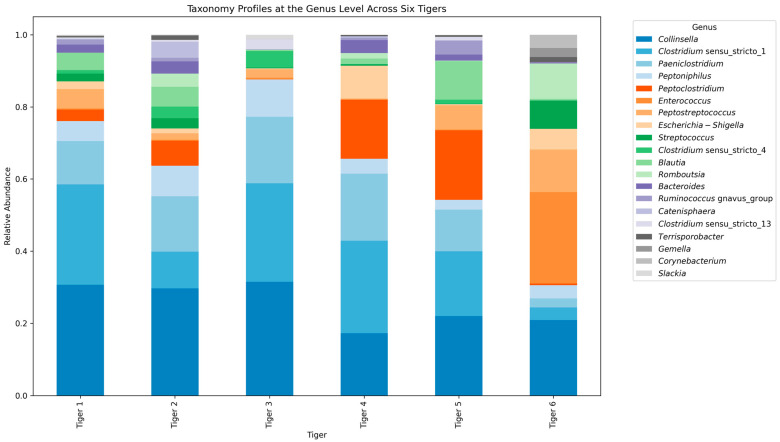
The gut microbiome is essential for the health of carnivorous mammals, including the endangered Siberian tiger (). However, limited research exists on the gut microbiome of captive Siberian tigers, especially regarding how diet and health status influence microbial diversity. This study addresses this gap by investigating the gut microbiome diversity and composition of six captive-born Siberian tigers housed at the Baekdudaegan National Arboretum in South Korea, using 16S rRNA gene sequencing. The study aimed to examine how diet and health status influence microbial communities, providing baseline data for managing captive tigers. Alpha diversity analysis revealed significant variation in microbial richness and evenness, with Tigers 2 and 6 exhibiting the highest microbial diversity and Tiger 3 the lowest, likely due to its surgical history and limited diet. Beta diversity analysis showed distinct microbial community structures influenced by diet and health. Taxonomic profiling identified and as the dominant phyla, with sensu stricto more prevalent in healthier tigers, while - and were abundant in tigers with lower diversity, suggesting dysbiosis. Comparisons with other tiger species confirm that diet, health, and captivity significantly shape the gut microbiome. These findings highlight the need for personalized health management in captive environments.
肠道微生物群对于包括濒危的东北虎在内的肉食性哺乳动物的健康至关重要。然而,关于圈养东北虎肠道微生物群的研究有限,尤其是在饮食和健康状况如何影响微生物多样性方面。本研究通过使用16S rRNA基因测序,调查了韩国太白山脉国立树木园饲养的6只圈养出生的东北虎的肠道微生物群多样性和组成,填补了这一空白。该研究旨在研究饮食和健康状况如何影响微生物群落,为圈养老虎的管理提供基线数据。α多样性分析显示微生物丰富度和均匀度存在显著差异,老虎2和老虎6表现出最高的微生物多样性,老虎3最低,这可能归因于其手术史和有限的饮食。β多样性分析表明,饮食和健康会影响不同的微生物群落结构。分类学分析确定厚壁菌门和拟杆菌门为主要门类,狭义梭菌纲在健康状况较好的老虎中更为普遍,而变形菌门和放线菌门在多样性较低的老虎中含量丰富,表明存在生态失调。与其他老虎物种的比较证实,饮食、健康和圈养环境会显著影响肠道微生物群。这些发现凸显了在圈养环境中进行个性化健康管理的必要性。