Adebusoye Favour Tope, Roy Sakshi, Bharadwaj Hareesha Rishab, Ali Syed Hasham, Awuah Wireko Andrew, Ferreira Tomas, Tan Joecelyn Kirani, Aderinto Nicholas, Azeem Saleha, Salako Paul Olutosin, Tenkorang Pearl Ohenewaa, Kumar Harendra, Abdul-Rahman Toufik
Faculty of Medicine Sumy State University Sumy Ukraine.
School of Medicine Queen's University Belfast Belfast UK.
Health Sci Rep. 2024 Nov 25;7(11):e70215. doi: 10.1002/hsr2.70215. eCollection 2024 Nov.
The diagnosis and management of soft tissue sarcoma (STS) in sub-Saharan Africa (SSA) present significant challenges. Positive outcomes in STS treatment include achieving negative margins, improved quality of life, and reduced recurrence rates, while negative outcomes involve incomplete resection, local recurrence, and surgical complications. This review aims to examine the current state of STS management in SSA, identify key challenges, and propose potential solutions to improve patient outcomes.
A comprehensive review of the literature using PubMed/MEDLINE, Google Scholar, and Scopus, focusing on English-language studies examining the management of STS in SSA. Inclusion criteria centered on studies reporting on surgical interventions, outcomes, and healthcare challenges in the region. Articles lacking sufficient data, non-English sources, conference abstracts, and duplicates were excluded.
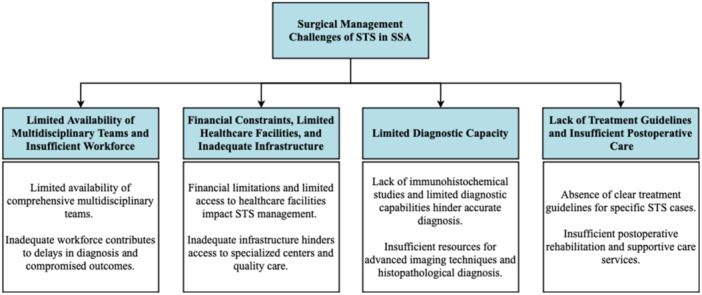
Findings highlight several obstacles in the management of STS in SSA, including limited multidisciplinary teams, inadequate healthcare infrastructure, financial constraints, and lack of standardized treatment protocols. Key themes such as diagnostic capacity and resource allocation were identified as significant barriers.
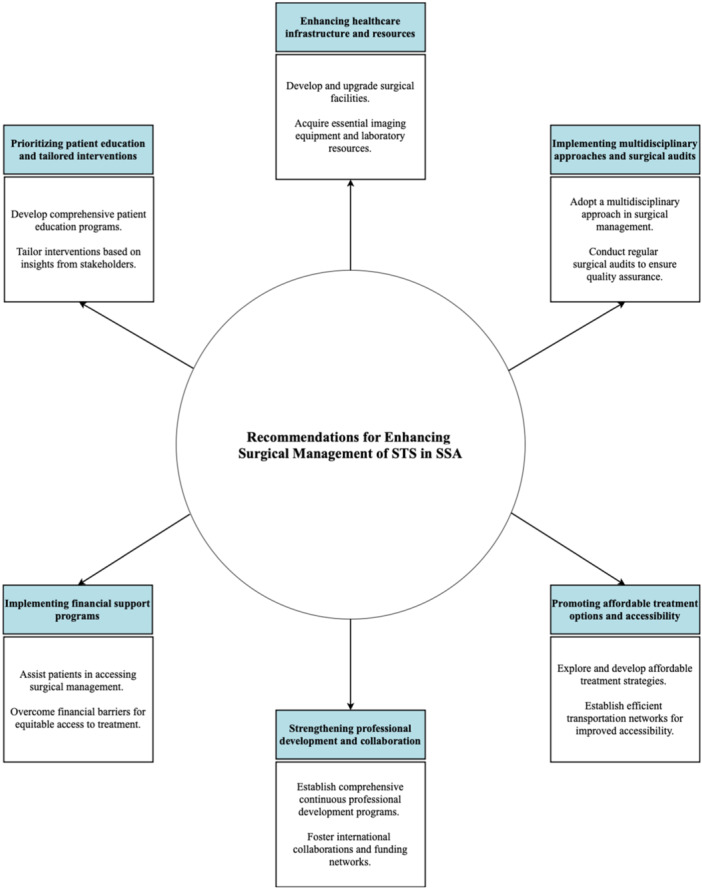
Improving STS outcomes in SSA requires investment in healthcare infrastructure, professional development, enhanced funding, and collaborative research. Addressing these gaps is crucial to achieving better surgical management and improving survival rates for patients with STS in SSA.
撒哈拉以南非洲地区(SSA)软组织肉瘤(STS)的诊断与管理面临重大挑战。STS治疗的积极结果包括实现切缘阴性、提高生活质量和降低复发率,而消极结果则包括切除不完全、局部复发和手术并发症。本综述旨在审视SSA地区STS管理的现状,识别关键挑战,并提出改善患者预后的潜在解决方案。
使用PubMed/MEDLINE、谷歌学术和Scopus对文献进行全面综述,重点关注研究SSA地区STS管理的英文研究。纳入标准集中在报告该地区手术干预、结果和医疗保健挑战的研究。缺乏足够数据的文章、非英文来源、会议摘要和重复文章被排除。
研究结果凸显了SSA地区STS管理中的几个障碍,包括多学科团队有限、医疗基础设施不足、资金限制以及缺乏标准化治疗方案。诊断能力和资源分配等关键主题被确定为重大障碍。
改善SSA地区STS的预后需要在医疗基础设施、专业发展、增加资金和合作研究方面进行投资。解决这些差距对于实现更好的手术管理和提高SSA地区STS患者的生存率至关重要。