Afolabi Muhammed O, Adu-Gyasi Dennis, Paintain Lucy, Tawiah Theresa, Ali Mohammed Sanni, Greenwood Brian, Asante Kwaku Poku
Department of Disease Control, Faculty of Infectious and Tropical Diseases, London School of Hygiene & Tropical Medicine, London, UK.
Research and Development Division, Kintampo Health Research Centre, Kintampo, Ghana.
Trop Med Int Health. 2025 Jan;30(1):22-30. doi: 10.1111/tmi.14062. Epub 2024 Nov 27.
To evaluate the effectiveness and cost-effectiveness of integrating seasonal malaria chemoprevention (SMC) with mass drug administration for helminth control among school-aged children living in communities where the burden of malaria and helminths is high in Ghana, West Africa.
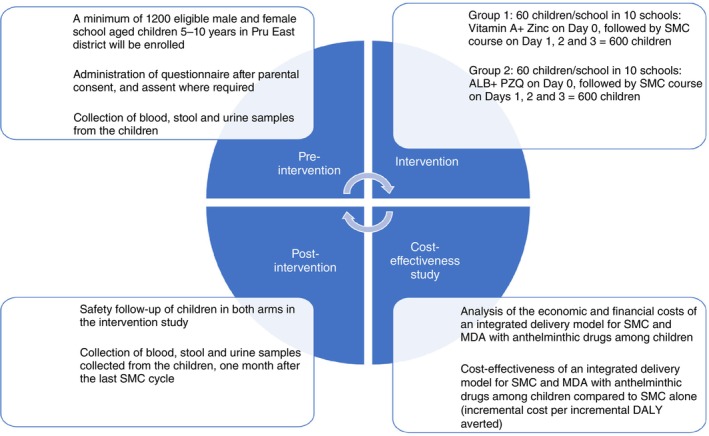
This cluster randomised controlled trial will enrol 1200 children aged 5-10 years. Eligible children randomised to intervention clusters will receive SMC drugs (sulphadoxine-pyrimethamine plus amodiaquine) and anthelminthic drugs for soil-transmitted helminths-(albendazole), and for schistosomiasis (praziquantel), while children randomised to control clusters will receive SMC drugs alone. Pre- and post-intervention blood, urine and stool samples will be collected from children in both clusters. The effectiveness of the concomitant delivery will be determined by checking whether the combination of SMC and anthelminthic drugs prevents anaemia in the children randomised to the intervention clusters compared to the children in the control clusters. Cost analysis and cost-effectiveness of this integrated delivery approach will be determined by estimating the incremental costs and effects of co-administration of SMC drugs with mass drug administration of anthelminthic drugs compared to SMC alone, including cost savings due to cases of moderate and severe anaemia averted.
The findings of this study will provide evidence to inform public health recommendations for an integrated control of malaria and helminths among children living in the poorest countries of the world.
评估在西非加纳疟疾和蠕虫负担较重社区的学龄儿童中,将季节性疟疾化学预防(SMC)与大规模药物驱虫相结合的有效性和成本效益。
这项整群随机对照试验将招募1200名5至10岁的儿童。随机分配到干预组的符合条件的儿童将接受SMC药物(磺胺多辛-乙胺嘧啶加阿莫地喹)以及针对土壤传播蠕虫的驱虫药物(阿苯达唑)和针对血吸虫病的药物(吡喹酮),而随机分配到对照组的儿童将仅接受SMC药物。干预前后将从两组儿童中采集血液、尿液和粪便样本。通过检查与对照组儿童相比,随机分配到干预组的儿童中SMC和驱虫药物的联合使用是否能预防贫血,来确定联合给药的有效性。这种综合给药方法的成本分析和成本效益将通过估计与单独使用SMC相比,SMC药物与大规模驱虫药物联合给药的增量成本和效果来确定,包括因避免中度和重度贫血病例而节省的成本。
本研究的结果将为为世界最贫穷国家儿童疟疾和蠕虫综合防治的公共卫生建议提供依据。