Nuffield Department of Primary Care Health Sciences, University of Oxford, Oxford, UK.
Action on Pre-eclampsia, The Stables, 80 B High Street, Evesham, Worcestershire, UK.
BMC Pregnancy Childbirth. 2024 Nov 28;24(1):800. doi: 10.1186/s12884-024-06972-4.
The COVID-19 pandemic accelerated the adoption of remote care, or telemedicine, in many clinical areas including maternity care. One component of remote care, the use of self-monitoring of blood pressure in pregnancy, could form a key component in post-pandemic care pathways. The BUMP trials evaluated a self-monitoring of blood pressure intervention in addition to usual care, testing whether it improved detection or control of hypertension for pregnant people at risk of hypertension or with hypertension during pregnancy. This paper reports the qualitative evaluation which aimed to understand how the intervention worked, the perspectives of participants in the trials, and, crucially, those who declined to participate.
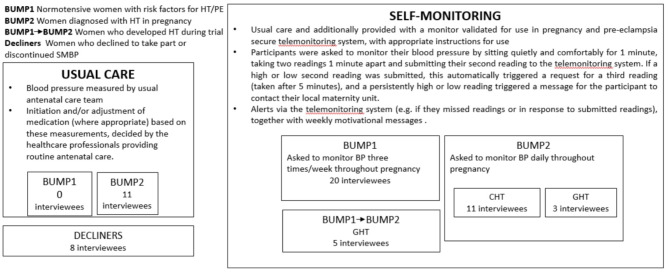
The BUMP trials were conducted between November 2018 and May 2020. Thirty-nine in-depth qualitative interviews were carried out with a diverse sample of pregnant women invited to participate in the BUMP trials across five maternity units in England.
Self-monitoring of blood pressure in the BUMP trials was reassuring, acceptable, and convenient and sometimes alerted women to raised BP. While empowering, taking a series of self-monitored readings also introduced uncertainty and new responsibility. Some declined to participate due to a range of concerns. In the intervention arm, the performance of the BUMP intervention may have been impacted by women's selective or delayed reporting of raised readings and repeated testing in pursuit of normal BP readings. In the usual care arm, more women were already self-monitoring their blood pressure than expected.
The BUMP trials did not find that among pregnant individuals at higher risk of preeclampsia, blood pressure self-monitoring with telemonitoring led to significantly earlier clinic-based detection of hypertension nor improved management of blood pressure. The findings from this study help us understand the role that self-monitoring of blood pressure can play in maternity care pathways. As maternity services consider the balance between face-to-face and remote consultations in the aftermath of the COVID-19 pandemic, these findings contribute to the evidence base needed to identify optimal, effective, and equitable approaches to self-monitoring of blood pressure.
COVID-19 大流行加速了远程护理(即远程医疗)在许多临床领域的应用,包括产科护理。远程护理的一个组成部分,即孕妇自我监测血压,可能成为大流行后护理路径的一个重要组成部分。BUMP 试验评估了自我监测血压干预措施,该措施除了常规护理外,还测试了其是否能提高有高血压风险或怀孕期间患有高血压的孕妇的高血压检测或控制率。本文报告了定性评估结果,目的是了解干预措施的效果、试验参与者的观点,以及至关重要的是,那些拒绝参与的人的观点。
BUMP 试验于 2018 年 11 月至 2020 年 5 月进行。在英格兰五家产科单位邀请参加 BUMP 试验的不同孕妇中进行了 39 次深入的定性访谈。
BUMP 试验中的自我监测血压既令人安心、可接受又方便,有时还能提醒女性血压升高。虽然有赋权作用,但进行一系列自我监测读数也会带来不确定性和新的责任。一些人因各种担忧而拒绝参与。在干预组中,由于女性有选择地或延迟报告血压升高读数以及为了获得正常血压读数而反复测试,BUMP 干预的实施效果可能受到影响。在常规护理组中,自我监测血压的女性比预期的要多。
在有子痫前期风险较高的孕妇中,血压自我监测加远程监测并未导致高血压的临床检测显著提前,也未改善血压管理。这项研究的结果有助于我们了解自我监测血压在产科护理路径中的作用。随着产科服务考虑在 COVID-19 大流行后平衡面对面和远程咨询,这些发现为确定自我监测血压的最佳、有效和公平方法提供了所需的证据基础。