Department of Obstetrics, Beijing Obstetrics and Gynecology Hospital, Capital Medical University, Beijing Maternal and Child Health Care Hospital, No. 251 Yaojiayuan Road, Beijing, 100026, China.
Central Laboratory, Beijing Obstetrics and Gynecology Hospital, Capital Medical University, Beijing Maternal and Child Health Care Hospital, Beijing, China.
BMC Pregnancy Childbirth. 2024 Nov 27;24(1):799. doi: 10.1186/s12884-024-06985-z.
There is an unmet need for a large comprehensive population-based dataset documenting national birthing trends in China and a partograph specifically tailored to Chinese women. This study assessed the impact of using the World Health Organization (WHO) partograph or Zhang's guideline to manage labor and delivery in China and inform the development of a partograph that specifically aligns with the progression of labor in Chinese women.
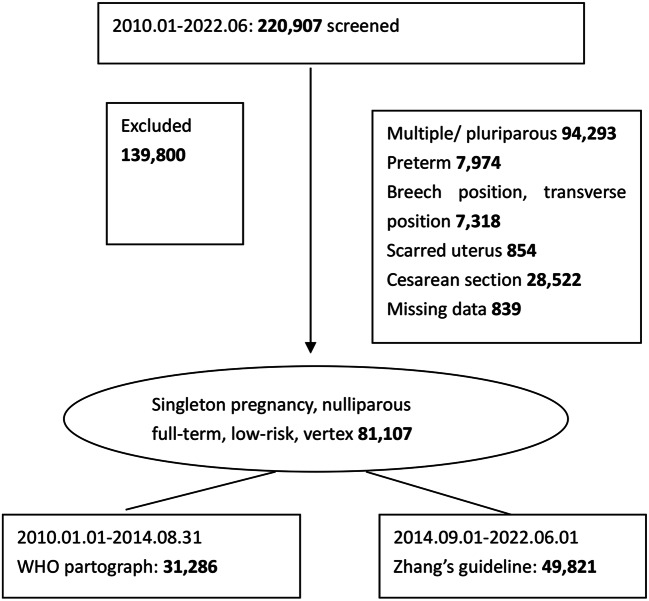
This retrospective analysis included low-risk nulliparous women with a singleton, full-term fetus in cephalic presentation entering spontaneous labor at a specialized obstetric hospital in China between January 2010 and June 2022. Pregnant women were managed according to the WHO partograph (January 2010-August 2014, n = 31,286) or Zhang's guideline (September 2014-June 2022, n = 49,821).
Rates of assisted reproduction (4.57% vs. 1.05%; p < 0.0001) and hypertension (7.44% vs. 6.71%; p < 0.0001) were significantly higher for pregnant women managed according to Zhang's guideline compared to the WHO partograph. Rates of labor intervention (35.31% vs. 13.95%; p < 0.0001), including induction of labor by oxytocin, artificial rupture of membranes, lateral episiotomy and conversion to cesarean section (all, p < 0.0001), were significantly higher for pregnant women managed according to the WHO partograph. Rates of forceps assisted vaginal deliveries (12.67% vs. 6.42%; p < 0.0001) and postpartum hemorrhage (10.9% vs. 6.2%; p < 0.0001) were significantly higher, and birth asphyxia (0.15% vs. 0.09%; p = 0.02) was significantly lower, for pregnant women managed according to Zhang's guideline.
This study provides valuable insights into the utilization of the WHO partograph and Zhang's guideline in managing labor and delivery among Chinese women. Findings indicate that women managed according to Zhang's guideline had higher rates of assisted reproduction and hypertension, suggesting a potentially different demographic profile or underlying health conditions compared to women managed according to the WHO partograph. Notably, the use of the WHO partograph was linked to a significant increase in labor interventions, while Zhang's guideline resulted in higher rates of forceps-assisted vaginal deliveries and postpartum hemorrhage, yet interestingly, a lower incidence of birth asphyxia. These contrasting outcomes underscore the importance of aligning labor management tools with the specific needs and progression of labor in Chinese women. The results advocate for a tailored partograph that could better reflect the unique characteristics of Chinese women and optimize decision making and maternal and neonatal outcomes.
目前,中国急需一份大型综合性、基于人群的文献,用以记录全国的分娩趋势,同时还需要一份专门针对中国女性的产程图。本研究旨在评估在中国使用世界卫生组织(WHO)产程图或张惜阴产程图管理分娩的效果,并为专门适用于中国女性产程的产程图的开发提供信息。
这是一项回顾性分析,纳入了 2010 年 1 月至 2022 年 6 月在中国一家专门的产科医院自然分娩的低危初产妇,且为单胎、足月、头位。根据 WHO 产程图(2010 年 1 月至 2014 年 8 月,n=31286)或张惜阴产程图(2014 年 9 月至 2022 年 6 月,n=49821)管理孕妇。
与 WHO 产程图相比,张惜阴产程图管理的孕妇中,辅助生殖(4.57% vs. 1.05%;p<0.0001)和高血压(7.44% vs. 6.71%;p<0.0001)的发生率显著更高。与 WHO 产程图相比,张惜阴产程图管理的孕妇中,干预性分娩(35.31% vs. 13.95%;p<0.0001)的发生率更高,包括催产素引产、人工破膜、会阴侧切和剖宫产(均为 p<0.0001)。与 WHO 产程图相比,张惜阴产程图管理的孕妇中,产钳助产(12.67% vs. 6.42%;p<0.0001)和产后出血(10.9% vs. 6.2%;p<0.0001)的发生率更高,而新生儿窒息(0.15% vs. 0.09%;p=0.02)的发生率更低。
本研究提供了有关 WHO 产程图和张惜阴产程图在中国管理分娩方面的使用的有价值的见解。结果表明,与 WHO 产程图相比,张惜阴产程图管理的孕妇中,辅助生殖和高血压的发生率更高,这表明与 WHO 产程图相比,这些孕妇可能具有不同的人口统计学特征或潜在的健康状况。值得注意的是,WHO 产程图的使用与干预性分娩的显著增加相关,而张惜阴产程图导致了更高的产钳助产率和产后出血率,但有趣的是,新生儿窒息的发生率更低。这些对比结果突显了使分娩管理工具与中国女性的具体分娩需求和进展保持一致的重要性。结果表明,需要开发一种适合中国女性的产程图,以更好地反映中国女性的独特特征,并优化决策以及母婴结局。