Shao Chen, Xia Wei, Liu Yang
Department of Nursing Science, The Second People's Hospital of Lianyungang, Jiangsu, China.
Department of Pharmacology, The Second People's Hospital of Lianyungang, Jiangsu, China.
Anatol J Cardiol. 2025 Nov 28;29(2):52-65. doi: 10.14744/AnatolJCardiol.2024.4723.
The current study aims to identify the key pathways and potential therapeutic targets for pulmonary arterial hypertension (PAH) and to further evaluate the anti-PAH effects of isorhamnetin.
The dataset of gene expression profiling for PAH (GSE113439) was downloaded from the gene expression omnibus (GEO) database. Isorhamnetin target genes were extracted from the comparative toxicogenomics database (CTD). Various bioinformatics methods were employed to identify the core pathways associated with PAH and potential intervention targets. Molecular docking was conducted between the interacting target and the candidate compound, isorhamnetin.
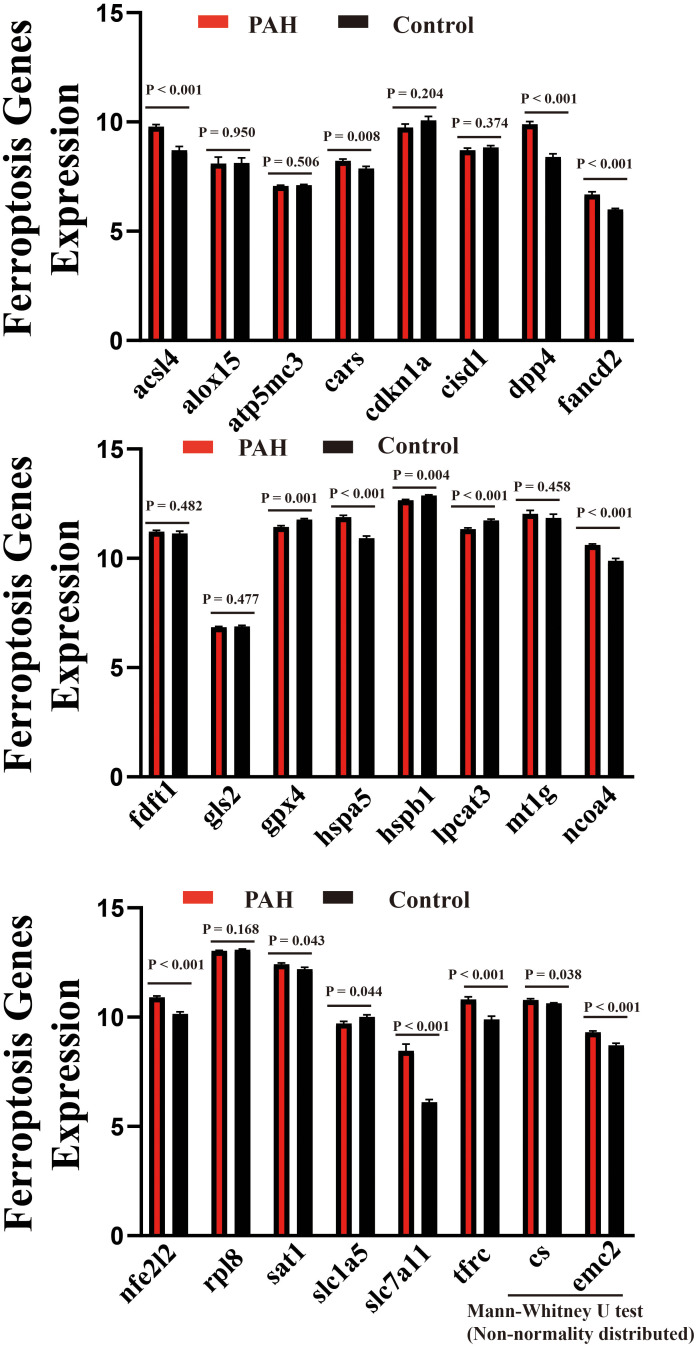
One thousand nine hundred sixty-two upregulated genes and 642 downregulated genes were identified. Molecular complex detection analyses revealed that the significant biological processes associated with upregulated genes included DNA damage response, mitotic cell cycle, and chromosome organization. In contrast, the signifi ant biological processes related to downregulated genes encompassed cellular response to growth factor stimulus, response to growth factor, and blood vessel development. Immune infilt ation analysis indicated that PAH is associated with signifi ant changes in the distribution of immune cells and differential expression of immune checkpoints. Furthermore, 58 isorhamnetin targets were extracted from the CTD, and we identified 1 interacting gene, NFE2L2, among the differentially expressed genes (DEGs), DEGs related to ferroptosis, and isorhamnetin targets. Isorhamnetin demonstrated strong affinities with vascular endothelial growth factor (VEGF) receptors and transcription factors (ATM and ZNF24) associated with VEGFs, as well as the ferroptosis protein NFE2L2.
Pulmonary arterial hypertension is characterized by a series of abnormalities in downstream molecular signaling pathways, including DNA damage, immune dysregulation, VEGF signaling deficienc , and the ferroptosis process. These may represent the core pathophysiological mechanisms of PAH. Ferroptosis-related genes, such as NFE2L2 and TF (ATM, ZNF24) associated with VEGFs, are potential therapeutic targets that contribute to the mechanisms mentioned above. Isorhamnetin is a promising candidate compound for the treatment of PAH.
本研究旨在确定肺动脉高压(PAH)的关键通路和潜在治疗靶点,并进一步评估异鼠李素的抗PAH作用。
从基因表达综合数据库(GEO)下载PAH的基因表达谱数据集(GSE113439)。从比较毒理基因组学数据库(CTD)中提取异鼠李素的靶基因。采用多种生物信息学方法来识别与PAH相关的核心通路和潜在干预靶点。在相互作用的靶点与候选化合物异鼠李素之间进行分子对接。
共鉴定出1962个上调基因和642个下调基因。分子复合物检测分析显示,与上调基因相关的显著生物学过程包括DNA损伤反应、有丝分裂细胞周期和染色体组织。相比之下,与下调基因相关的显著生物学过程包括细胞对生长因子刺激的反应、对生长因子的反应和血管发育。免疫浸润分析表明,PAH与免疫细胞分布的显著变化和免疫检查点的差异表达有关。此外,从CTD中提取了58个异鼠李素靶点,我们在差异表达基因(DEG)、与铁死亡相关的DEG和异鼠李素靶点中鉴定出1个相互作用基因NFE2L2。异鼠李素与血管内皮生长因子(VEGF)受体以及与VEGF相关的转录因子(ATM和ZNF24)以及铁死亡蛋白NFE2L2表现出很强的亲和力。
肺动脉高压的特征是下游分子信号通路存在一系列异常,包括DNA损伤、免疫失调、VEGF信号缺陷和铁死亡过程。这些可能代表了PAH的核心病理生理机制。与VEGF相关的铁死亡相关基因,如NFE2L2和转录因子(ATM、ZNF24),是导致上述机制的潜在治疗靶点。异鼠李素是一种有前景的治疗PAH的候选化合物。