Broeren Eleanor, Gitau Vanessa, Byrne Alicia, Ajuyah Pamela, Balzotti Marie, Berg Jonathan, Bluske Krista, Bowen B Monica, Brown Matthew P, Buchanan Amanda, Burns Brendan, Burns Nicole J, Chandrasekhar Anjana, Chawla Aditi, Chong Jessica, Chopra Maya, Clause Amanda, DiStefano Marina, DiTroia Stephanie, Elnagheeb Marwa, Girod Amanda, Goel Himanshu, Golden-Grant Katie, Ha Thuong, Hamosh Ada, Huang Jennifer, Hughes Madeline, Jamuar Saumya, Kam Sylvia, Kesari Akanchha, Koh Ai Ling, Lassiter Rhonda, Leigh Sarah, Lemire Gabrielle, Lim Jiin Ying, Malhotra Alka, McCurry Hannah, Milewski Becky, Moosa Shahida, Murray Stephen, Owens Emma, Palmer Emma, Palus Brooke, Patel Mayher, Rajkumar Revathi, Ratliff Julie, Raymond F Lucy, Assis Bruno Della Ripa Rodrigues, Sajan Samin, Schlachetzki Zinayida, Schmidt Sarah, Stark Zornitza, Strom Samuel, Taylor Julie, Thaxton Courtney, Thrush Devon, Toro Sabrina, Tshering Kezang, Vasilevsky Nicole, Wayburn Bess, Webb Ryan, O'Donnell-Luria Anne, Coffey Alison J
Program in Medical and Population Genetics, Broad Institute of MIT and Harvard, Cambridge, MA, United States.
Myriad Women's Health, Myriad Genetics, South San Francisco, CA, United States.
medRxiv. 2024 Nov 20:2024.11.19.24317561. doi: 10.1101/2024.11.19.24317561.
The Clinical Genome Resource (ClinGen) Gene Curation Expert Panels (GCEPs) have historically focused on specific organ systems or phenotypes; thus, the ClinGen Syndromic Disorders GCEP (SD-GCEP) was formed to address an unmet need.
The SD-GCEP applied ClinGen's framework to evaluate the clinical validity of genes associated with rare syndromic disorders. 111 Gene-Disease Relationships (GDRs) associated with 100 genes spanning the clinical spectrum of syndromic disorders were curated.
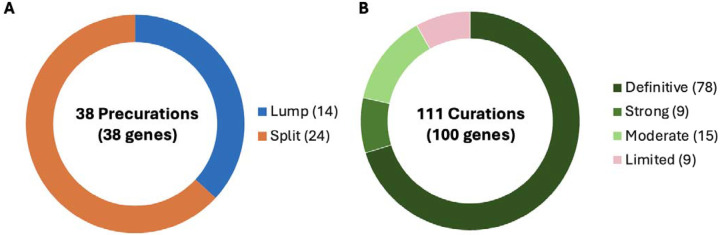
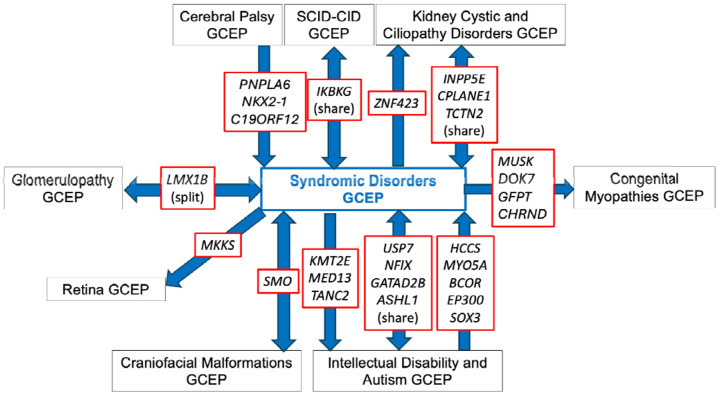
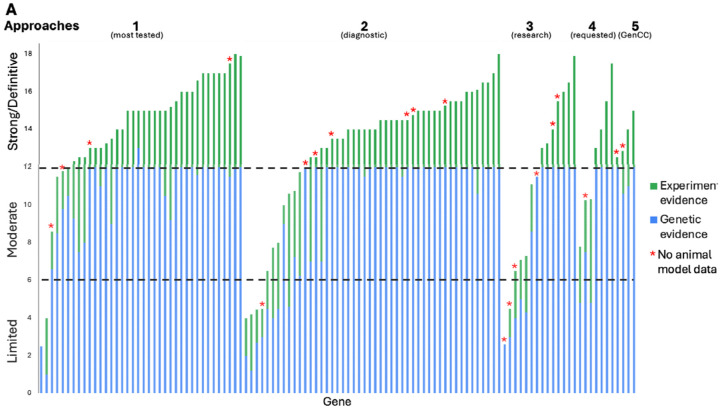
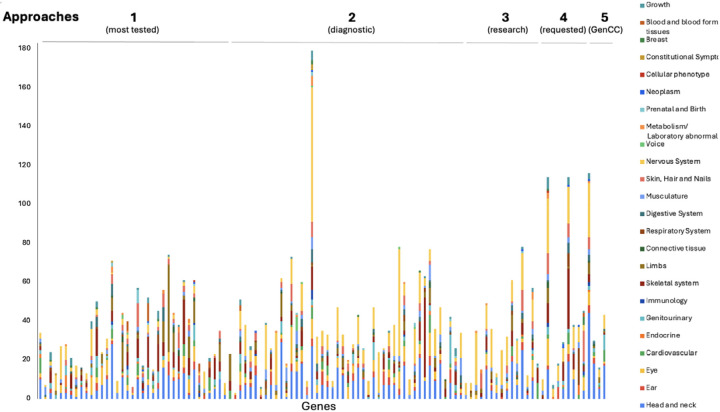
From April 2020 through March 2024, 38 precurations were performed on genes with multiple disease relationships and were reviewed to determine if the disorders were part of a spectrum or distinct entities. 14 genes were lumped into a single disease entity and 24 were split into separate entities, of which 11 were curated by the SD-GCEP. A full review of 111 GDRs for 100 genes followed, with 78 classified as Definitive, 9 as Strong, 15 as Moderate, and 9 as Limited highlighting where further data are needed. All diseases involved two or more organ systems, while the majority (88/111 GDRs, 79.2%) had five or more organ systems affected.
The SD-GCEP addresses a critical gap in gene curation efforts, enabling inclusion of genes for syndromic disorders in clinical testing and contributing to keeping pace with the rapid discovery of new genetic syndromes.
临床基因组资源(ClinGen)基因管理专家小组(GCEPs)以往专注于特定器官系统或表型;因此,ClinGen综合征性疾病GCEP(SD - GCEP)应运而生,以满足一项未被满足的需求。
SD - GCEP应用ClinGen的框架来评估与罕见综合征性疾病相关基因的临床有效性。整理了与100个基因相关的111种基因 - 疾病关系(GDRs),这些基因涵盖了综合征性疾病的临床谱。
从2020年4月到2024年3月,对具有多种疾病关系的基因进行了38次预整理,并进行审查以确定这些疾病是谱系的一部分还是不同的实体。14个基因被归为单一疾病实体,24个被拆分为单独的实体,其中11个由SD - GCEP整理。随后对100个基因的111种GDRs进行了全面审查,其中78种被归类为确定型,9种为强型,15种为中型,9种为有限型,突出了需要进一步数据的地方。所有疾病都涉及两个或更多器官系统,而大多数(88/111种GDRs,79.2%)有五个或更多器官系统受到影响。
SD - GCEP填补了基因管理工作中的一个关键空白,使临床检测中能够纳入综合征性疾病的相关基因,并有助于跟上新遗传综合征快速发现的步伐。