Shen Yangyang, Verkhoglyadova Olga P, Artemyev Anton, Hartinger Michael D, Angelopoulos Vassilis, Shi Xueling, Zou Ying
Department of Earth, Planetary, and Space Sciences University of California Los Angeles CA USA.
Jet Propulsion Laboratory California Institute of Technology Pasadena CA USA.
AGU Adv. 2024 Dec;5(6):e2024AV001302. doi: 10.1029/2024AV001302. Epub 2024 Nov 25.
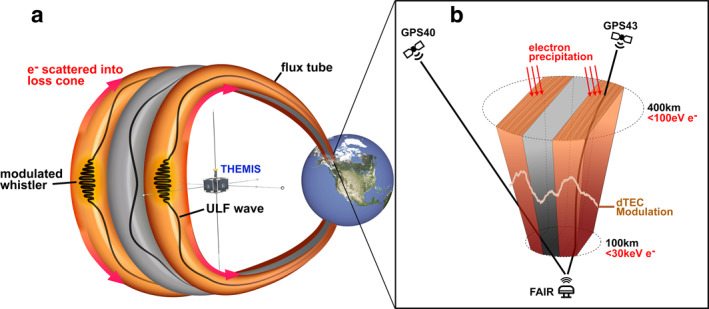
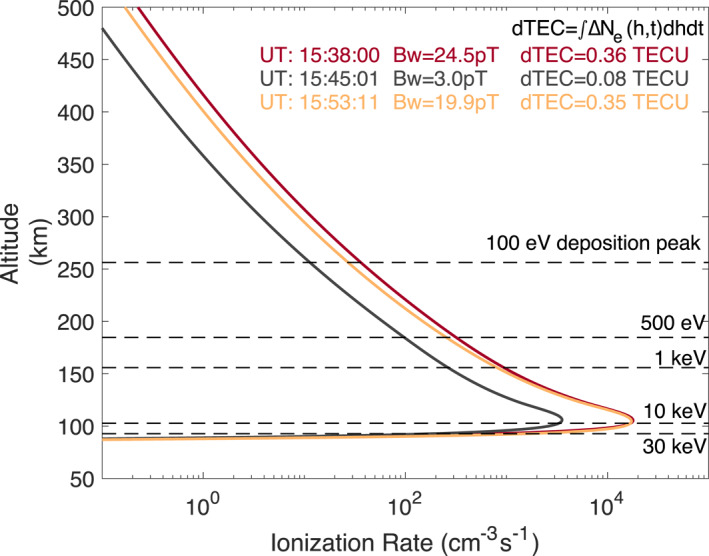
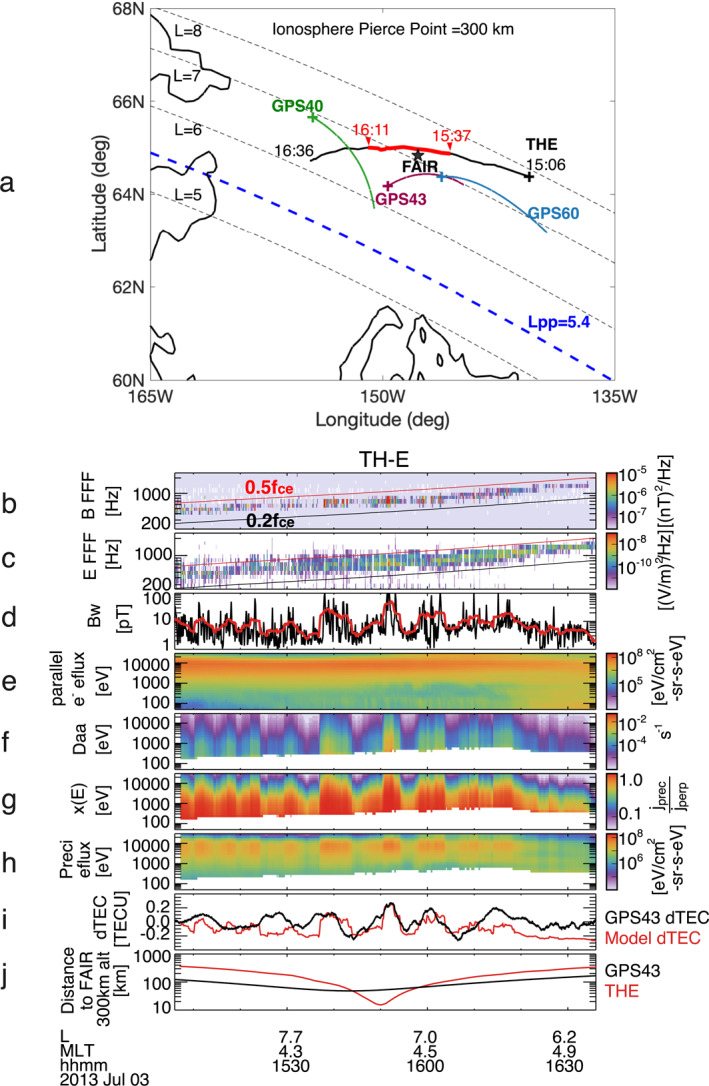
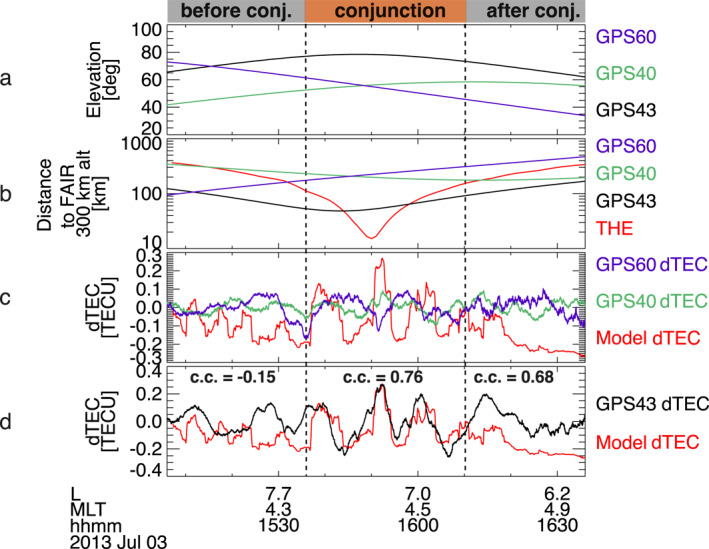
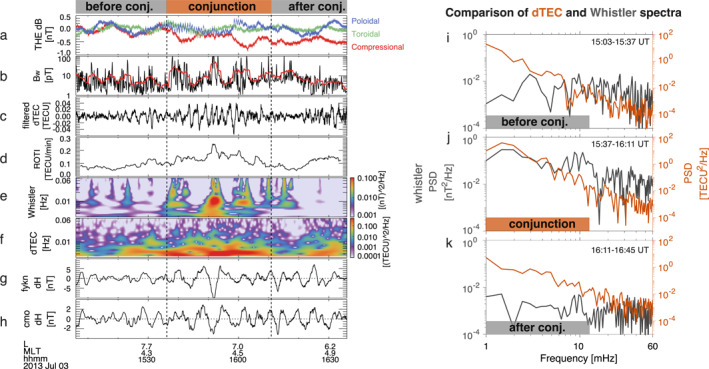
The weakly ionized plasma in the Earth's ionosphere is controlled by a complex interplay between solar and magnetospheric inputs from above, atmospheric processes from below, and plasma electrodynamics from within. This interaction results in ionosphere structuring and variability that pose major challenges for accurate ionosphere prediction for global navigation satellite system (GNSS) related applications and space weather research. The ionospheric structuring and variability are often probed using the total electron content (TEC) and its relative perturbations (dTEC). Among dTEC variations observed at high latitudes, a unique modulation pattern has been linked to magnetospheric ultra-low-frequency (ULF) waves, yet its underlying mechanisms remain unclear. Here using magnetically conjugate observations from the THEMIS spacecraft and a ground-based GPS receiver at Fairbanks, Alaska, we provide direct evidence that these dTEC modulations are driven by magnetospheric electron precipitation induced by ULF-modulated whistler-mode waves. We observed peak-to-peak dTEC amplitudes reaching 0.5 TECU (1 TECU is equal to electrons/ ) with modulations spanning scales of 5-100 km. The cross-correlation between our modeled and observed dTEC reached 0.8 during the conjugacy period but decreased outside of it. The spectra of whistler-mode waves and dTEC also matched closely at ULF frequencies during the conjugacy period but diverged outside of it. Our findings elucidate the high-latitude dTEC generation from magnetospheric wave-induced precipitation, addressing a significant gap in current physics-based dTEC modeling. Theses results thus improve ionospheric dTEC prediction and enhance our understanding of magnetosphere-ionosphere coupling via ULF waves.
地球电离层中的弱电离等离子体受到来自上方的太阳和磁层输入、来自下方的大气过程以及内部的等离子体电动力学之间复杂相互作用的控制。这种相互作用导致电离层的结构和变化,给全球导航卫星系统(GNSS)相关应用的精确电离层预测和空间天气研究带来了重大挑战。电离层的结构和变化通常使用总电子含量(TEC)及其相对扰动(dTEC)进行探测。在高纬度地区观测到的dTEC变化中,一种独特的调制模式与磁层超低频(ULF)波有关,但其潜在机制仍不清楚。在这里,我们利用来自THEMIS航天器和阿拉斯加费尔班克斯地面GPS接收器的磁共轭观测数据,提供了直接证据,证明这些dTEC调制是由ULF调制哨声波模式引起的磁层电子降水驱动的。我们观测到峰峰值dTEC振幅达到0.5 TECU(1 TECU等于电子数/),调制范围跨越5 - 100公里的尺度。在共轭期间,我们模拟的和观测的dTEC之间的互相关达到0.8,但在共轭期之外则下降。在共轭期间,哨声波模式和dTEC的频谱在ULF频率上也紧密匹配,但在共轭期之外则出现分歧。我们的研究结果阐明了磁层波诱导降水产生的高纬度dTEC,填补了当前基于物理的dTEC建模中的一个重大空白。因此,这些结果改进了电离层dTEC预测,并增强了我们对通过ULF波的磁层-电离层耦合的理解。