Damci Aysun, den Hollander Marlies, Hoeijmakers Janneke G J, Faber Catharina G, Goossens Mariëlle E J B, Verbunt Jeanine A M C F
Mental Health and Neuroscience Research Institute, Maastricht University, Maastricht, Netherlands.
Department of Neurology, Maastricht University Medical Centre, Maastricht, Netherlands.
Front Neurol. 2024 Nov 13;15:1493326. doi: 10.3389/fneur.2024.1493326. eCollection 2024.
Small fiber neuropathy (SFN) is a chronic neuropathic pain condition that can lead to a decreased quality of life (QOL) and disability. Current pain treatment is mainly symptomatic, consisting of analgesics, with often disappointing results. There is a need for new, more effective treatment modality. Treatment based on a biopsychosocial approach on SFN-related pain may be a promising alternative. A rehabilitation treatment study protocol is presented with the following main objective: to test the effect of a tailored interdisciplinary rehabilitation treatment targeting both cognitive and psychological factors related to pain, in decreasing disability, and improving QOL in SFN.
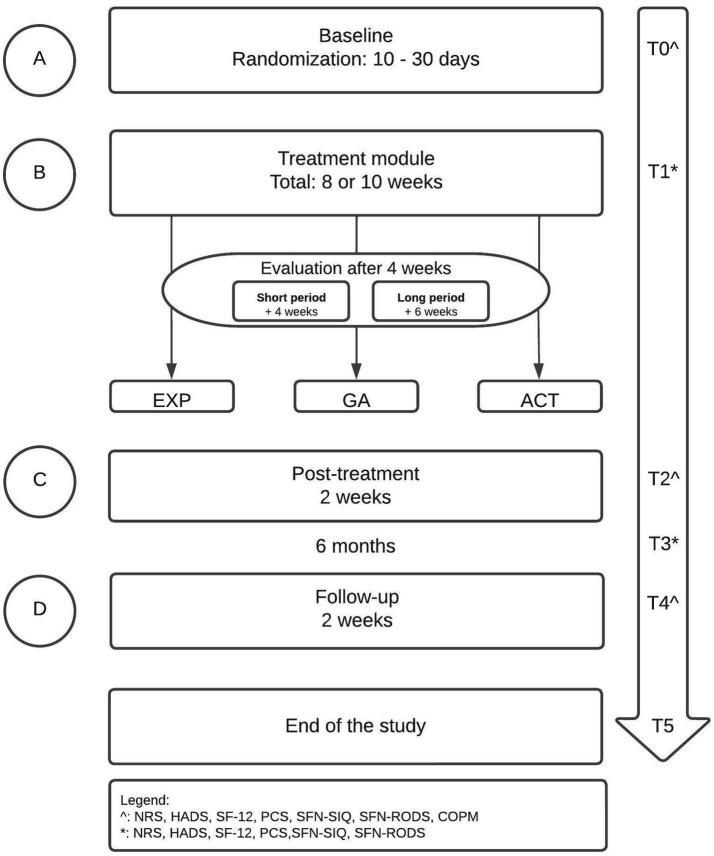
Single-case experimental design. Ten participants with SFN will be included. Every patient will be offered a personalized program based on one of three rehabilitation treatment modules (graded activity, exposure or acceptance and commitment therapy) depending on the most prominent factor maintaining disability. Treatment will be provided for at least 8 weeks with 2 sessions a week.
DISCUSSION/CONCLUSION: This is the first study investigating personalized rehabilitation treatment in patients with idiopathic SFN. The findings are expected to result in an effective treatment for SFN with an increase in QOL and a decrease in disability.
ClinicalTrials.gov, identifier NCT05798949.
小纤维神经病变(SFN)是一种慢性神经性疼痛疾病,可导致生活质量(QOL)下降和残疾。目前的疼痛治疗主要是对症治疗,包括使用镇痛药,但效果往往令人失望。需要新的、更有效的治疗方式。基于生物心理社会方法治疗SFN相关疼痛可能是一种有前景的替代方法。本文介绍了一项康复治疗研究方案,其主要目标如下:测试一种针对与疼痛相关的认知和心理因素的量身定制的跨学科康复治疗,对降低SFN患者的残疾程度和提高生活质量的效果。
单病例实验设计。将纳入10名SFN患者。根据维持残疾的最突出因素,为每位患者提供基于三个康复治疗模块(分级活动、暴露或接受与承诺疗法)之一的个性化方案。治疗将至少持续8周,每周进行2次。
讨论/结论:这是第一项研究特发性SFN患者个性化康复治疗的研究。预期研究结果将产生一种有效的SFN治疗方法,提高生活质量并降低残疾程度。
ClinicalTrials.gov,标识符NCT05798949。