Department of Neurology, Leiden University Medical Centre, Leiden, The Netherlands.
Division of Vascular Medicine and Pharmacology, Department of Internal Medicine, Erasmus University Medical Centre, Rotterdam, The Netherlands.
Eur J Neurol. 2024 Feb;31(2):e16106. doi: 10.1111/ene.16106. Epub 2023 Oct 17.
The aim was to evaluate the effect of anti-calcitonin gene related peptide (CGRP) (ligand or receptor) antibodies on depressive symptoms in subjects with migraine and to determine whether depressive symptoms predict treatment response.
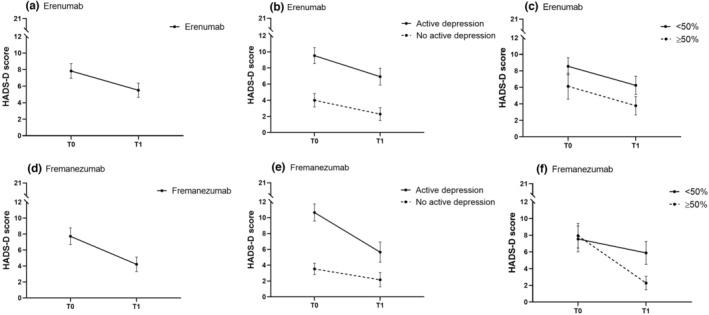
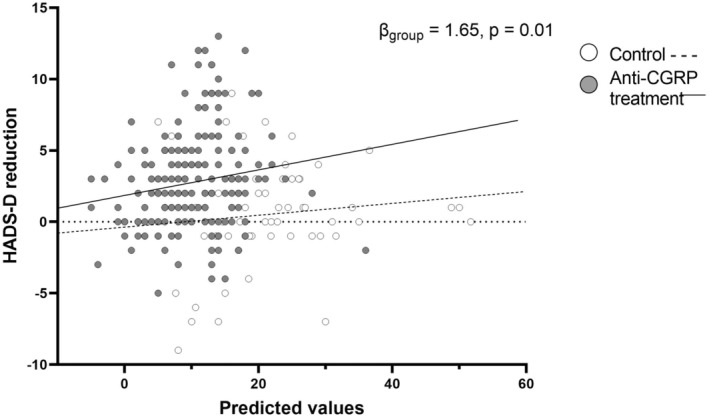
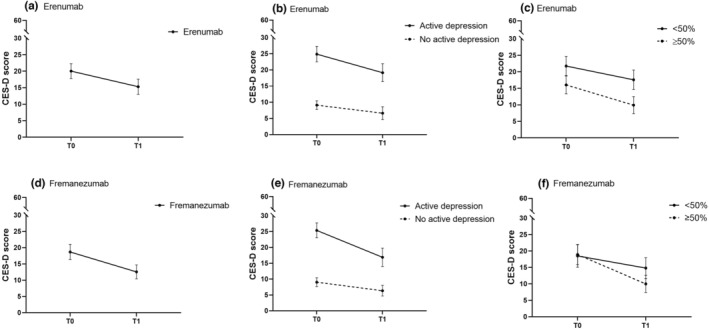
Patients with migraine treated with erenumab and fremanezumab at the Leiden Headache Centre completed daily E-headache diaries. A control group was included. Depressive symptoms were assessed using the Hospital Anxiety and Depression Scale (HADS) and the Center for Epidemiological Studies Depression Scale (CES-D) questionnaires at baseline (T0) and after 3 months (T1). First, the effect of treatment on the reduction in HADS-D and CES-D scores was assessed, with reduction in depression scores as the dependent variable and reduction in monthly migraine days (MMD) and treatment with anti-CGRP medication as independent variables. Second, depression as a predictor of treatment response was investigated, using the absolute reduction in MMD as a dependent variable and age, gender, MMD, active depression, impact, stress and locus of control scores as independent variables.
In total, n = 108 patients were treated with erenumab, n = 90 with fremanezumab and n = 68 were without active treatment. Treatment with anti-CGRP medication was positively associated with a reduction in the HADS-D (β = 1.65, p = 0.01) compared to control, independent of MMD reduction. However, the same effect was not found for the CES-D (β = 2.15, p = 0.21). Active depression predicted poorer response to erenumab (p = 0.02) but not to fremanezumab (p = 0.09).
Anti-CGRP (ligand or receptor) monoclonals lead to improvement of depressive symptoms in individuals with migraine, independent of migraine reduction. Depression may predict treatment response to erenumab but not to fremanezumab.
本研究旨在评估抗降钙素基因相关肽(CGRP)(配体或受体)抗体对偏头痛患者抑郁症状的影响,并确定抑郁症状是否能预测治疗反应。
在莱顿头痛中心,接受依那西普和弗雷美尼单抗治疗的偏头痛患者完成每日电子头痛日记。纳入了一个对照组。在基线(T0)和 3 个月(T1)时,使用医院焦虑抑郁量表(HADS)和流行病学研究中心抑郁量表(CES-D)评估抑郁症状。首先,评估治疗对 HADS-D 和 CES-D 评分降低的影响,将抑郁评分降低作为因变量,每月偏头痛天数(MMD)减少和抗 CGRP 药物治疗作为自变量。其次,将抑郁作为治疗反应的预测因子进行研究,将 MMD 的绝对减少作为因变量,年龄、性别、MMD、活动性抑郁、影响、压力和控制源评分作为自变量。
共有 108 例患者接受依那西普治疗,90 例患者接受弗雷美尼单抗治疗,68 例患者未接受活性治疗。与对照组相比,抗 CGRP 药物治疗与 HADS-D 评分降低呈正相关(β=1.65,p=0.01),与 MMD 降低无关。然而,对于 CES-D 评分,未发现同样的效果(β=2.15,p=0.21)。活动性抑郁预测依那西普治疗反应较差(p=0.02),但对弗雷美尼单抗治疗反应无影响(p=0.09)。
抗 CGRP(配体或受体)单克隆抗体可改善偏头痛患者的抑郁症状,与偏头痛缓解无关。抑郁可能预测依那西普治疗反应,但不能预测弗雷美尼单抗治疗反应。