Okabe Makoto, Yamamoto Shuji, Shiokawa Masahiro, Hisamatsu Tadakazu, Yamazaki Hajime, Nakanishi Risa, Hamada Kensuke, Kitamoto Hiroki, Kuwada Takeshi, Uza Norimitsu, Sakatani Aki, Fujii Toshimitsu, Ohno Masashi, Matsuura Minoru, Shibuya Tomoyoshi, Ohmiya Naoki, Ooi Makoto, Hoshi Namiko, Moriya Kei, Tsuchiya Kiichiro, Yamaguchi Yoshiharu, Kunisaki Reiko, Takahara Masahiro, Takagi Tomohisa, Takehara Tetsuo, Hirai Fumihito, Kakimoto Kazuki, Esaki Motohiro, Nakase Hiroshi, Kinjo Fukunori, Torisu Takehiro, Kanmura Shuji, Narimatsu Kazuyuki, Matsuoka Katsuyoshi, Hiraga Hiroto, Yokoyama Kaoru, Honzawa Yusuke, Naganuma Makoto, Saruta Masayuki, Kodama Yuzo, Chiba Tsutomu, Seno Hiroshi
Department of Gastroenterology and Hepatology, Graduate School of Medicine, Kyoto University, 54 Shogoin Kawahara-cho, Sakyo-ku, Kyoto, 606-8507, Japan.
Department of Gastroenterology and Hepatology, Kyorin University School of Medicine, Mitaka-shi, Tokyo, 181-8611, Japan.
J Gastroenterol. 2025 Jan;60(1):86-95. doi: 10.1007/s00535-024-02176-x. Epub 2024 Nov 28.
A serum biomarker for diagnosing ulcerative colitis (UC) remains to be established. Although we recently reported an anti-integrin αvβ6 antibody (V6 Ab) for diagnosing UC with high sensitivity and specificity, no large-scale validation study exists. This study aimed to validate the diagnostic value of V6 Ab for UC using a nationwide multicenter cohort study.
We measured V6 Ab titers in patients definitively diagnosed with UC, Crohn's disease (CD), or other gastrointestinal disorders (OGDs). The primary outcome was the diagnostic value of V6 Ab. Secondary outcomes were factors associated with false-negative results in patients with UC and false-positive results in patients without UC and the heterogeneity of the diagnostic value of V6 Ab among the participating facilities.
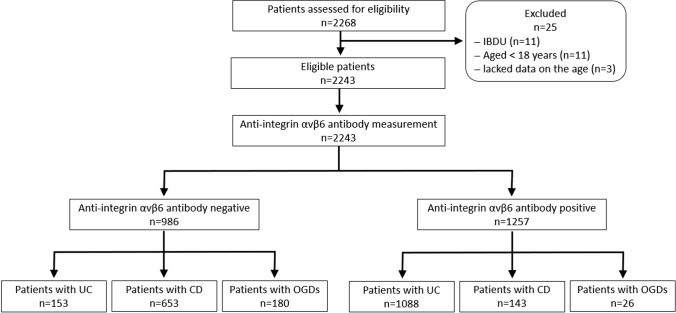
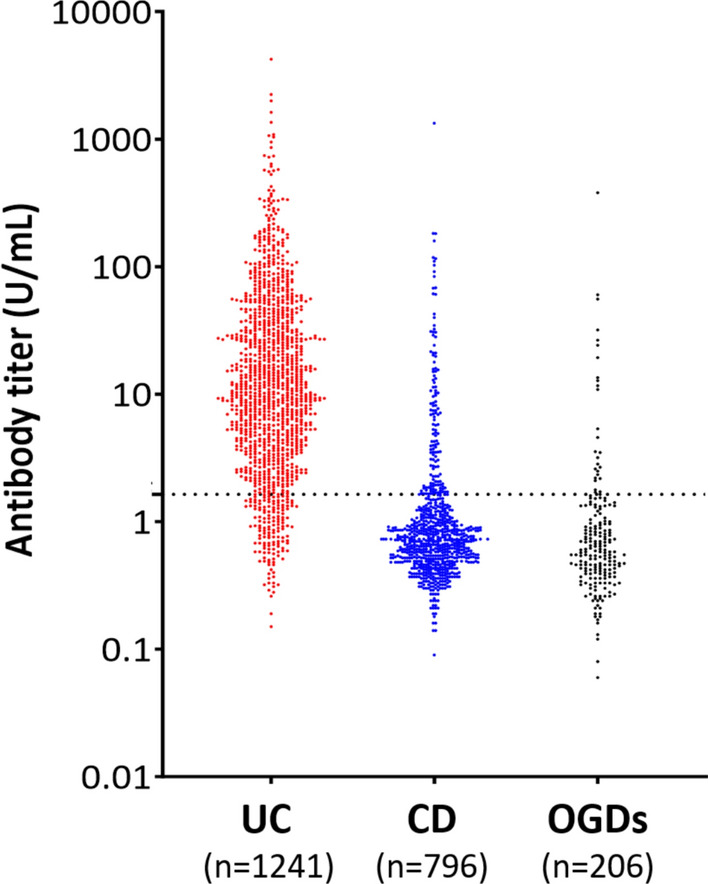
We enrolled 1241, 796, and 206 patients with UC, CD, and OGD, respectively, from 28 Japanese high-volume referral centers. The diagnostic sensitivity of V6 Ab for UC was 87.7%, and its specificities for CD and OGDs were 82.0% and 87.4%, respectively. Multivariable logistic regression analysis showed that false-negative results were associated with older age at the time of sample collection, current smokers, lower partial Mayo score, and not receiving advanced therapies in patients with UC, and false-positive results were associated with colonic CD in patients with CD. No factor was associated with false-positive results in patients with OGDs. There were no significant differences in the diagnostic value of V6 Ab among the centers.
The diagnostic value of V6 Ab for UC was validated in the large-scale nationwide multicenter study.
用于诊断溃疡性结肠炎(UC)的血清生物标志物仍有待确立。尽管我们最近报道了一种抗整合素αvβ6抗体(V6抗体)用于诊断UC具有高敏感性和特异性,但尚无大规模验证研究。本研究旨在通过一项全国性多中心队列研究来验证V6抗体对UC的诊断价值。
我们测定了确诊为UC、克罗恩病(CD)或其他胃肠道疾病(OGD)患者的V6抗体滴度。主要结局是V6抗体的诊断价值。次要结局是与UC患者假阴性结果和非UC患者假阳性结果相关的因素,以及参与机构中V6抗体诊断价值的异质性。
我们从28个日本大型转诊中心分别纳入了1241例、796例和206例UC、CD和OGD患者。V6抗体对UC的诊断敏感性为87.7%,对CD和OGD的特异性分别为82.0%和87.4%。多变量逻辑回归分析显示,假阴性结果与样本采集时年龄较大、当前吸烟者、较低的部分梅奥评分以及UC患者未接受高级治疗有关,假阳性结果与CD患者的结肠CD有关。没有因素与OGD患者的假阳性结果相关。各中心之间V6抗体的诊断价值没有显著差异。
在大规模全国性多中心研究中验证了V6抗体对UC的诊断价值。