Iqbal Ummar, Azam Akkasha, Ahmad Khawaja Shafique, Mumtaz Sahar, Mehmood Ansar, Naz Nargis, Usman Zartasha, Abbas Hina, Akram Muhammad
Department of Botany, The Islamia University of Bahawalpur, Bahawalpur, 63100, Pakistan.
Department of Botany, University of Poonch Rawalakot, Rawalakot, 12350, Pakistan.
Bot Stud. 2024 Nov 29;65(1):36. doi: 10.1186/s40529-024-00440-0.
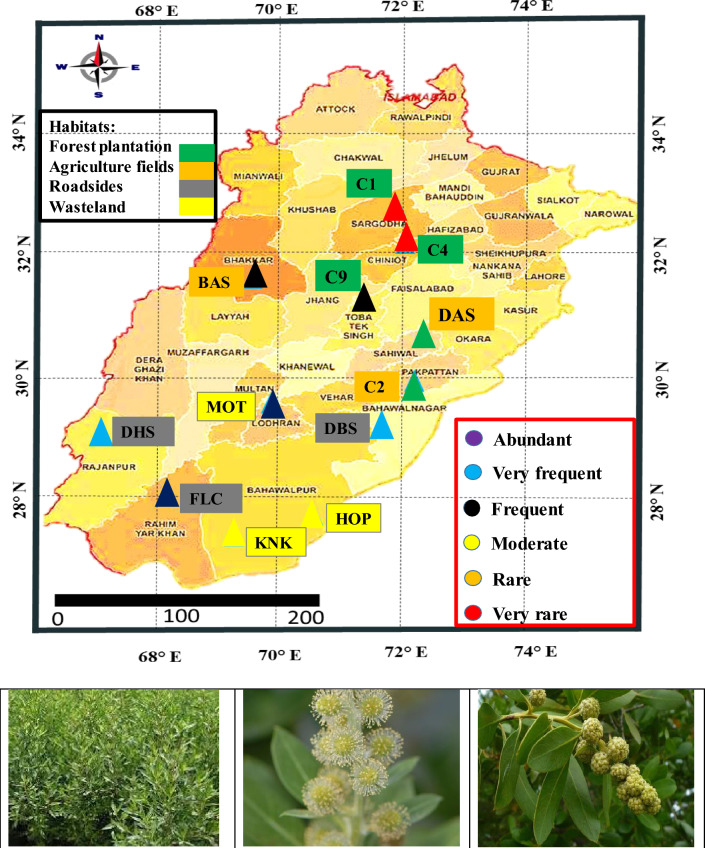
The button mangrove (Conocarpus erectus L.) is regarded as a peripheral species within mangrove communities. This particular species has the ability to thrive in regions that are arid or semiarid, where there is limited availability of nutrients. This study provides evidence of the ecological dominance of Conocarpus erectus across various habitats, highlighting its adaptability and success throughout the country of Pakistan. We collected twelve populations from four distinct ecological regions, including artificial forest plantations, agricultural fields, roadsides, and wastelands, offering a comprehensive assessment of C. erectus adaptability across diverse environmental contexts.
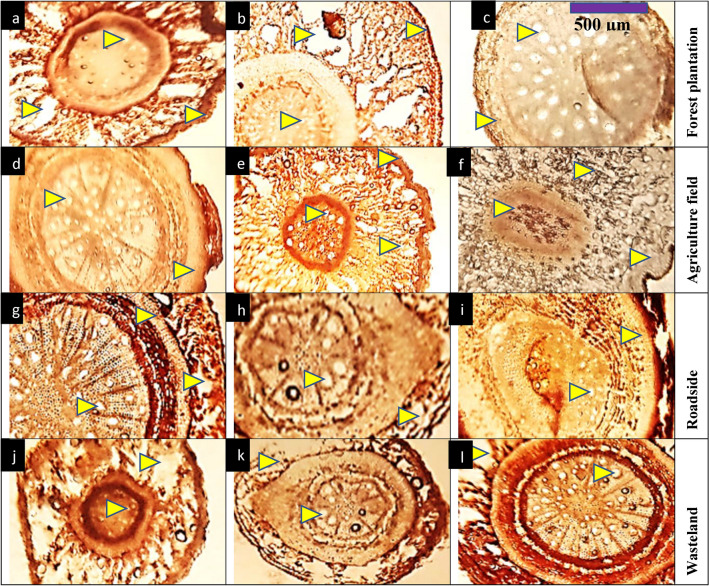
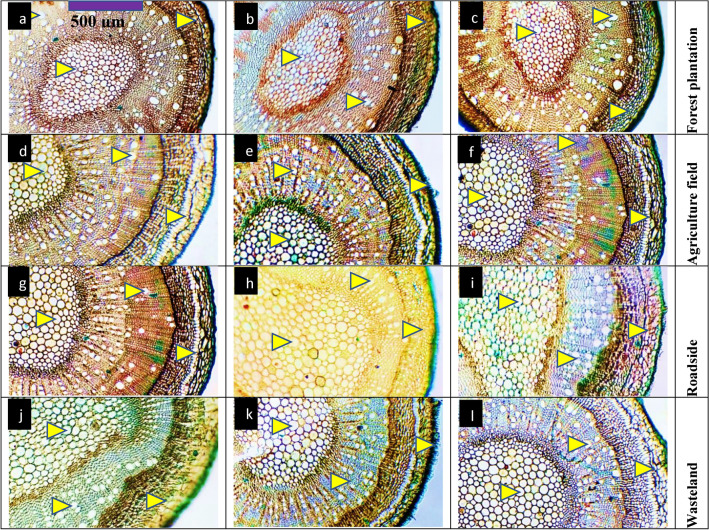
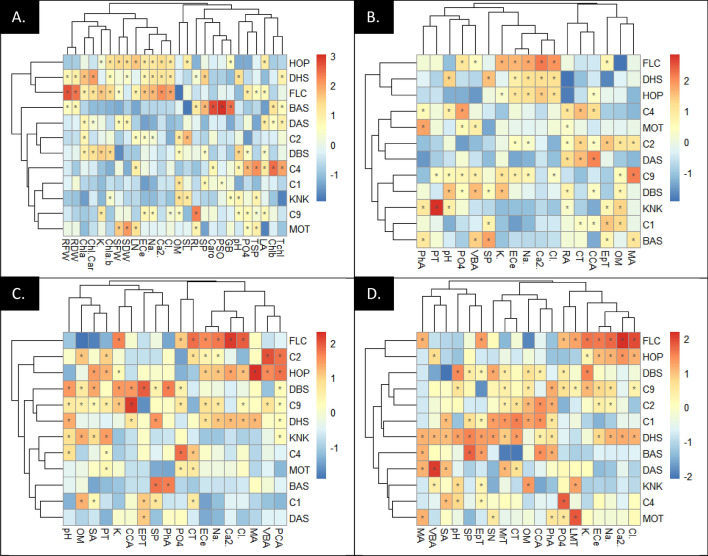
Forest plantation populations exhibited impressive shoot growth and moderate root lengths, with plants generally tall and well-weighted. Physiologically, they had moderate chlorophyll content and low carotenoid levels, with a balanced chlorophyll a/b ratio, indicating stable photosynthetic activity. Anatomically, these populations had thicker epidermal and cortical root layers but smaller vascular bundles and phloem regions. Stem and leaf structures were generally moderate in size, with thicker midribs and cortical layers in the leaves. Agricultural field populations showed robust shoot and root systems with balanced fresh and dry biomass. They exhibited high chlorophyll and carotenoid levels, indicating strong photosynthetic capacity. Root and stem anatomy revealed larger root areas, thicker cortex, and wide vascular bundles, reflecting enhanced structural development. Leaves from these populations had moderate midrib and cortical thickness, with larger stomatal areas, promoting efficient gas exchange. Roadside populations displayed deeper roots and reduced biomass production. These populations adapted to environmental stress through leaf expansion, with high leaf numbers and areas. Physiologically, populations had high chlorophyll content, with a high chlorophyll a/b ratio. Root and stem anatomy showed compact structures with smaller vascular bundles, indicating adaptation to harsher conditions. Leaf anatomy was moderate, with smaller vascular bundles and reduced water transport capacity. Wasteland populations exhibited poor growth and high shoot biomass despite small leaves. Physiologically, these populations had the highest total soluble protein and proline contents, reflecting stress adaptation. Anatomically, root and stem structures were variable, with some populations showing reduced cortical cell areas and smaller vascular bundles, indicating limited resource transport. Leaf structures had thicker lamina, thinner epidermal layers, and lower stomatal densities, reflecting adaptation to nutrient-poor soils.
This study reveals the adaptability and thriving potential of Conocarpus erectus across varied habitats, providing key insights into its resilience and survival strategies. Understanding these adaptive traits can support habitat restoration, conservation planning, and improve species management in diverse environmental conditions, especially in response to climate change and habitat degradation.
纽扣红树(Conocarpus erectus L.)被视为红树林群落中的边缘物种。该特定物种有能力在干旱或半干旱地区茁壮成长,这些地区养分供应有限。本研究提供了纽扣红树在不同栖息地生态优势的证据,突出了其在巴基斯坦全国的适应性和成功之处。我们从四个不同的生态区域收集了12个种群,包括人工林种植园、农田、路边和荒地,全面评估了纽扣红树在不同环境背景下的适应性。
人工林种植园种群表现出令人印象深刻的地上部分生长和适中的根长,植株通常高大且重量适宜。生理上,它们的叶绿素含量适中,类胡萝卜素水平较低,叶绿素a/b比例平衡,表明光合活动稳定。解剖学上,这些种群的根表皮和皮层较厚,但维管束和韧皮部区域较小。茎和叶结构一般大小适中,叶片中脉和皮层较厚。农田种群的地上部分和根系健壮,鲜重和干重平衡。它们的叶绿素和类胡萝卜素水平较高,表明光合能力较强。根和茎的解剖结构显示根面积较大、皮层较厚且维管束较宽,反映出结构发育增强。这些种群的叶片中脉和皮层厚度适中,气孔面积较大,有利于高效气体交换。路边种群的根更深,生物量生产减少。这些种群通过叶片扩展适应环境压力,叶片数量和面积较多。生理上,种群叶绿素含量高,叶绿素a/b比例高。根和茎的解剖结构显示结构紧凑,维管束较小,表明适应更恶劣的条件。叶片解剖结构适中,维管束较小,水分运输能力降低。荒地种群尽管叶片小,但生长不良且地上生物量高。生理上,这些种群的总可溶性蛋白和脯氨酸含量最高,反映出对压力的适应。解剖学上,根和茎结构各异,一些种群的皮层细胞面积减小,维管束较小,表明资源运输有限。叶片结构的叶片较厚、表皮层较薄且气孔密度较低,反映出对贫瘠土壤的适应。
本研究揭示了纽扣红树在不同栖息地的适应性和繁荣潜力,为其恢复力和生存策略提供了关键见解。了解这些适应性特征有助于栖息地恢复、保护规划,并改善不同环境条件下的物种管理,特别是应对气候变化和栖息地退化。