Department of Bioprocess Development, Genetic Engineering and Biotechnology Research Institute, City of Scientific Research and Technological Applications (SRTA-City), New Borg El-Arab City, 21934, Alexandria, Egypt.
Microbial Biotechnology Department, Genetic Engineering and Biotechnology Research Institute, University of Sadat City, Sadat City, Egypt.
Sci Rep. 2024 Nov 28;14(1):29625. doi: 10.1038/s41598-024-77867-9.
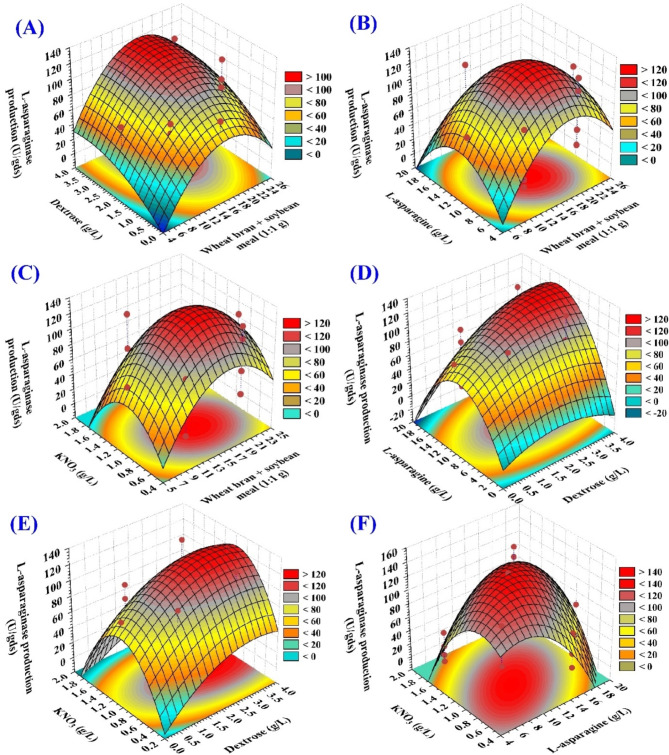
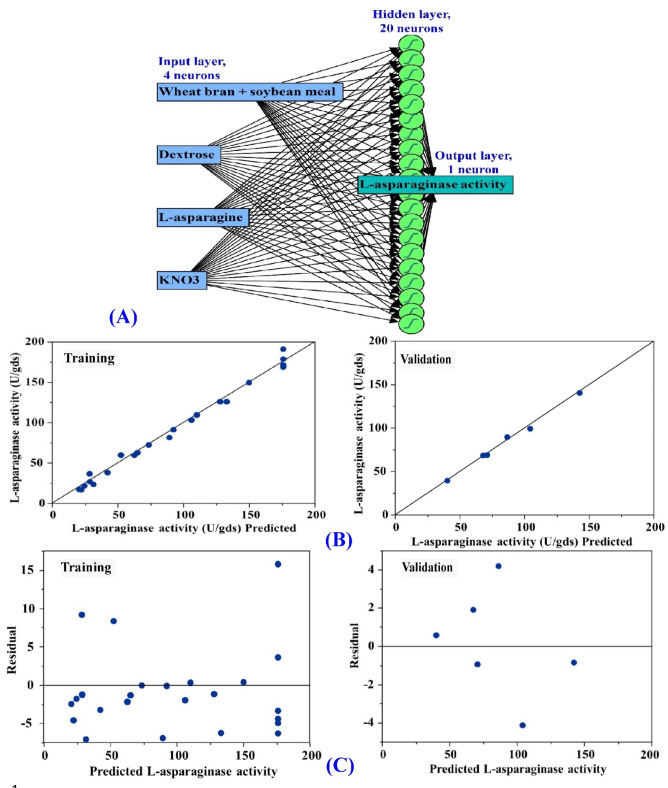
The bacterial L-asparaginase is a highly effective chemotherapeutic drug and a cornerstone of treatment protocols used for treatment the acute lymphoblastic leukemia in pediatric oncology. A potential actinomycete isolate, Streptomyces sp. strain NEAE-99, produces glutaminase-free L-asparaginase was isolated from a soil sample. This potential strain was identified as S. violaceoruber strain NEAE-99. The central composite design (CCD) approach was utilized for finding the optimal values for four variables including the mixture of soybean and wheat bran in a 1:1 ratio (w/w), the concentrations of dextrose, L-asparagine, and potassium nitrate under solid state fermentation conditions. Through the use of an artificial neural network (ANN), the production of L-asparaginase by S. violaceoruber has been investigated, validated, and predicted in comparison to CCD. It was found that the optimal predicted conditions for maximum L-asparaginase production (216.19 U/gds) were 8.46 g/250 mL Erlenmeyer flask of soybean and wheat bran mixture in a 1:1 ratio (w/w), 2.2 g/L of dextrose, 18.97 g/L of L-asparagine, and 1.34 g/L of KNO. The experimental results (207.55 U/gds) closely approximated the theoretical values (216.19 U/gds), as evidenced by the validation. This suggests that the ANN exhibited a high degree of precision and predictive capability.
细菌来源的 L-天冬酰胺酶是一种高效的化疗药物,也是儿科肿瘤学中治疗急性淋巴细胞白血病的治疗方案的基石。从土壤样本中分离到一种潜在的放线菌分离株,即链霉菌属 NEAE-99 株,它可以产生无谷氨酰胺酶的 L-天冬酰胺酶。该潜在菌株被鉴定为 S. violaceoruber 菌株 NEAE-99。利用中心复合设计(CCD)方法,在固态发酵条件下,寻找 4 个变量(包括豆粉和麦麸以 1:1 的比例(w/w)、葡萄糖、L-天冬酰胺和硝酸钾的浓度)的最佳值。通过使用人工神经网络(ANN),对 S. violaceoruber 产生的 L-天冬酰胺酶进行了研究、验证和预测,并与 CCD 进行了比较。结果发现,最大 L-天冬酰胺酶产量(216.19 U/gds)的最佳预测条件为:250 毫升 Erlenmeyer 摇瓶中含有 8.46 g 的豆粉和麦麸混合物(w/w),2.2 g/L 的葡萄糖、18.97 g/L 的 L-天冬酰胺和 1.34 g/L 的 KNO3。实验结果(207.55 U/gds)与理论值(216.19 U/gds)非常接近,验证了这一点。这表明 ANN 具有很高的精度和预测能力。