Department of Respiration, West China Hospital of Sichuan University, 37# Guo Xue Xiang, Chengdu, 610041, Sichuan Province, China.
Department of Respiration, Chengdu First People's Hospital, Chengdu, 610095, China.
Sci Rep. 2024 Nov 28;14(1):29564. doi: 10.1038/s41598-024-80072-3.
Distinguishing latent tuberculosis infection (LTBI) from active tuberculosis (ATB) is very important. This study aims to analyze cases from multiple cohorts and get the signature that can distinguish LTBI from ATB.
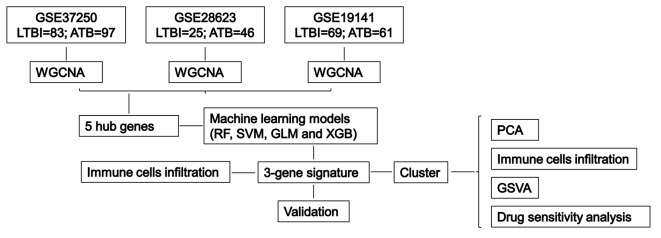
Thirteen datasets were downloaded from the gene expression omnibus (GEO) database. Three datasets were selected as discovery datasets, and the hub genes were discovered through WGCNA. In the training cohort, we use machine learning to establish the signature, verify the authentication ability of the signature in the remaining datasets, and compare it with other signatures. Cluster analysis was carried out on ATB cases, immune cell infiltration analysis, GSVA analysis, and drug sensitivity analysis were carried out on different clusters.
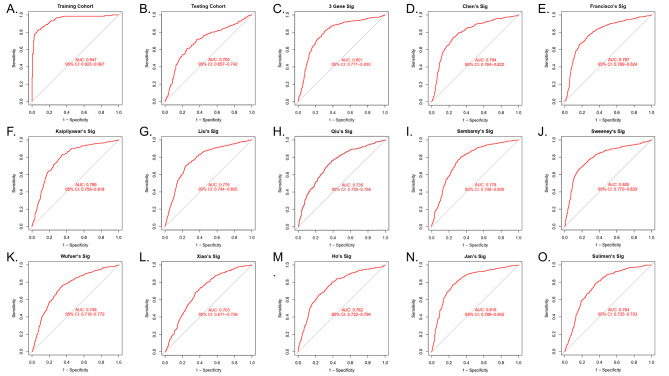
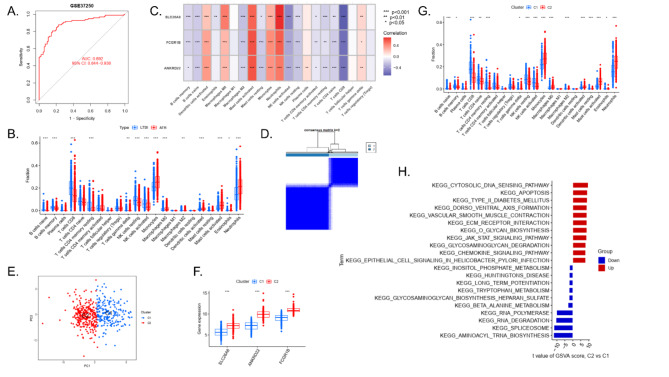
In the discovery datasets, we discovered five hub genes. A signature (SLC26A8, ANKRD22, and FCGR1B) is obtained in the training cohort. In the total cohort, the three-gene signature can separate LTBI from ATB (the total area under ROC curve (AUC) is 0.801, 95% CI 0.771-0.830). Compared with other author's signatures, our signature shows good identification ability. Immunological analysis showed that SLC26A8, ANKRD22, and FCGR1B were closely related to the infiltration of immune cells. According to the expression of the three genes, ATB can be divided into two clusters, which are different in immune cell infiltration analysis, gene set variation, and drug sensitivity.
Our study produced an immune-related three-gene signature to distinguish LTBI from ATB, which may help us to manage and treat tuberculosis patients.
区分潜伏性结核感染(LTBI)和活动性结核(ATB)非常重要。本研究旨在通过分析多个队列的病例,获得能够区分 LTBI 和 ATB 的特征。
从基因表达综合数据库(GEO)中下载了 13 个数据集。选择了 3 个数据集作为发现数据集,通过 WGCNA 发现了枢纽基因。在训练队列中,我们使用机器学习建立特征,验证特征在其余数据集中的验证能力,并与其他特征进行比较。对 ATB 病例进行聚类分析,对不同聚类进行免疫细胞浸润分析、GSVA 分析和药物敏感性分析。
在发现数据集中,我们发现了 5 个枢纽基因。在训练队列中获得了一个特征(SLC26A8、ANKRD22 和 FCGR1B)。在总队列中,三基因特征可将 LTBI 与 ATB 区分开来(总受试者工作特征曲线(ROC)下面积(AUC)为 0.801,95%CI 为 0.771-0.830)。与其他作者的特征相比,我们的特征显示出良好的识别能力。免疫分析表明,SLC26A8、ANKRD22 和 FCGR1B 与免疫细胞浸润密切相关。根据这三个基因的表达,ATB 可分为两个簇,在免疫细胞浸润分析、基因集变异和药物敏感性方面存在差异。
我们的研究产生了一个与免疫相关的三基因特征,可用于区分 LTBI 和 ATB,这可能有助于我们管理和治疗结核患者。