Department of Laboratory Medicine, Tongji Hospital, Tongji Medical College, Huazhong University of Science and Technology, Wuhan, China.
Department of Immunology, School of Basic Medicine, Tongji Medical College, Huazhong University of Science and Technology, Wuhan, China.
Front Immunol. 2021 Aug 26;12:721013. doi: 10.3389/fimmu.2021.721013. eCollection 2021.
Rapid and effective discrimination between active tuberculosis (ATB) and latent tuberculosis infection (LTBI) remains a challenge. There is an urgent need for developing practical and affordable approaches targeting this issue.
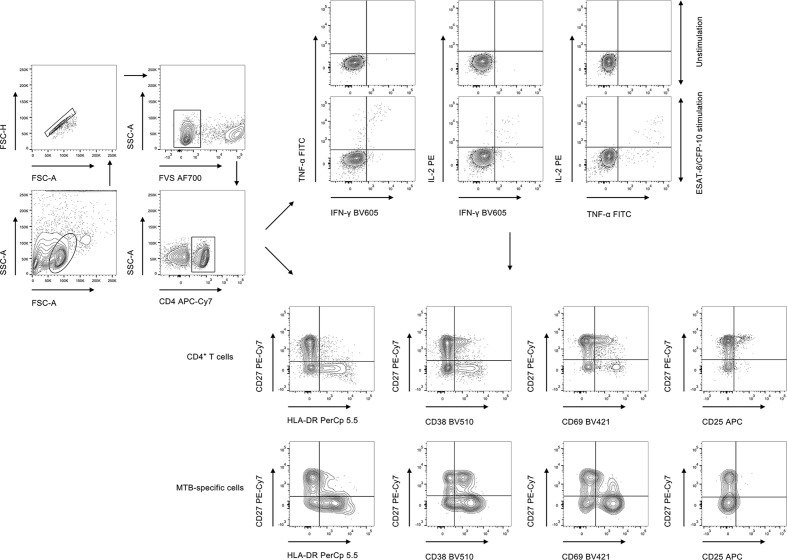
Participants with ATB and LTBI were recruited at Tongji Hospital (Qiaokou cohort) and Sino-French New City Hospital (Caidian cohort) based on positive T-SPOT results from June 2020 to January 2021. The expression of activation markers including HLA-DR, CD38, CD69, and CD25 was examined on (MTB)-specific CD4 T cells defined by IFN-γ, TNF-α, and IL-2 expression upon MTB antigen stimulation.
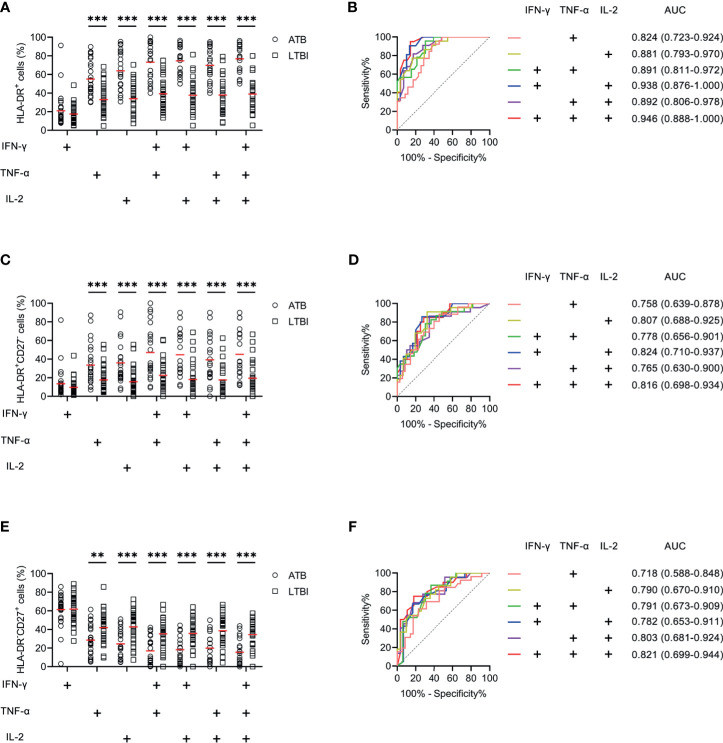
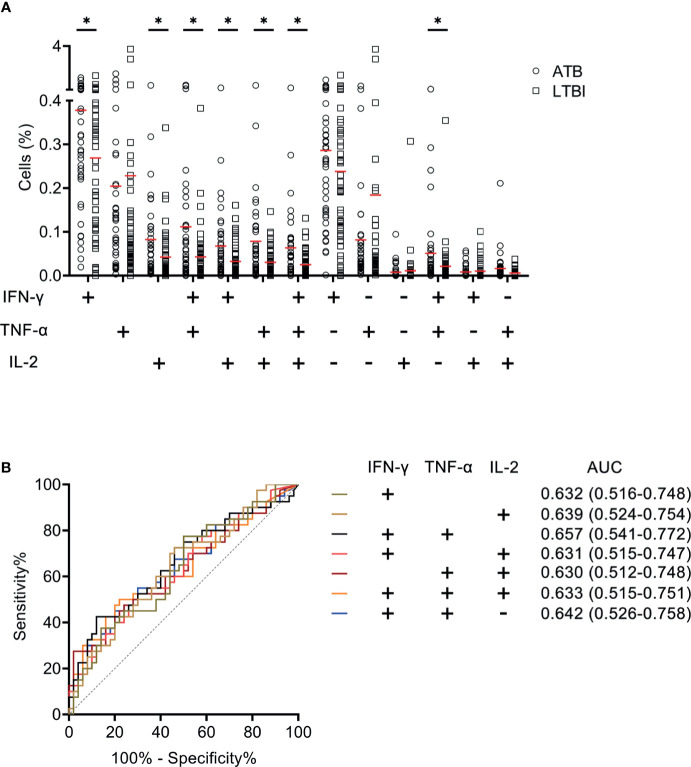
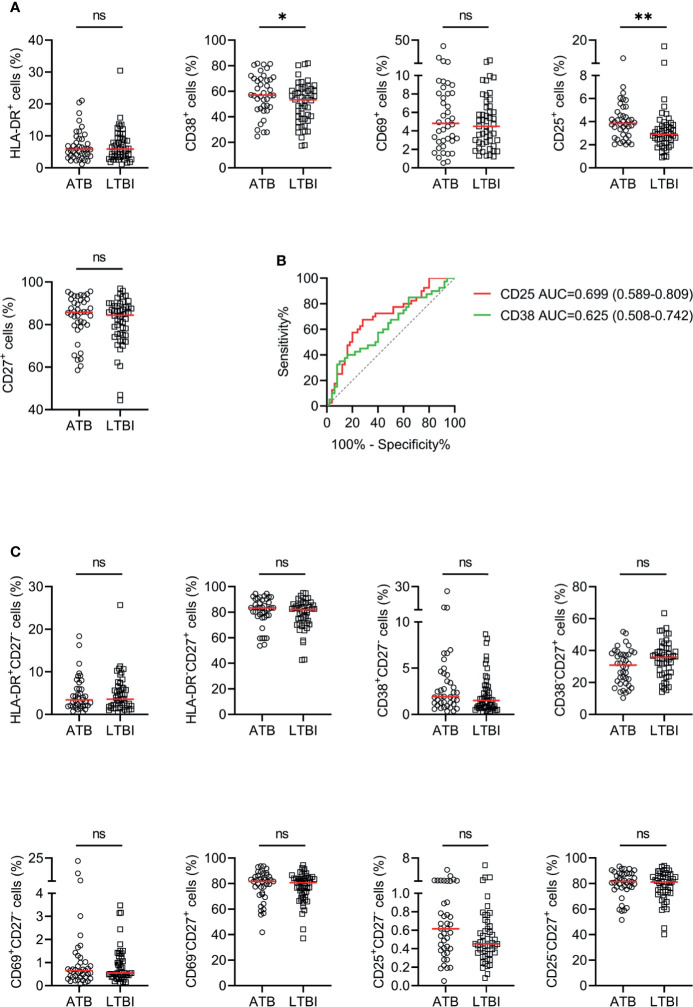
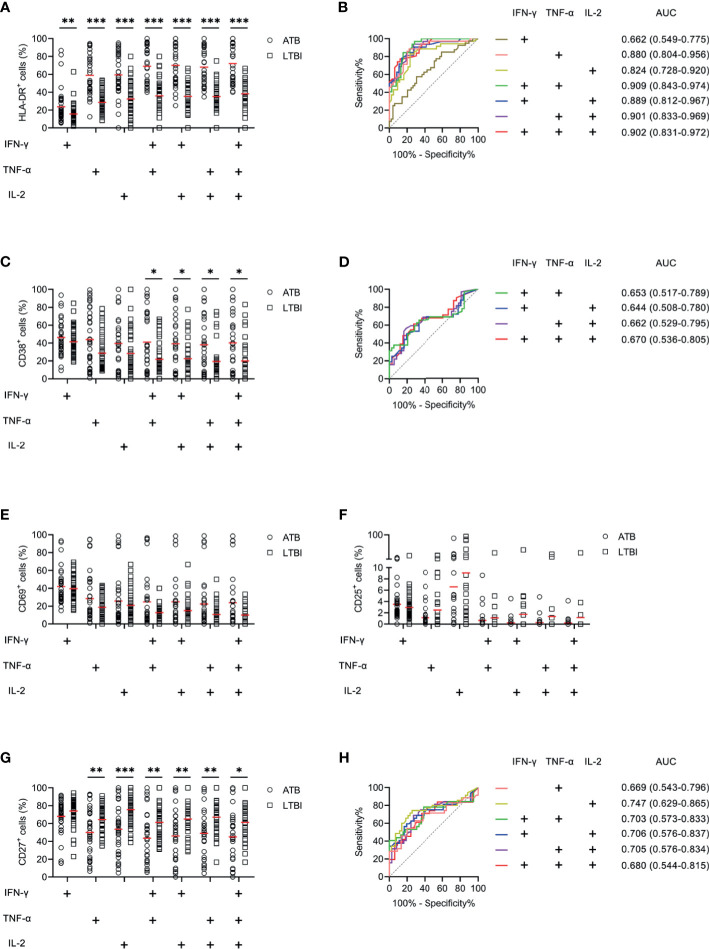
A total of 90 (40 ATB and 50 LTBI) and another 64 (29 ATB and 35 LTBI) subjects were recruited from the Qiaokou cohort and Caidian cohort, respectively. The expression patterns of Th1 cytokines including IFN-γ, TNF-α, and IL-2 upon MTB antigen stimulation could not differentiate ATB patients from LTBI individuals well. However, both HLA-DR and CD38 on MTB-specific cells showed discriminatory value in distinguishing between ATB patients and LTBI individuals. As for developing a single candidate biomarker, HLA-DR had the advantage over CD38. Moreover, HLA-DR on TNF-α or IL-2 cells had superiority over that on IFN-γ cells in differentiating ATB patients from LTBI individuals. Besides, HLA-DR on MTB-specific cells defined by multiple cytokine co-expression had a higher ability to discriminate patients with ATB from LTBI individuals than that of MTB-specific cells defined by one kind of cytokine expression. Specially, HLA-DR on TNF-αIL-2 cells produced an AUC of 0.901 (95% CI, 0.833-0.969), with a sensitivity of 93.75% (95% CI, 79.85-98.27%) and specificity of 72.97% (95% CI, 57.02-84.60%) as a threshold of 44% was used. Furthermore, the performance of HLA-DR on TNF-αIL-2 cells for differential diagnosis was obtained with validation cohort data: 90.91% (95% CI, 72.19-97.47%) sensitivity and 68.97% (95% CI, 50.77-82.73%) specificity.
We demonstrated that HLA-DR on MTB-specific cells was a potentially useful biomarker for accurate discrimination between ATB and LTBI.
快速有效地鉴别活动性结核病(ATB)和潜伏性结核感染(LTBI)仍然是一个挑战。迫切需要开发针对这一问题的实用且负担得起的方法。
根据 2020 年 6 月至 2021 年 1 月期间 T-SPOT 阳性结果,在同济医院(硚口队列)和中法新城医院(蔡甸队列)招募 ATB 和 LTBI 患者。通过 IFN-γ、TNF-α和 IL-2 的表达,检测 MTB 抗原刺激后 MTB 特异性 CD4 T 细胞(定义为 TNF-α、IFN-γ和 IL-2 的表达)上的激活标志物 HLA-DR、CD38、CD69 和 CD25 的表达。
分别从硚口队列和蔡甸队列招募了总共 90 名(40 名 ATB 和 50 名 LTBI)和 64 名(29 名 ATB 和 35 名 LTBI)参与者。MTB 抗原刺激后 Th1 细胞因子(IFN-γ、TNF-α和 IL-2)的表达模式不能很好地区分 ATB 患者和 LTBI 个体。然而,MTB 特异性细胞上的 HLA-DR 和 CD38 均具有区分 ATB 患者和 LTBI 个体的价值。对于开发单个候选生物标志物,HLA-DR 优于 CD38。此外,在区分 ATB 患者和 LTBI 个体时,TNF-α或 IL-2 细胞上的 HLA-DR 优于 IFN-γ细胞上的 HLA-DR。此外,由多种细胞因子共表达定义的 MTB 特异性细胞上的 HLA-DR 比由一种细胞因子表达定义的 MTB 特异性细胞具有更高的区分 ATB 患者和 LTBI 个体的能力。特别是,TNF-αIL-2 细胞上的 HLA-DR 产生的 AUC 为 0.901(95%CI,0.833-0.969),以 44%作为阈值,灵敏度为 93.75%(95%CI,79.85%-98.27%),特异性为 72.97%(95%CI,57.02%-84.60%)。此外,使用验证队列数据获得了 TNF-αIL-2 细胞上 HLA-DR 用于鉴别诊断的性能:90.91%(95%CI,72.19%-97.47%)的灵敏度和 68.97%(95%CI,50.77%-82.73%)的特异性。
我们证明了 MTB 特异性细胞上的 HLA-DR 是区分 ATB 和 LTBI 的一种潜在有用的生物标志物。