Hartman Hayden, Fehr Shannon, Gianakos Arianna L
DeBusk College of Osteopathic Medicine, Lincoln Memorial University, Knoxville, TN, USA.
Liberty University College of Osteopathic Medicine, Lynchburg, VA, USA.
Foot Ankle Orthop. 2024 Nov 27;9(4):24730114241300140. doi: 10.1177/24730114241300140. eCollection 2024 Oct.
With higher incidences of ankle sprains and chronic ankle instability in women, it has been postulated that hormonal modulation and ligamentous laxity influences injury propensity. The purpose of this study is to investigate the impact of hormonal fluctuation on ankle stability and ligamentous laxity and their potential contribution to injury propensity in the female athlete.
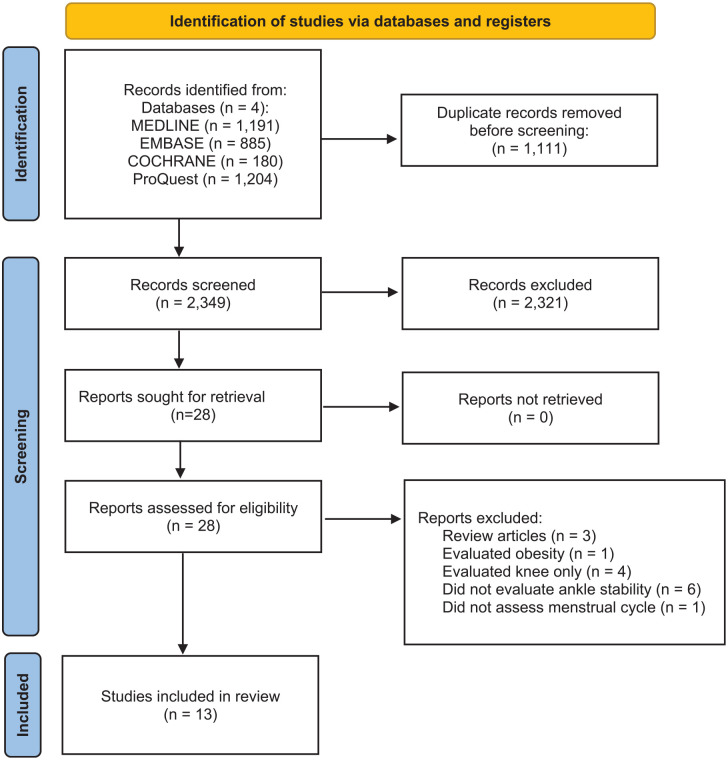
In November 2023, a systematic review of the MEDLINE, Embase, and Cochrane Library databases was performed following PRISMA guidelines. Articles were included if they were published after the year 2000, evaluated outcomes related to the impact of hormones on ankle stability in healthy patients, and included menstrual tracking. The following search terms were used: "(sex or gender) AND (ankle stability)" and "(hormone) AND (ankle)."
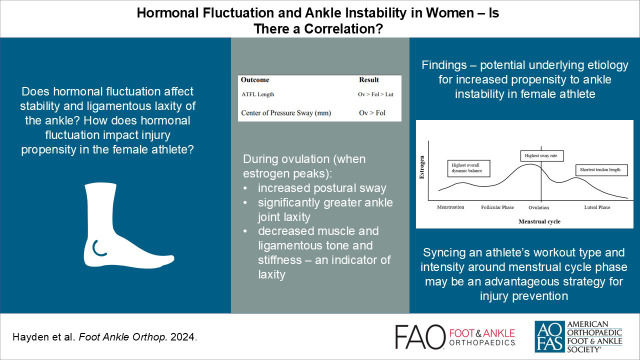
Thirteen articles were included, with 253 (76.4%) women at a weighted mean age of 21.9 ± 2.0 years (range, 20.0-25.9). Five studies evaluated postural sway and balance noting greater sway rates during ovulation compared with the follicular phase. Greater muscle tone ( < .001) was observed in the follicular phase than ovulation for the tibialis anterior, peroneus longus, and lateral gastrocnemius. Significantly higher ankle joint laxity was observed in ovulation ( = .016).
This review found that during ovulation, when estrogen peaks, subjects showed impaired balance with higher postural sway rates, greater ankle joint laxity, and decreased muscle and ligamentous tone and stiffness-an indicator of laxity. An underlying hormonally mediated etiology for the increased propensity to ankle instability in the female athlete is suggested. Syncing an athlete's workout type and intensity around menstrual cycle phase may be an advantageous strategy for injury prevention.
女性踝关节扭伤和慢性踝关节不稳定的发生率较高,据推测,激素调节和韧带松弛会影响受伤倾向。本研究的目的是调查激素波动对踝关节稳定性和韧带松弛的影响,以及它们对女运动员受伤倾向的潜在影响。
2023年11月,按照PRISMA指南对MEDLINE、Embase和Cochrane图书馆数据库进行了系统综述。纳入2000年后发表的、评估激素对健康患者踝关节稳定性影响的相关结果且包含月经追踪的文章。使用了以下检索词:“(性别)与(踝关节稳定性)”以及“(激素)与(踝关节)”。
纳入13篇文章,其中253名(76.4%)女性,加权平均年龄为21.9±2.0岁(范围20.0 - 25.9岁)。五项研究评估了姿势摆动和平衡,发现与卵泡期相比,排卵期的摆动率更高。在卵泡期观察到胫骨前肌、腓骨长肌和外侧腓肠肌的肌张力(<0.001)高于排卵期。排卵期踝关节松弛度显著更高(=0.016)。
本综述发现,在雌激素达到峰值的排卵期,受试者表现出平衡受损,姿势摆动率更高,踝关节松弛度更大,肌肉和韧带张力及刚度降低——这是松弛的一个指标。提示女运动员踝关节不稳定倾向增加存在潜在的激素介导病因。根据月经周期阶段调整运动员的训练类型和强度可能是一种有益的预防受伤策略。