Zhejiang Cancer Hospital, Hangzhou Institute of Medicine, Chinese Academy of Sciences, Hangzhou 310022, Zhejiang Province, China.
School of Medicine, Zhejiang University, Hangzhou 310058, Zhejiang Province, China.
World J Gastroenterol. 2024 Nov 28;30(44):4709-4724. doi: 10.3748/wjg.v30.i44.4709.
Gastric cancer (GC) is a highly prevalent gastrointestinal tract tumor. Several trials have demonstrated that the location of GC can affect patient prognosis. However, the factors determining tumor location remain unclear.
To investigate the tumor location of patients, we went on to study the influencing factors that lead to changes in the location of GC.
A retrospective evaluation was carried out on 3287 patients who underwent gastrectomy for GC in Zhejiang Cancer Hospital. The patients were followed up post-diagnosis and post-gastrectomy. The clinicopathological variables and overall survival of the patients were recorded. By analyzing the location of GC, the tumor location was divided into four categories: "Upper", "middle", "lower", and "total". Statistical software was utilized to analyze the relationship of each variable with the location of GC.
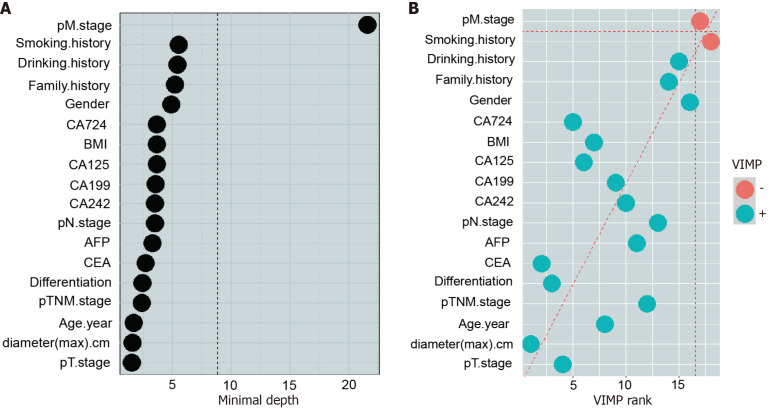
A total of 3287 patients were included in this study. The clinicopathological indices of gender, age, serum levels of carcinoembryonic antigen (CEA), carbohydrate antigen (CA19-9) and CA72-4 levels, were significantly associated with tumor location in patients with GC. In addition, there was a strong correlation between GC location and the prognosis of postoperative patients. Specifically, patients with "lower" and "middle" GC demonstrated a better prognosis than those with tumors in other categories.
The five clinicopathological indices of gender, age, CEA, CA19-9 and CA72-4 levels exhibit varying degrees of influence on the tumor location. The tumor location correlates with patient prognosis following surgery.
胃癌(GC)是一种高发的胃肠道肿瘤。多项试验表明,GC 的位置会影响患者的预后。然而,决定肿瘤位置的因素仍不清楚。
为了研究患者的肿瘤位置,我们进一步研究了导致 GC 位置变化的影响因素。
对在浙江省肿瘤医院接受胃癌胃切除术的 3287 例患者进行回顾性评估。对患者进行诊断后和胃切除术后随访。记录患者的临床病理变量和总生存期。通过分析 GC 的位置,将肿瘤位置分为四个类别:“上部”、“中部”、“下部”和“全部”。使用统计软件分析每个变量与 GC 位置的关系。
本研究共纳入 3287 例患者。GC 患者的性别、年龄、血清癌胚抗原(CEA)、糖类抗原(CA19-9)和 CA72-4 水平等临床病理指标与肿瘤位置显著相关。此外,GC 位置与术后患者的预后有很强的相关性。具体来说,“下部”和“中部”GC 的患者预后比其他部位肿瘤的患者要好。
性别、年龄、CEA、CA19-9 和 CA72-4 水平这五个临床病理指标对肿瘤位置有不同程度的影响。肿瘤位置与术后患者的预后相关。